
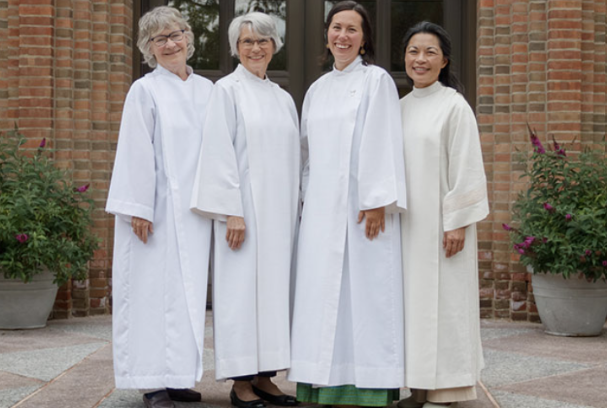
Twenty-seven women from 18 dioceses in the United States and Canada gathered at Saint Mary’s College this summer for the inaugural in‑person residency of PROCLAIM, a new lay‑preaching formation program operated by Discerning Deacons and funded through a 1.25 million dollar Lilly Endowment grant. The weeklong residency marked a milestone for the 22‑month program, which began last fall with online coursework.
The residency unfolds as Catholics continue to debate the question of women in the diaconate. PROCLAIM’s parent organization, Discerning Deacons, accompanies Catholics in “prayer, study, and conversation” about women “ministers of the Word.” Both Saint Mary’s and Discerning Deacons emphasize that PROCLAIM operates “fully within canon law,” forming women only for preaching in settings the Church permits. The Church currently excludes women from the diaconate.
The program began in September 2025 with online courses, formation companions—including Holy Cross Sisters—and regular Zoom circles where participants practiced preaching reflections. The Saint Mary’s residency added workshops on the history of women’s preaching, canon‑law norms, and pastoral practice. Participants also took part in a “Preaching Slam” at the Church of Our Lady of Loretto, where three women “stood before the large congregation [and] offered liturgical, traditional, and creative reflections” and concluded the week with a “liturgy in which the women blessed one another … and were sent home to preach in their own ministry contexts.”
Daily Mass was celebrated throughout the residency, and the priest chaplain preached at each liturgy. Women preached only at non‑Eucharistic services, consistent with canon law. “Catholic Canon Law 767 reserves the homily at Mass to priests and deacons,” said Ellie Hidalgo, co‑director of Discerning Deacons, to the Rover. “Canon 766 allows lay people to preach in other settings according to norms set by bishops’ conferences. PROCLAIM abides by and follows this teaching.”
Those settings include retreats, days of reflection, OCIA, Bible studies, the Liturgy of the Hours, children’s liturgies, and prayer services in hospitals, prisons, schools, and nursing homes. Hidalgo said many women already serve in these ministries but lack access to formal preaching formation. “Women are underutilized,” she said. “PROCLAIM forms women to inhabit those places faithfully, authentically, and more fully.”
Some participants said that the residency offered a rare opportunity for spiritual formation rooted in obedience to the Church. Lillie Rodgers, a graduate of Notre Dame’s M.Div. program who serves at the Catholic Newman Center in Laramie, Wyoming, described the week as “a boon for the soul.” After months of online formation, meeting her cohort in person “was deeply transformational,” she told the Rover. “PROCLAIM has given me the confidence to allow the Holy Spirit to use me in ways I couldn’t have imagined previously.”
Rodgers emphasized that her attraction to PROCLAIM was not driven by activism but by a desire for deeper spiritual grounding. “I have yearned for not just professional development, but spiritual development alongside other passionate Catholic women and leaders in the Church,” she said. She hopes to carry forward a renewed sense of baptismal identity: “PROCLAIM is equipping me to grasp my identity as a conduit of God’s Word. All of the baptized have this essential role.”
Saint Mary’s became a core partner with PROCLAIM in 2024, citing the legacy of Sister Madeleva Wolff, C.S.C., who expanded graduate theological education for women.
The college stated that Bishop Kevin Rhoades of Fort Wayne-South Bend supported the partnership, though he declined to comment to the Rover.
While Molly Gower, Vice President for Mission at Saint Mary’s, also declined speaking to the Rover, students on both Saint Mary’s and Notre Dame’s campuses expressed concerns about Saint Mary’s partnership with PROCLAIM. Notre Dame senior Kaliana Stalboerger agreed that “it is important to ensure that women have opportunities for leadership roles within the Church,” but she also raised some concerns about the program. She told the Rover, “This program does raise some ambiguities on what exactly [women’s] roles might be.”
“As Catholics,” she adds, “We should look to the female saints as models for how to lead … so that we can follow their footsteps rather than simply try to give women specific titles and positions.”
Saint Mary’s senior Salma Gamsho similarly expressed her concerns to the Rover and commented, “Women’s dignity and vocation do not require the Church to change her teachings, and Saint Mary’s should empower women to serve faithfully within them.”
The Church has definitively ruled out priestly ordination for women but has not issued a definitive judgment on the female diaconate. A Vatican commission released a report in December 2025 concluding, by a seven to one vote, that the Church “cannot currently move toward admitting women … to the diaconate,” while calling the question open to further study and encouraging broader access to existing ministries for women. Pope Francis stated an emphatic “no” to ordained female deacons in a 2024 CBS interview. As a cardinal, the future Pope Leo XIV affirmed the exclusion of women from priestly ordination but noted that multiple Vatican commissions had studied the diaconate question.
Conservative Catholic analysis remains divided. Some theologians argue the question is closed due to the unity of Holy Orders; others say the matter is unsettled but unlikely to change. Background perspectives can be found in First Things, Catholic World Report, and the Rover’s earlier coverage.
Supporters say that PROCLAIM simply implements existing norms. Hidalgo told the Rover that the organization welcomed the Vatican commission’s report and remains committed to “discernment in communion with the Church.” She added that PROCLAIM is one concrete example of the commission’s encouragement to expand ministries for women.
Rodgers, who has two young daughters, hopes the Church continues to strengthen women’s roles without compromising doctrine. “I feel called to do my small part to help the Church increasingly reflect God’s Kingdom,” she said. “I believe the Catholic Church needs women’s voices in preaching to align with the roles women already occupy in teaching, ministering, and serving within the Church.”
On the other hand, some Notre Dame students said the rollout of PROCLAIM has already collided with existing tensions on Campus. Notre Dame sophomore Isabelle Glunz and her friends noticed a flyer from Discerning Deacons posted in Flaherty Hall’s chapel. They were alarmed by the flyer’s framing, which they felt blurred the Church’s teaching on women and the diaconate.
The flyer read, in part, “Since 2021, our mission has been to engage Catholics in the active discernment of our Church about women and the diaconate and contribute to the renewal of this ministry for our times.” Glunz said the language raised questions about what kind of advocacy was being promoted in residence halls and how it aligned with official Church teaching.
PROCLAIM is funded entirely through the Lilly Endowment’s Compelling Preaching Initiative, which supports 142 preaching‑formation programs across Christian traditions. Twenty two of those programs are Catholic. All Lilly funds are restricted to PROCLAIM and primarily cover participant tuition. Discerning Deacons raises separate funds for its synodal work and educational forums.
A second residency and a new cohort are planned for summer 2027. Participants will continue coursework this fall as the Church’s global conversation on women’s ministry and the diaconate continue to unfold.
Abigail Smith is a Senior from Nashville, Tennessee. She can be reached at asmith78@nd.edu.