
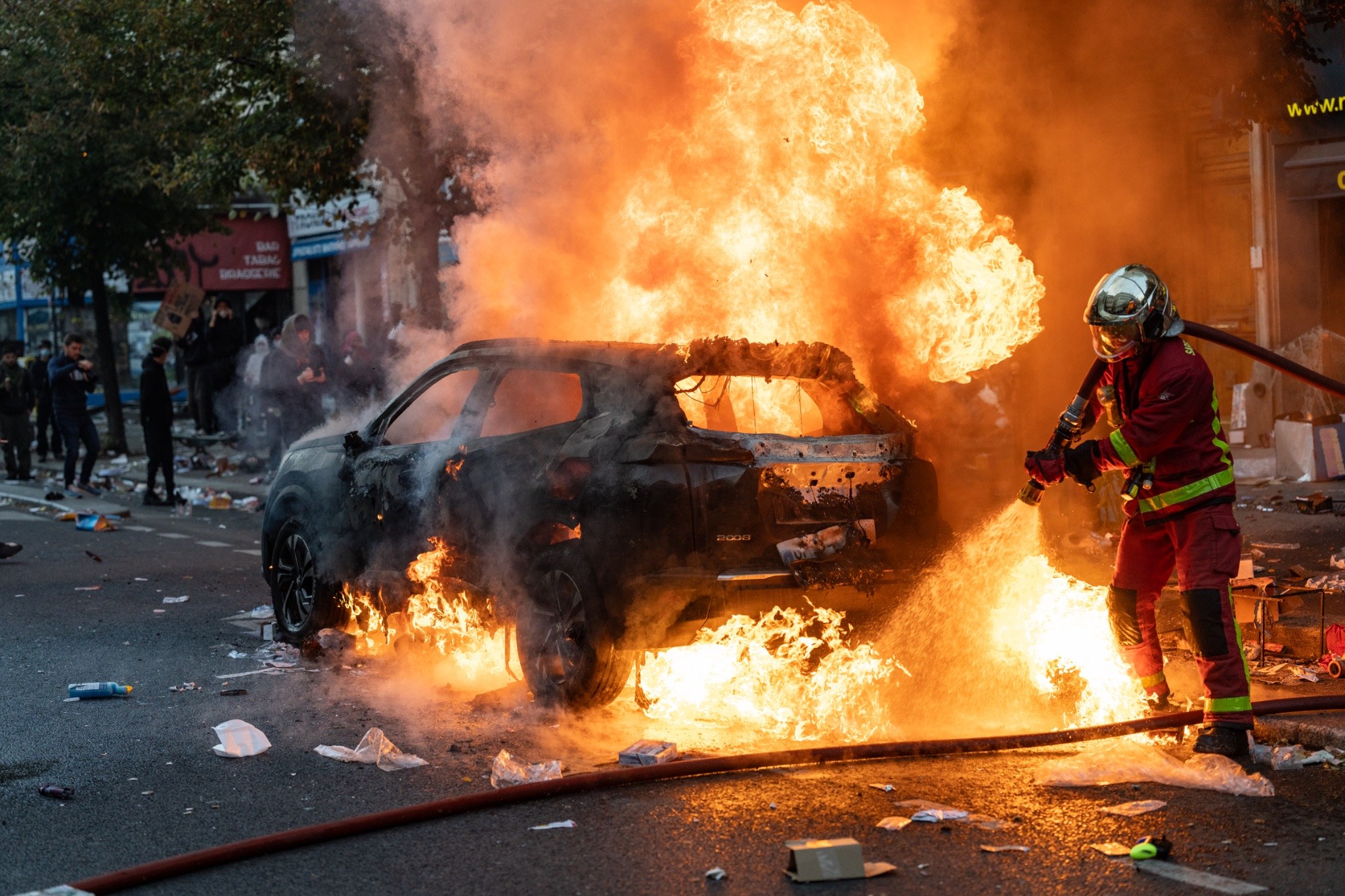
France’s student-led protests began in mid-September as a teachers’ strike over staffing. They have since grown into the country’s greatest unrest in years, with violent riots causing major destruction to French infrastructure.
This Halloween weekend marked the third week of rioting, and according to the Interior Ministry, the demonstrations proceeded peacefully with 320,000 participants. Fearing a possible Halloween pretext, the French government prepared to limit the damages, instructing the marchers to stay out of the city centers and placing a curfew on minors.
The most violent night of the French riots thus far occurred on October 17. Roughly 550,000 people marched into Paris, Lyon, and Marseille while masked groups hijacked the marches by looting shops and torching vehicles.
Nearly 1,000 officers and gendarmes were reportedly injured, and in Limoges, rioters set fire to the city’s 143-year-old town hall. Another mobilization of over 400,000 marchers occurred on October 24, as authorities deployed over 70,000 officers and enacted several curfews across the country.
However, the amount of resources being dedicated each week to defending French cities is a major financial constraint, with national debt nearing 120 percent of GDP. The unrest is also reshaping the 2027 election.
Protests inspired by the French student movements have spread across Europe, but catalysts differ by country.
In Spain, housing protests swelled after the televised eviction of an 87-year-old woman and concerns over the legitimacy of Prime Minister Pedro Sánchez’s election rose. Similarly, German students met at Berlin’s Brandenburg Gate to protest education and housing on October 31, while Belgian students have protested education costs since October 1.
In Italy, students, truckers, and farmers have violently protested living costs and fuel prices, which resulted in nine arrests and 371 temporary detentions across eight cities after rioters looted stores in Milan, Turin, and Bologna and stormed the Colosseum in Rome last weekend.
While mainstream coverage stresses cost of living, housing, school conditions, and bleak job prospects, conservative commentators in Europe point to far-left organizations and Islamic pro-Palestinian participation. French intelligence reportedly told ministers on October 1 that the protests were heavily linked to far-left politicians in the La France Insoumise (LFI) party along with allied left-wing anarchist groups. Experts interviewed by the Rover say these explanations are not mutually exclusive.
Father Bill Miscamble, C.S.C., a historian of how crises reshape nations, told the Rover that the French riots are “not a revolution.” He claimed, however, “It is setting things up so that the choices for the French election next year will be two extremists, and that will be a very challenging circumstance for the French.” Nevertheless, he believes Europeans will endure the violence, saying, “Europe has been through crises before, and significant leaders have emerged before who preserve order and maintain strength.”
However, he acknowledged that the riots will have major implications for future European politics, arguing, “The unrest is revealing the inability of the French elite (Macron and his ministers) to address the problems in France.”
Fr. Miscamble also pointed to weak leadership. “The leadership of Europe, especially of France, Germany, Italy, and Britain has been mediocre for the last quarter century,” he claimed. With respect to the protestors, he believes that “high schoolers, the organized left, working-class people, and urban criminals,” are stealing from high-class shops to “exploit the protest for their benefit.”
Theology professor Gabriel Reynolds, who lived in France from 2016 to 2017, told the Rover that the conflicts in Europe are not merely a result of Muslim influence. “There is a significant Muslim population in the U.S. (8-10 million), and there has been practically no violence in the U.S. compared to France, Belgium, Holland, and Sweden.”
Reynolds continued, “It doesn’t have to be that way. There is something distinctive in Europe, but especially France. Because in France, you have this vibrant dynamic of public demonstrations, connected to the French Revolution, the 1848 Revolution, the 1968 student protests, alongside a rigid secularism and Muslim communities concentrated in the housing-project suburbs (les banlieues).”
He described the modern revolutionary sentiment in France as associated with “the anti-colonial struggle that has now migrated to France itself.” He added, “The far left’s revolutionary, anti-colonial rhetoric, from LFI especially, acts as an activator, an instigating effect in some of the culture of the Muslim population in France.” He continued, “The culture of pride in French intellectual sophistication can add friction between French whites and Muslim immigrants.”
Dr. Luke Foster, now a graduate professor at Hillsdale College who teaches at the annual Academia Tocqueville Summer Seminar in France after completing his postgraduate studies at Notre Dame, told the Rover that the date of the worst violence in France is itself a clue for who should be held responsible for the violence.
“Choosing the date of October 17 showed that these riots are a chance to repudiate the entire country and destroy what makes France,” he said, alluding to October 17, 1961, when police broke up a march of Algerians in Paris during the final months of the Algerian War. It is now remembered as the Paris massacre of 1961.
Foster rejected the comparison to ordinary French unrest, stating, “For most of the last 60 years, the unions have had a very official legal status in France, and they typically coordinate demonstrations with the police in advance. There is a legitimacy to it.”
Conversely, what happened on October 17, Foster said, uniquely made the day about Islamic resentment of the French. He called the extensive looting, the burning of the town hall, and even attacks on private homes different in kind: “That is new.”
Foster described a secular left that has replaced the working-class concerns of the old left with newer, more mobilizable causes, and he says its alliance with Muslim activists is fragile. “The two factions don’t actually agree and are using each other.”
Nevertheless, he conceded that the protests have a certain legitimacy, saying, “The student grievances are not without basis, but the underlying problem is a state that is at once too intrusive and too powerless … Education and policing are both national, cabinet-level decisions, so an attack on the school is an attack on the state.”
Fr. Miscamble points to France’s 2027 presidential election as the signal for what Europe’s future will look like. He expects the two leading contenders to be Marine Le Pen and Jean-Luc Mélenchon, which would leave the centrists nervous and voters facing two hard choices; furthermore, he expects greater upheaval if Le Pen wins.
Foster, by contrast, says he is hopeful. “I think this is more so a symptom than cause of collapse.” He also points to a French intellectual elite that is self-confident and rooted in its own tradition, referencing a legacy of Charles de Gaulle and the Bourbons. “France has been through worse,” he said, citing the Paris Commune of 1871, the French Revolution, and the defeat of 1940, “and has been reborn.”
The capacity for humility, he said, aids renewal, and a short-term crisis that reveals France’s problems “could actually help.”
Abigail Smith writes for the Rover in hopes of saving the West one article at a time. When Abby is not defending Western civilization, she’s probably defending the Oxford comma. Contact her at asmith78@nd.edu.