
Rover masthead shares favorites from Summer break
Lucy Spence, Editor-in-Chief: Death Comes for the Archbishop (Willa Cather)
I was not expecting the rich spiritual insights that I found in this novel by Willa Cather. Not a Catholic herself, Cather nevertheless crafts a moving story of vocation, love, and spiritual brotherhood in this simple tale of the mid-1800s missionary Church in New Mexico. Centered on the life of Archbishop Vaillant, the reader follows this quiet but deeply faithful priest through his decades spent tending to the souls around him. A testament to the author’s perceptive prose, the book teaches much about the value of friendship, the brokenness of human nature, and the beauty of the quiet and sacrificial love that is the Church.
Michael Canady, Editor-in-Chief Emeritus; Opinion Editor: The Scarlet and the Black (Jerry London)
If you’re looking for an inspirational vibe for your next movie night, this is your pick. Starring Gregory Peck as Monsignor Hugh O’Flaherty, The Scarlet and the Black tells the true story of an Irish Catholic priest who organized a complex rescue operation of over 6,500 Jews and Allied POWs during the Nazis’ occupation of Rome. The film provides what today’s Hollywood lacks: a strong, prayerful, and courageous example of Catholicism and the priesthood. Perhaps just as important, it also properly portrays evil as an attack against God and the Church. If we need more vocations to the priesthood, The Scarlet and the Black would be a good place to start. And if you need one more reason to watch it, I’ll add that it’s one of Frater Cosmas (formerly W. Joseph) DeReuil’s favorites.
Kephas Olsson, Executive Editor: Hydriotaphia, or Urn Burial (Sir Thomas Browne)
“Few people love the writings of Sir Thomas Browne, but those who do are the salt of the earth.” While Virginia Woolf’s comment on Browne’s readership remains elusive, one thing at least is certain: Browne is likely your favorite prose stylist’s favorite prose stylist. Browne, a seventeenth-century English polymath, neologist (he is cited 775 times by the OED with the first usage of a word, including ‘analogous’, ‘approximate’, and ‘ascetic’ in the ‘a’s’ alone), and author wrote on a dazzling array of subjects, and the short Hydriotaphia is a similarly heterogeneous treatise. Browne first sets out to talk about recently discovered sepulchral urns, but the work quickly morphs into a meditation on death, oblivion, and history, all the while in Browne’s extraordinarily striking language: “But the iniquity of oblivion blindly scattereth her poppy, and deals with the memory of men without distinction to merit of perpetuity.” Give Hydriotaphia a read, and come closer to your favorite author, who—through merit or not—has come into a perpetuity due Sir Thomas Browne.
Haley Garecht, Managing Editor: The Space Trilogy (C.S. Lewis)
As a longtime fan of the science fiction genre, I found C.S. Lewis’ trilogy to be a wonderful meeting between engaging storytelling and Christian symbolism. In the first installment, Out of the Silent Planet, Lewis captivates readers with the kidnapping of Elwin Ransom, who is sent in a spaceship to the planet Malacandra. When Elwin escapes his captors, he meets the planet’s population and learns of the existence of Oyarsa, a celestial being who governs Malacandra. In his conversations with Oyarsa, Elwin learns that Earth is referred to throughout the cosmos as “The Silent Planet” because of a great spiritual conflict many years ago. In the following two books, Lewis explores spiritual warfare, secular materialism, and the impact of death on the human person, all through the lens of space exploration and interplanetary communication. If Interstellar were written by a close friend of St. Augustine, it would look something like Lewis’ trilogy.
Clare DiFranco, Campus Editor: The Count of Monte Cristo (Alexandre Dumas)
After a semester filled with finance and business readings, I took this summer to dive into The Count of Monte Cristo, an exciting novel that highlights how one’s finances can be used to impart revenge on one’s sworn enemies. The tale begins with an introduction to Edmond Dantes, a young, successful, soon-to-be married sailor from Marseilles. Spurred by jealousy of his recent good fortunes, Dantes’ friends falsely accused him of conspiracy, resulting in his wrongful imprisonment. In a simple twist of fate, Dantes escapes the dungeon after 14 years and lands on the island of Monte Cristo, where he finds a buried fortune, establishes a home, and names himself a count. Monte Cristo joins Parisian society to gain proximity to his betrayers and, under his new identity, wields his wealth and power to reward friends from his prior life and to seek revenge on his enemies. While this novel is a lengthy 1,300-page read, it is an easy and enjoyable one that is hard to put down. As the book follows each step of the count’s plot, the reader is faced with questions about providence, justice, mercy, and the proper means of these virtues.
Caleb Vaughan, Campus Editor: Mater Purissima (Frederick Goodall)
This 1868 portrait of the Blessed Virgin Mary is displayed in Notre Dame’s Raclin Murphy Museum of Art. A gentle reminder of Our Lady’s purity, poverty, and obedience. She is depicted holding two turtledoves close to her breast with subtle rays of light peaking in behind. These rays induce a light glow on both her face and white veil. Obeying Jewish custom despite her virgin purity, Mary offered the ritual sacrifice after childbirth. The two doves are a sign of her poverty, being unable to afford a young lamb for the purifying offering.
Shri Thakur, Politics Editor: La Piscine (Jacques Deray)
This 1969 French language film starring Alain Delon and Romy Schneider is as profound as it is stylish. Set in the French Riviera during the Trente Glorieuses, the film is centered around the web of jealousy and possessiveness that pervade the holiday of four people who stay in a villa together, culminating in one’s brutal murder. Delon’s acting is compelling and psychological, and his raw emotion seeps into every scene in which one finds him. The cinematography is similarly beautiful and embodies some of the finest technique in French cinema. The ending of the story forces viewers to grapple with questions of loyalty and justice, and leaves them with a renewed insight into the human condition.
Darius Colangelo, Culture Editor: Beauty in the Light of the Redemption (Dietrich von Hildebrand)
In this essay, Hildebrand defends the role of artistic beauty in the Christian life. Rather than laying out a straightforward positive case, Hildebrand begins each section by taking up the voice of the critic. To the critic, art is distracting, worldly, and indulgent. These criticisms can be seen today in the question, “Why doesn’t the Church sell everything and give to the poor?” In response, Hildebrand articulates a vision for art that rejects these utilitarian perspectives that would sacrifice art in a cold material or spiritual calculation. Sitting at around 40 pages, it is concise, relevant, and yet very accessible—three surprising and welcome traits for an essay! From my experience, the essay is a great way to pass a Sunday afternoon.
Elizabeth Mitchell, Religion Editor: Up (Pixar)
On a whim of childhood nostalgia (or perhaps simply a desire to be entertained by something artful and easy on my brain), I decided to watch Up on my flight to D.C. this summer. I’ll admit, as a twenty-something, relatively ambitious college student, I didn’t expect to “get” much out of rewatching a so-called “family classic.” But as I let scene upon scene of the delightful and heartwarming misadventures of Carl Fredrickson invade my imagination, I found myself surprised—and even, dare I say, profoundly moved—by the story I saw unfolding before my eyes. Now, reflecting back on what exactly it was that so struck me about Up, I couldn’t help but think of the words of Pope Paul IV in his encyclical Gaudium et Spes. There, speaking about the ultimate purpose of the human person, he writes, “Man … cannot fully find himself except through a sincere gift of himself” (trust the religion editor to somehow weave in a papal encyclical). But in all seriousness, far from being a childish film, Up shows that it is only through the self-oblating, often cumbersome, and frequently mundane acts of loving another person that we discover our meaning as individuals. As we enter into the hectic schedule of football, papers, and trips that is fall semester, perhaps we, too, can learn something about happiness from Up. I know I have.
James Whitaker, Humor Editor: Severance (Apple TV)
Both wildly original and building on ideas first explored in Eternal Sunshine of the Spotless Mind,, Apple TV’s Severance proposes a fascinating hypothetical: what if one could sever his mind, coming home from a day at the office with no recollection of the day? The show’s creator, Dan Erickson, first considered the show’s premise when working an unsatisfying office job. He began to wish that he could just turn his consciousness off as he went into work, and wake up at 5 p.m. when the workday was done. Severance presents a world in which the Lumon Corporation has made this possible through a procedure, and it follows the lives of some of their “severed” employees. The show’s many charms come from its charismatic cast and high level of cinematography, while the fantastic direction of Ben Stiller makes the atmosphere of each episode perfectly gripping and intense without becoming grotesque. The show’s strongest suit, for some viewers, is the presentation of novel philosophical dilemmas. The second season in particular presses the audience to find an answer to the question, “where is the seat of one’s identity found?” These characters, whose memories are turned on and off by a switch, seem to be two consciousnesses, two memories, two persons. What makes someone himself—his memories, his consciousness, or his one soul?
Eddie Giuntini, Publisher: The Blues Brothers (John Landis)
This 1980 musical classic teaches its audience the importance of following the will of God. When Jake Blues (John Belushi) is released from prison, he goes with his brother, Elwood (Dan Aykroyd), to visit their childhood Catholic orphanage. During their visit they learn that the orphanage will close unless a sum of five thousand dollars in property taxes is paid. Jake and Elwood are apathetic to the situation until they go to church, where Jake receives a light from God. He and Elwood are told to put their former blues band back together in order to raise the requisite money. The movie follows their adventures as they go about this divine mission of recruiting all the members of their band. Jake and Elwood risk their lives innumerable times, overcoming seemingly insurmountable obstacles arising from incredibly inimical individuals and perilous car chases. In addition to the film’s gripping plot, it comes to life with an amazing soundtrack and cast. This star-studded cast includes famous musicians such as James Brown, Ray Charles, and Aretha Franklin. The Blues Brothers is a theatrical masterpiece that leads you to contemplate God’s divine will for man while enjoying some soulful tunes.
Gianna Castillo, Layout Manager: F1 (Joseph Kosinski)
The thrill of the race track comes to the cinema in Joseph Kosinski’s F1: The Movie. Brad Pitt stars as driver Sonny Hayes, who is returning to Formula 1 (F1) after a 30-year long hiatus to help save his friend’s underdog team. Cameos from actual F1 drivers, such as Sergio Perez, and the setting of famous Grand Prix tracks brings the F1 lover in, while dynamic characters and a storyline of friendship, determination, and grit draws the viewer into the world of car racing. A movie that pays homage to the beauty of Formula 1, F1: The Movie is a must watch for racer and cinema fans alike.
Matthew McBride, Webmaster: Running with the Buffaloes (Chris Lear)
Running with the Buffaloes is a non-fiction inspirational narrative about the 1998 season of the University of Colorado men’s cross-country team. My high school cross-country coach—a former Navy Seal and 100-mile Acadia Centennial Trek competitor—gifted me this book a few years ago. He found it gave him hope during difficult times and has since passed it on to others for inspiration. The narrative provides an intimate account of the team in pursuit of an NCAA championship, detailing their immense dedication, grueling workouts and personal sacrifices. However, the season takes a turn when a teammate, Chris Severy, unexpectedly passes away. I strongly recommend this book for anyone interested in sports literature. It is an unfiltered, raw look into the world of competitive distance running, and its authentic portrayal of the camaraderie and adversity of the team is truly inspirational.
Sofia Fair, Social Media Coordinator: Animal Farm (George Orwell)
While you may have studied this quick read in your middle school social studies class, it proved a valuable re-read this summer. Published in 1945 as a response to rising tension with Soviet Communism, this dystopian novel takes on a slightly bizarre style as it tells the story of singing, drinking, and plotting animals on Manor Farm. The fairy-tale-like story follows the journey of the animals of Manor Farm, led by the pigs, as they strive towards equality, “animalism,” and power over humans. This battle for power and justice calls into question what we think of as an ideal society. If you’re looking for a conversation-provoking book, Animal Farm is sure to leave you with more questions asked than answered.
Bridgette Rodgers, Photography Director: Dawn of All (Msgr. Robert Hugh Benson)
Published in 1911, Dawn of All takes the reader on a journey through a world in which the Catholic Church is the dominant authority guiding almost every political society. The protagonist, Monsignor Masterman, awakes one day and is told he is suffering from amnesia. In order to understand this unfamiliar world order, he travels to various countries attempting to grasp how people have agreed to let the Church, namely the Pope, order their civilization. Throughout the novel, the reader is able to contemplate for themselves how our modern world might create the peaceful flourishing of societies, like the ones found in this book, if there was a return to governance in line with the Church. While it may seem like a work of fiction, Msgr. Benson offers the reader hope that this world order is not out of our grasp—we just have to be courageous enough to not settle for the world we know, and instead seek ways to make our societies virtuous and oriented toward the good.
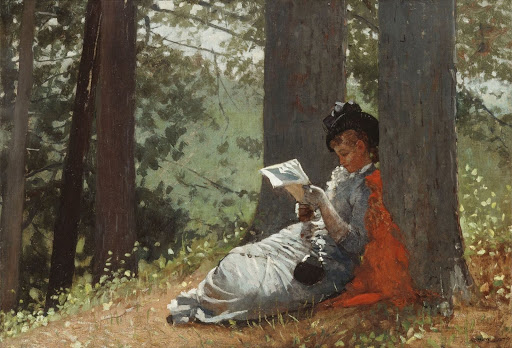
Photo Credit: Winslow Homer, Girl Reading Under an Oak Tree, 1879
Subscribe to the Irish Rover here.
Donate to the Irish Rover here.