
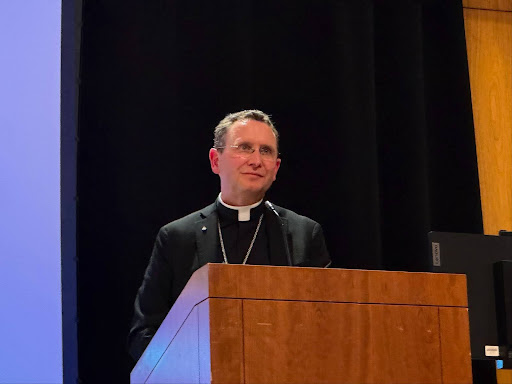
Minnesota bishop speaks on living hope humbly and magnanimously
As the Catholic Church celebrates the Jubilee Year of Hope, Bishop Andrew Cozzens of the diocese of Crookston, Minnesota visited Notre Dame on September 24 to speak on the importance of radical hope in the midst of suffering.
Bp. Cozzens, formerly the auxiliary bishop for the Archdiocese of Saint Paul and Minneapolis, is a graduate of Benedictine College and holds multiple degrees from the Pontifical University of Saint Thomas Aquinas in Rome, Italy.
Bp. Cozzens opened by identifying a “crisis of hope,” highlighting the cultural descent into depression and isolation and citing statistics on rising rates of mental illness and suicide among the youth.
“How do we have hope in the midst of stunning, shocking evil?” he pressed, referring to the recent shooting at Annunciation Church and the assassinations of Melissa Hortman and Charlie Kirk.
The only response to such evil and suffering, Bp. Cozzens argued, is radical hope. Explaining that the word “radical” derives from the Latin word radix, meaning “root,” Bp. Cozzens said, “To be rooted in something deeply is required to be able to grow strong and tall.”
He stated, “This is actually what hope wants to do: allow us to be deeply rooted in Christ. … Sometimes there are not what we would call rational reasons for hope or facts for hope. … It’s rooted in something deeper, something spiritual, beyond what can be seen.”
“Hope is very different from natural optimism,” Bp. Cozzens stressed, noting that optimism places unrealistic expectations on a fallen world. Instead, Bp. Cozzens encouraged the audience to look to a kind of hope that does not deny suffering, but points to the greater reality of the Cross.
“We have hope because of the Cross of Jesus Christ,” said Bp. Cozzens. “The power of the Cross is this: There is nothing so evil that it cannot be taken up by God and turned into a good. St. Paul expresses it this way, ‘We know that all things work together for good for those who love God, who are called according to His purpose.’”
Bp. Cozzens referenced the definition of hope given by the Thomistic philosopher, Josef Pieper: “Hope means both humility and magnanimity.” Defining humility as recognition of our weakness and hopelessness without Christ, Bp. Cozzens also described magnanimity as greatness of soul, based on our dignity as persons. “I’m called to greatness,” he said, “Why? Because God found me worthy to die for. Because God, when He looks at me, doesn’t see my sins, He sees my dignity. He sees the son or the daughter whom He created.”
When asked how Notre Dame students can practice hope in their daily lives, Bp. Cozzens replied, “I think the most practical thing they can do is go to confession. … It’s a very practical way to encounter the reason for our hope, which is Jesus’ mercy and goodness.” He later said, “Confession is a sacrament of hope. Confession combines these two virtues, humility and magnanimity. It forces me to face my sin.”
Several Notre Dame students appreciated Bishop Cozzens’ message of radical hope.
Therese Brungardt, a first-year Master of Divinity student who attended the talk, told the Rover, “I wanted to come to this talk because, in this jubilee year of hope, cultivating the virtue is something I’ve been pondering, especially in our culture of loneliness and despair.”
Joshua Velasquez, a senior in Siegfried studying theology, reflected, “The theme of humility and magnanimity both being necessary for hope was the most striking idea, just because there’s such a tension between them, it seems, but they’re also two sides of the same coin.”
When asked how she intends to practice radical hope after hearing this talk, Bridget Healy, a junior—and Bishop Cozzens’ niece—told the Rover, “I’d say the first thing I need to do is go to confession, that was one of the first practicals that he said. Additionally, I think that as a Notre Dame student, I can kinda get stressed out a lot, so definitely more bringing my worries to Jesus in prayer.”
Matthew is a sophomore from Champlin, Minnesota, majoring in philosophy, theology, and the Program of Liberal Studies. When he’s not travelling the country pretending to be a lawyer, you can find him not doing his homework in the PLS lounge. Recommend other good spots to socialize instead of studying at mmrosla@nd.edu.
Photo Credit: Image by the Irish Rover
Subscribe to the Irish Rover here.
Donate to the Irish Rover here.