
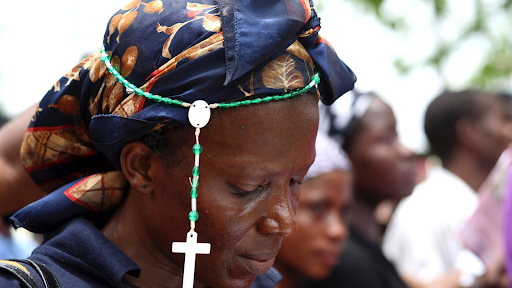
Students, alumni raise concerns amidst media silence
Three weeks ago, Father Matthew Eya, a Catholic priest in Nigeria, was shot and killed while driving back to his parish. Far from remaining an isolated tragedy, this incident is part of a larger, decades-long pattern: the persecution of Nigerian Christians.
According to the Catholic World Report, at least 160 Nigerian priests have been kidnapped or killed in the past decade. At least 850 Christians suffer extreme conditions in jihadist camps, and three churches per day, on average, have been destroyed, looted, or shut down—largely perpetrated by Muslim terrorist group Boko Haram. EWTN claims that more Christians were killed or kidnapped in Nigeria than in any other country in 2024.
One analysis from Notre Dame’s Under Caesar’s Sword project notes that these persecutions have been predominantly ignored by both the Nigerian government and the United Nations. The issue has also received only minimal media coverage.
Freshman Teresa Harkins told the Rover she had not heard any news about the persecutions outside of her high school classes: “I took AP Comparative Government and Politics and Nigeria was one of the core countries, so we talked about the Muslim-Christian split … but I haven’t heard anything current.”
One alumnus said, “I do not find it surprising that there are no widespread conversations about this as foreign policy activism in the U.S. is characterized by cherry-picking. Many of those concerned with human rights do not have religion on their checklist and when they do, you find that those concerned with the plight of the Rohingyas, for instance, do not share the same sentiment with the plight of persecuted Christians and vice versa.”
Kimberlie Orr, International Legal Fellow at the Lindsay and Matt Moroun Religious Liberty Clinic and Term Teaching Professor of Law, thought the issue has been largely ignored due to the ubiquity of violence worldwide. “There’s so many instances around the world that I think take away focus. It kind of dilutes the focus that can be paid to any specific issue,” Orr explained. “I think that would also be a contributing factor to why, in this specific instance, [Nigerian Christians are] getting a little bit less attention.”
Despite the dire situation, many have expressed hope in the possibility for action. Already, Notre Dame has shown solidarity with Nigerian Christians in a few different ways.
As Orr mentioned, “Last year, [the Religious Liberty Clinic at the Notre Dame Law School] sponsored this event where we actually had a priest who had been abducted and wrote a book about it, and he did a book talk … so we were able to give him a platform. Having those who have actually been impacted is really important.”
Orr also discussed how Notre Dame is working with other organizations this year to free two religious prisoners of conscience, and Nigeria is one of their countries of focus.
When asked what else students can do at Notre Dame to support the persecuted Christians in Nigeria, the alumnus told the Rover, “A key aspect of solidarity for ordinary Catholics will be to present well-researched priorities for Congress’ engagement with the issue, one of which should be that in countries of concern, the state and the law should work justly for people of all faiths and persuasions just as is fundamentally the case in the United States. Those at Notre Dame are called to a degree of solidarity commensurate with their education, influence, and affiliation with Catholic Social Teaching.”
Orr proposed additional practical strategies: “It’s talking about it. It’s writing it. It’s inviting scholars to maybe write some more scholarship on it. It’s inviting speakers…. You can reach out to members of Congress and say we want Nigeria to be a focus of what’s happening with their International Religious Freedom policy.”
Harkins, meanwhile, expressed concern that raising awareness would be meaningless without concrete action, such as advocating for education in Nigeria. “I think education is always a good step in the right direction. Because these actions [of violence] are driven by thoughts…. So [it’s helpful] if you can get at the thoughts, and also maybe try to understand where these people who are doing this stuff are coming from, and what’s motivating them—and go to the root of the issues.”
Ultimately, Orr mentioned the importance of prayer in this crisis: “Even keeping people in your hearts and praying for them, I think, can be a really important mechanism available.”
Clare Hettich is a freshman from Potomac, Maryland majoring in the Program of Liberal Studies. She loves helping de-rail seminar conversations onto philosophical tangents and keeping the vending machines in Hesburgh in business. If you’re involved in a theological debate, please include her by emailing chettich@nd.edu.
Photo Credit: OSV News photo/Akintunde Akinleye, Reuters
Subscribe to the Irish Rover here.
Donate to the Irish Rover here.