
STEM faculty predict impacts of 100,000 dollar annual fee for work visa
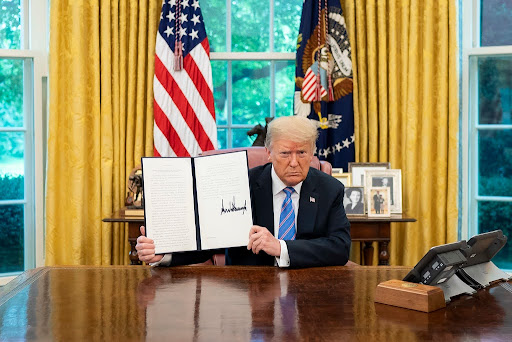
President Donald Trump signed a proclamation on September 19 requiring United States employers hiring foreigners to pay a 100,000 dollar fee for each H-1B visa.
Citing falling wages and rising unemployment rates for American STEM workers, namely in computer science and engineering, the executive order aims to “impose higher costs on companies seeking to use the H-1B program in order to address the abuse of that program while still permitting companies to hire the best of the best temporary foreign workers.”
The H-1B visa was created by the Immigration Act of 1990 to allow for corporate sponsorship of foreign workers with useful skills. Holders of H-1B visas are only allowed to remain in the U.S. at the discretion of their employer, who sponsors their visa and may terminate it without notice. In 2024, U.S. Customs and Immigration Services (USCIS) approved over 390,000 H-1B visas, with more than 64 percent employed in computer-related fields, per USCIS. Data shows that 73 percent of H-1B holders are Indian nationals, followed by Chinese nationals at 12 percent.
Supporters of the H-1B, including many faculty members at Notre Dame, argue that the H-1B fills gaps left by insufficient numbers of qualified American graduates. The Federal Reserve Bank of New York published data in February showing that American STEM graduates have an unemployment rate between 7.8 percent for physics majors and 6.1 percent for computer science majors, nearly twice the general unemployment rate of just 4.3 percent.
Kirk Doran, Associate Professor of Economics, authored a 2022 paper in the Journal of Public Policy that argued that hiring additional H-1B workers directly contributed to a decline in wages and an increase in corporate profit. Other studies have also indicated that H-1B workers are paid less than Americans for comparable roles, partially as a result of their willingness to accept lower wages and possessing little bargaining power with employers.
The University of Notre Dame employs a large number of H-1B visa holders, and the imposition of a 100,000 dollar fee for further foreign hires was met with widespread opposition by faculty members.
Gregory Snider, Chair of the Department of Electrical Engineering, talked to the Rover about the impacts of visa modifications on research at Notre Dame. Snider said, “The people that come on H-1B visas are usually faculty, staff, and postdocs.” “Our signals and systems people are probably going to be the most affected,” Snider said, describing the research conducted by H-1B holders working in electrical engineering.
When asked what the larger impacts on American universities would be, Snider was frank. “I’m not sure what I can say without getting put into jail,” Snider said, adding, “This is the stupidest thing that I have seen in my forty years in the industry and in academia. This is the worst thing I have ever seen.”
“It has traditionally been the fact that the United States could attract the world’s best. We did very, very well with that,” said Snider, referring to the 1990 restructuring of the H-1B visa into its current form.
Outlining the impact of visa restrictions on Notre Dame, Snider said, “We will not be able to attract the best and brightest.” For his department in particular, Snider clarified, “Of any of the engineering disciplines, electrical engineering has the highest international component. We’re probably going to be hurt more than other disciplines. It’s prohibitive to pay that for every H-1B that we want to bring in.”
Dante Lee, a senior studying electrical engineering, approved of the visa restrictions. “As an American college student I would benefit from visa restrictions, especially as someone trying to get into the tech sector.” Recognizing that information technology workers comprise over 65 percent of H-1B holders, Lee said that “the tech industry is being flooded with workers from other countries.”
Alex Keaty, a junior studying biochemistry, felt differently, telling the Rover, “It definitely seems good for generating some STEM jobs for Americans, but I wouldn’t want smart foreigners to be driven away because of cost.”
Mark Moloney, a junior also studying biochemistry, felt optimistic about visa modification, telling the Rover, “I feel like it’s a good thing; it ensures we use our own talented people and not foreigners. I can’t think of any drawbacks.”
William Schneider, Keating-Crawford Professor and Department Chair of Chemical and Biomolecular Engineering, disagreed. Schneider told the Rover, “The uncertainty surrounding the future cost of the program is a concern for us.”
Regarding current doctoral students in chemical engineering, Schneider said, “My larger concern, however, is for our Ph.D. graduates, a significant fraction of whom come here on J-1 visas, who become significantly skilled, and who may now have an even more difficult time finding opportunities to work in the U.S. following their graduation.”
Mark McCready, Senior Associate Dean for Research and Faculty Affairs in chemical and biomolecular engineering, questioned the applicability of the fee, telling the Rover, “The most reliable information that I have states that it is not clear if this 100,000 dollar fee applies to universities.”
Describing impacts of the fee on hiring, McCready was blunt, “If there is a 100,000 dollar fee, there is no chance that we would pay this to hire a postdoc,” adding, “If we wanted to hire a senior faculty member from, say, Oxford, who is an established ‘star’ in a field that we are emphasizing, we might be willing to pay the 100,000 dollars. But, this would be a rare event.”
When asked about the impact of such reforms on chemical engineering research, McCready said, “This will cause some significant disruption to our research efforts.”
Sam Marchand is a junior studying political science and finance from Beaumont, Texas. He squanders much of his spare time by reading the Current Events section of Wikipedia preparing arguments for ND Speech & Debate, of which he serves as head yapper. He can be reached in Dublin for the fall at smarcha3@nd.edu.
Photo Credit: Flickr
Subscribe to the Irish Rover here.
Donate to the Irish Rover here.