
Theology program offers students a new encounter with Catholicism
Over the past two years, the McGrath Institute for Church Life (MICL) has launched the Take a Second Look (TASL) program, designed to support the university’s theological pedagogy. Through extracurricular discussion groups and speaker series, the program aims to support theology professors and existing theology courses in the core curriculum as they invite students to “take a second look” at the beliefs of the Catholic Church.
According to the MICL website, the initiative aims to “persuasively engage and encourage students to ‘take a second look’ at the beauty and profundity of the Catholic faith that they thought they had left behind, outgrown, or had never considered relevant to their lives in the first place.”
A key dimension of the TASL mission is combating the rise in religious disaffiliation amongst young people by awakening theological curiosity. John Cavadini, MICL Director and Professor of Theology, told the Rover, “Students now are looking for something more than they were 10 years ago. But they don’t know what it is that they’re looking for.” He continued, “They’re not planning on majoring in theology. But if you do it right, they see that theology is not just another academic discipline; it’s the science of revelation. [Theology] has as its object God, as God has revealed himself, and therefore all of this beauty.”
According to Joshua McManaway, Academic Director of TASL, the crisis of student disaffiliation is caused by a twofold issue: lack of meaning and lack of community.
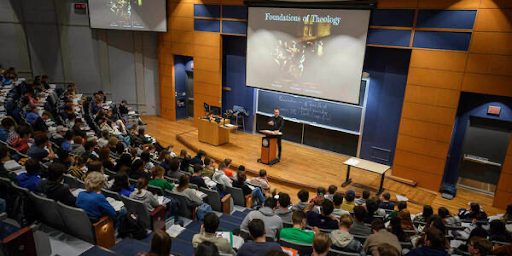
McManaway cited this lack of community as a reason for the creation of the 200 to 300 student “supersections” of Foundations of Theology, Notre Dame’s first theology requirement, taught by Anthony Pagliarini, Director of Undergraduate Studies for Theology and Associate Teaching Professor, and Father Kevin Grove, C.S.C., Associate Professor of Theology. The classes are accompanied by “Conversations of Purpose” discussion groups that are formed in residence halls, giving the students a built-in community where they can feel comfortable asking meaningful questions.
McManaway told the Rover, “We saw the wild success of these supersections because we created these little pockets of community. People would go to their dorms and have these discussions. … Our thinking was that this provided people a space to actually ask the real questions, to hash it out, to raise doubts … to think about, is this really intelligible or not”?
“We receive a lot of students who stopped learning anything about the Catholic faith in middle school, and Confirmation for them was a kind of graduation,” McManaway continued. “Imagine trying to live your life with the knowledge that you had as a 12-year-old for any other realm of your life! And so the hope was to show [that] there’s a real credibility, there’s intelligibility here.”
Another critical component of TASL’s mission is exposing students to the richness of the Church’s teaching across a variety of disciplines, with the hope that they will integrate the truths of Catholicism into their own studies and out to the world.
An essential part of building such a culture, according to Cavadini and McManaway, is enabling different theology professors to teach from their unique skillsets, doing what they already do best.
In Pagliarini’s Foundations “supersection,” the students are taught to sing Palestrina’s arrangement of Sicut Cervus, a Latin choral motet. Timothy O’Malley, Associate Director for Research at the McGrath Institute, Academic Director of Notre Dame’s Center for Liturgy, and Professor of the Practice in Theology, also assists with the initiative, teaching a popular course titled “Nuptial Mystery” on the Catholic vision of marriage.
As part of the TASL initiative, two one-credit theology courses were taught by Fr. Grove and Bill Mattison, Wilsey College Professor of Theology, in the spring semesters of 2024 and 2025. Fr. Grove’s course, on The Confessions by Saint Augustine, required students to write their own “spiritual autobiography” in the style of the saint, while Mattison’s course on the works of C.S. Lewis ended with students composing their own “Screwtape Letter.” Both classes were extremely popular, with hundreds of students filling Debartolo 101 each week to learn about the rich heritage of the Christian intellectual tradition.
McManaway listed the classes as examples of TASL’s success, saying, “It’s about putting resources in the hands of very capable teachers, creating a community of practice amongst the professors who can talk about best practices in the classroom, but then really just being very hands-off and letting people do what they do best.”
While each professor takes a different approach, McManaway said, “The kind of common thread between all of the classes is on showing the credibility of the Catholic faith, the generosity of the Catholic faith, even that it’s not just about having answers, but it’s about the fact that you are loved and that you’re made for love.”
The recent success of TASL has coincided with an increased engagement with the Catholic faith among Notre Dame students.
Last year, Notre Dame’s student body saw a historic surge in conversions to the Catholic church, with a record number of 52 catechumens entering the Church through the Order of Christian Initiation of Adults (OCIA) program.
Alongside the rise in conversions, Notre Dame’s Department of Theology was ranked first in the world for the fourth year since 2020. It is also the home of more than 800 theology majors and minors, many of whom did not originally plan on studying theology. According to Cavadini, “Somehow they’re majoring or minoring because they saw something, they took a second look, or they were offered a second look, and it was persuasive to them, and they wanted to find out more.”
He continued, “Notre Dame has an impact, for good or for ill. Sometimes for ill, but a lot of times it’s for good, and I want to amplify it. … It’s very difficult to change your culture negatively by denouncing something; generally speaking, you don’t change things that way. If you want to change a culture, it has got to be by attraction, by persuasion, by getting people to take a second look.”
Abby Strelow is a sophomore majoring in theology and PLS who unfortunately did not buy a large enough bookshelf for her dorm room. She would like to formally apologize to her roommate for the piles of Platonic dialogues on the floor that are currently making it hazardous to walk. (Sorry.) Send her suggestions on book organization at astrelow@nd.edu.
Photo Credit: University of Notre Dame Department of Theology
Subscribe to the Irish Rover here.
Donate to the Irish Rover here.