
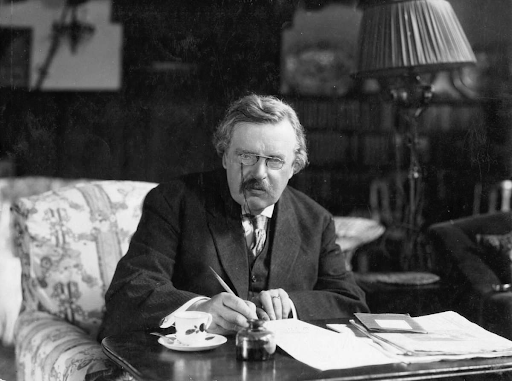
Dale Ahlquist on the front-porch poet’s visit to Notre Dame
Dale Ahlquist is President of the Society of Gilbert Keith Chesterton and co-founder of the Chesterton Academy Schools Network. He discussed Chesterton’s famous visit to Notre Dame with the Rover.
Editor’s note: This interview was edited for the sake of brevity and clarity.
Irish Rover: G.K. Chesterton came to Notre Dame in the fall of 1930 as a visiting professor. Could you discuss what he did while he was at Our Lady’s University?
Dale Ahlquist: At the time of his visit, Chesterton was one of the most famous writers in the world, and so it was a great coup for Notre Dame to get him as a visiting lecturer for six weeks. Chesterton gave 18 lectures in Victorian literature and 18 lectures in Victorian history, all in Washington Hall. Students had to sign up to get in, and there were 500 slots for each series.
It was all the buzz on campus when Chesterton arrived, as he came at the same time that the Notre Dame football stadium was opened and dedicated. He was there at the opening of the football stadium with Knute Rockne and got a huge ovation when they introduced this English writer who, of course, was very much a Catholic celebrity at that point in his career.
What did Notre Dame think of Chesterton?
First of all, the students who went to the lectures were very impressed. No transcripts were made of any of the lectures—the only records we have are some student notes, which are in the university archives. Three students took notes from the literature lectures, and one person took notes from the history lectures. But their notes are just full of great Chesterton quotations.
Chesterton himself made no notes. He would go up to the lectern with just a scrap of paper in his hand, and usually what was on this piece of paper was a few drawings and doodles—who knows what use that piece of paper was to him! But there was an interesting article written by the editor of the student newspaper, who actually chastised the fact that not all 500 tickets for his lectures were claimed, complaining that people did not take advantage of this great literary figure in their midst.
But many students were very enthusiastic, as well as a lot of the faculty and staff. A good number really took the chance to get to know Chesterton personally, inviting him to parties, where he sat and mixed with the students.
Was Chesterton able to engage with campus life outside of the classroom?
Yeah. Another place students would go visit was the private residence in South Bend where Chesterton stayed. It had a front porch, and in the evening, Chesterton would sit out on this porch—something they don’t have in England—thinking it was the most novel and neighborly idea there was. As soon as he’d set up, he would start smoking his cigar and people would just come by and visit him.
One of the most remarkable things that came out of those recorded conversations was how up-to-date Chesterton was on modern literature. First, he quoted T.S. Eliot’s “The Four Quartets,” which is the only reference that we have of Chesterton reading that work. Though he regarded Eliot as very much a modernist, he also saw him as someone with profound insight and absolute command of these modern poems.
The other thing, as far as fun stories go, is students claim they had to carry him up the stairs and down the stairs of Sorin Hall—which I think is sort of an exaggeration, but it makes for a very good story.
Chesterton wrote a poem about his time at Notre Dame called The Arena. What strikes you from that poem and what messages do you think that we can glean from it today as readers?
Chesterton wrote The Arena directly after his visit to Notre Dame. He sent a handwritten manuscript of it to the University President, Father O’Connell, who was just shocked and honored that he wrote this original poem for Notre Dame. It was widely published as a result.
The overarching image that Chesterton uses is the gladiators of ancient Rome—drawing out the differences in these two events, as well as their similarities: though the football stadium is an arena, the games are a “bloodless battle,” and instead of the Roman gods overlooking the arena, it’s the Virgin Mary, because she’s there on the gold dome that Chesterton could also see from his seat.
But then comes the great conclusion, “Queen of Death and deadly weeping/Those about to live salute thee.” Isn’t that great? Just the opposite of what the gladiators would say to the Roman emperor—“We who are about to die, salute thee”—the football players look up and say, “We who are about to live salute thee,” such that Chesterton can say it’s “holier bread and a happier circus.” There’s really some nice images from that poem.
What do you think Chesterton would say to Notre Dame today?
I think something that really impressed Chesterton when he arrived on campus was that, here, in the middle of the country, was this place that was honoring Mary. It was named for her, and this was the great presence—really, he knew it then, just as it is now—that Notre Dame is the heart of the church in America. Notre Dame is the barometer people look at to figure out what’s going on with the Catholic Church in America.
He also already noticed that America had this image of Notre Dame as being just a football school. He says, no, the intellectual atmosphere there is very strong, and there’s much more to the school than football, and he could see why. Intellectuals were drawn to it—and clearly, he was one of the great giant intellectuals of the first third of the 20th century, coming all the way from England to speak at Notre Dame.
One of the great lines Chesterton says is, “The purpose of education is to prevent us from taking educated people seriously.” The whole point of education is not to be a great intellect, but to be a better servant of God. And if the education isn’t filled with a true Catholic perspective and informed by the Catholic faith, it really is an empty education. I think he would always try to remind every Catholic school that it is really set apart from secular education. Chesterton saw that then—it’s one of the reasons why we named the Chesterton Academies for him. He knew that a Catholic school had to be very distinct from a secular school. It has a different outlook altogether, and a different focus, but one that’s much more full and certainly much more relevant.
Where should students who are interested in learning more about Chesterton look?
The introductory book that I always recommend is Common Sense 101: Lessons from G.K. Chesterton. It’s very accessible, and the way I write is that I just quote Chesterton—that’s really the great strength of the book. I also just had a new book come out with Ignatius Press, I Also Had My Hour: The Alternative Autobiography of G.K. Chesterton.. Putting it together was the result of years of research, and I have actually manufactured an autobiography where Chesterton is writing about himself in his own words, strung together from his massive journalism. It’s truly a new look at Chesterton that his own autobiography didn’t reveal, because he spent most of his own autobiography writing about other people. So it’s the book that probably has the most information about Chesterton of any other book ever written.
Elizabeth Mitchell is a junior in the Program of Liberal Studies and theology. She also is a proud alumna of Chesterton Academy of the Twin Cities in Hopkins, MN. To rave about the genius of Andrew Wahlquist’s radio production of The Man Who Was Thursday, email her at emitche8@nd.edu.
Photo Credit: The Catholic Thing
Subscribe to the Irish Rover here.
Donate to the Irish Rover here.