
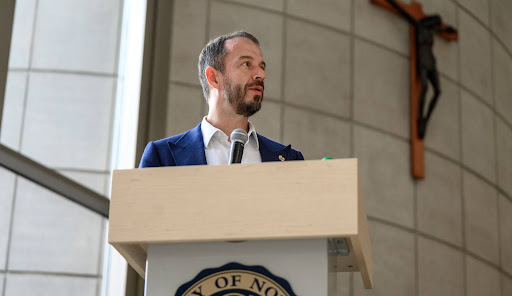
Mendoza Dean Martijn Cremers on ambition and Catholicism
Elizabeth Mitchell is a junior who forsook her Mendoza aspirations to drink fine chai and ponder the merits of gyrovagues. Any similarly ambitious souls are welcome to join her in the Program of Liberal Studies and theology, or contact her at emitche8@nd.edu.
Let’s start at the beginning with your early upbringing. Are there any foundational moments that you can think of growing up, and what role did faith play in your life before college?
I grew up in the Netherlands in a remote village where my parents were born and raised. I had two siblings, an older brother and younger sister, and though I was a cradle Catholic, I grew up in a time when the Netherlands were already aggressively secular—very different from the United States. I simply didn’t know anyone my age who was practicing their faith. Though I tried to walk in my parents’ strides, I was very confused. I didn’t know my faith at all. I didn’t know the Bible, and I didn’t know the Catechism.
My main thought growing up was that there was a big world outside my village which I was very interested in exploring. Like many Notre Dame students, I was thinking of exploring and creating options. I was very ambitious. I wanted to work really hard, and also do lots of different things.
How did your ambition manifest in your college years?
As I was preparing to enter college, I didn’t really know what to do, but I knew I was good at math and statistics. At the last minute, I decided I wanted to go to Amsterdam—which is one of the best cities in the world, I think. Ultimately I made a decision more on where I wanted to live than anything else.
In college I was engaged with lots of different things, but I did not spend much time discerning. In terms of my academics, I don’t think I really enjoyed what I was studying. Though I worked pretty hard and was very good at taking tests, I mainly just wanted to get the highest grades, and didn’t really understand the “why” behind my studies.
I got a lot of help, though, from mentors who saw things in me. One example was I took this introduction class in the fall of my first year. Right after, the professor asked me to become his TA and then his RA (research assistant), which meant I got my own office cubicle. I was one of only two first-years. Through this job I got to be a part of a certain community of students and faculty together, and I think that was my first inkling that maybe the academic world could be for me.
In Amsterdam, the professors were very focused on finding students who would have a certain aptitude for becoming an academic. The plan they proposed to me was to do my Ph.D. in Amsterdam, which would be faster and give me the option to build my career there. I was always thinking that I wanted to explore further, though, and so the next logical step for me was to go to New York for a year on a scholarship to an economics program. All of a sudden, I found a much bigger world than I had anticipated. I had never been to the United States, and quickly learned what it meant to work hard. It was so completely overwhelming for me at that time, but it was also exhilarating, interesting, and challenging.
How did you navigate the difficulties of this season of your life?
Moving to New York, especially the first few months, was really tough. I wanted to do well in my courses, but since I had limited time and basically no money, most of my hours were spent working. I was lonely, everything was new, and I missed the place where my family had such deep roots and where there was such an active social environment. No one spoke my language.
I also did not really enjoy what I was studying. It was a massive Ph.D. program in economics, and my background was all math and statistics. Almost everybody else, I think, already had masters in economics and the professors taught as if you already had learned the material.
At the same time I discovered Wall Street. These were very exciting years, as I came to New York in ‘97 when Wall Street was booming, NASDAQ was going crazy, and there were lots of new tech firms.
I also was able to take an advanced course on derivatives that was taught at the business school in the finance department. I’d never taken a finance class, and so I think it was providential. Since I was very active in that class, the professor saw something in me, and asked if I would consider doing a Ph.D. in finance. I did eventually end up switching and I loved it. There was a much stronger community in finance, and the classes were a lot more practical.
The other big thing that happened was that for the first time in my life, I met people my age who were practicing their faith. This inspired me to explore Catholicism more deeply.
I also got involved with the Catholic association for graduate students at NYU and started
going to their Catholic center, where I met people from all over the world. There I began to read the Bible and some religious authors, such as C.S. Lewis and Peter Kreeft. But the most influential person I discovered for my reading was Gilbert Keith Chesterton. I became a huge Chesterton fan.
What happened after you graduated from NYU?
Finishing my Ph.D., I was still very unsure about what to do, but I was open and wanted to see where I would get an invitation. I also got engaged, and all of a sudden, everything became more of an “us” decision versus just what I wanted to do. I’m still working on that today, but that’s the ideal, right?
One of the schools that gave me a campus visit when I was on the academic job market as a doctoral student was Yale University. That visit went remarkably well, and they gave me an offer on the spot. Strangely enough, on that same day I got an email from a business school in London. I thought that my wife would prefer the London offer, but she quickly said no, because she could keep her job in the city, and I could work at Yale. It was a great opportunity for me, and I had never expected to end up at a place like that.
At Yale, I really discovered that I loved the life of a professor. Intellectually, it was very stimulating, and I loved teaching MBA students. After I started teaching, our life completely changed because we got married the same month. We got married on the feast of Sts. Peter and Paul, and through friends we had made at the Catholic Center at NYU, we had arranged a Wednesday audience in a special section preserved for newlyweds. This was 2002 when St. John Paul II was quite ill, but it was really heroic how he was still serving us both and giving us a blessing. It was fantastic.
Soon after, our first son was born. I like to joke he was born on our wedding day—exactly one year after. That completely changed our life again. Over the next couple of years, we had basically another baby every two years. We had our first five children in my first eight years at Yale, so those years are a bit of a blur, understandably. I think my wife and I were just utterly overwhelmed because we didn’t have any in-laws close, and we didn’t have much help. We were part of a great group of young adults, but I was still working crazy hours.
The hard thing for those years was learning how to not let a certain academic ambition completely overwhelm all other aspects of life. Certainly in the beginning of my time at Yale, the hours I was working were overwhelming everything else. On the one hand, I benefited from that in my academic career, but I did not show up as I should have with the family.
From there, I started to think differently about what it means to be successful, and recognizing that success has many dimensions. Success in the eyes of whom? In the eyes of God? In the eyes of others? In the eyes of people who love you? In your own eyes? Over time my certainty in this answer grew.
What does success mean to you today?
There are three interrelated senses of vocation. All of us have the vocation to be children of God and become saints. Then we have a particular vocation to a state of life, which for most of us is being married and at least being open to children. And the third and more particular vocation, is one that can change, I think, over the course of one’s life. For me, this was to be a professor, teaching, doing research.
It took me a while to see that this ordering—faith, family, and finance—is probably the right one. All three vocations matter, but there’s a certain alignment in these that I’m still working on.
I think it was especially my wife who encouraged me to consider Catholic universities in the hope that there would be more integration across those three different locations. Once I discovered Notre Dame, I couldn’t believe that a place like this actually existed.
Drawing on the wisdom of your own story, what advice would you give students today about their ultimate goal and purpose?
A very important aspect of life as a student is to see your four years here as part of your formation into an adult. Take time for prayer and reflection. Make space for silence, for listening, for deepening your faith and making it your own. But also become part of a community. I think that’s what Notre Dame is so good at, because discernment and prayer are not things you should be doing alone. God is the main actor in your life, but there’s also an important social component. That’s the reason why we get together to worship and pray, so you don’t have to face all these questions yourself and you don’t have to figure it all out. It’s all a lifelong process.
And this is more advice for the people who are engaged to get married or starting their families, but when I was young I was part of some great group of dads, where I really got to know them. This type of community is extremely helpful as an example.
I think I would start, though, with the realization that everything is a gift. You’re here at Notre Dame to discover your gifts, to develop these gifts in a holistic way, and then figure out what God’s plan really is, because every gift is inherently meant to be shared. It’s so central to remember that we are made in the image and likeness of God, and so God has a loving plan for us.
I think that one of the challenges with that, very practically, is what are you going to do after you graduate? Or even what are you going to do in the summer, with internships and things like that?
I recognize those challenges. It’s hard to give a general answer to that, because where people are at with their discernment processes is so person-specific. One of the problems I see is that many options are presented to students very early on, and that put students on a certain path which may not always be the right fit for them. You need to allow yourself to change your mind or explore multiple things that you don’t initially foresee.
On the other hand, sometimes it may actually be good for you to make a decision. When I look back at my life, sometimes I was afraid to make a decision, simply because I was afraid to lose optionality. And so it’s complicated, yeah? I know I was definitely that way when I was a senior in Amsterdam and even when I applied to graduate school, because I simply felt unable to make a decision about other paths. But ultimately I’m very glad I decided to come to the United States, and I feel very fortunate.
How does this advice apply to Notre Dame specifically?
I was recently invited by Bishop Kevin Rhoades to give the annual Bishop’s lecture, and my topic was the parable of the rich fool. I think the parable of the rich fool and many of the parables of our Lord are extremely rich subject matter for contemplation.
The rich fool defines success in a particular way. He wants to have a bigger barn and security, and then eat, drink, and be merry. The parable grabs our attention though, because our Lord immediately goes to the end of the rich man’s life. I think that’s a useful exercise, because it’s like He’s asking, at the end of your life, what will you care about? Of course, in the parable our Lord says that we should focus on being rich towards God, and therefore love of God and neighbor. Our material riches are only a means, not an end.
I’ve written quite a bit about how to think about purpose. The very general framework I use for that is what I call “the three C’s”: communion, contribution, common good.
Purpose is ultimately communion. The way that we can make progress towards communion is how we contribute from our gifts and how we share our gifts with others. But the more theological part is to have a certain purpose of communion with God, and therefore contribute to the common good, to God’s plan for all of creation. The primary way in which you contribute is through cooperation and teamwork, which we do in a competitive environment.
In some sense the rich fool was primarily focused on the competitive level, which is important, but it needs the right ordering. You can give glory to God through how you compete with excellence.
I always like to emphasize that there’s two senses to competition. The primary way to contribute is through cooperation and solidarity with others. External excellence in competition always arises from a certain earlier internal competition towards the best version of yourself by the grace of God and the support of others. This is what Catholic Social teachings called subsidiarity.
I think for much of my life, and even still, there’s a natural temptation for me to invert the order.
I really need God and support from friends and family to help me with that. When you ask about skills and success, you’re going to want to back think again to those three levels. What does success look like in terms of communion or what you contribute? It’s difficult, and the answer will look different for many people because there’s no one metric. But it ultimately comes down to how you measure success in your social relationships, in your vocation to be married, and in your openness to life.
Photo Credit: Matt Cashore / University of Notre Dame
Subscribe to the Irish Rover here.
Donate to the Irish Rover here.