
Students divided over free speech, controversial conservative commentator
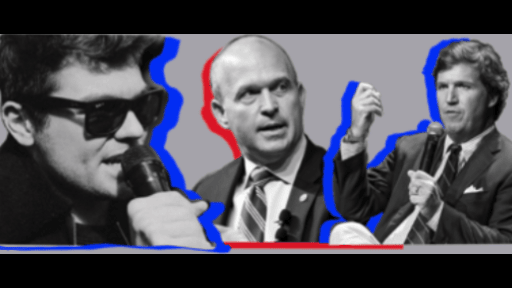
The Heritage Foundation’s recent internal turmoil—triggered by President Kevin Roberts’ defense of Tucker Carlson’s interview with controversial commentator Nick Fuentes—has reverberated across college campuses, where students are sharply divided over the rise of Fuentes’ thought and the expanding boundaries of acceptable political discourse.
Carlson’s interview with Fuentes covered U.S. foreign policy, elite political influence, and mass migration. After Roberts defended Carlson and argued that such conversations should not be dismissed outright, several Heritage staff members resigned, drawing national media scrutiny and igniting broader debates within conservative circles. Several prominent figures, including President Donald Trump, have defended Carlson.
Fuentes’ political platform largely rests on his disapproval of Jewish influence in American politics and his opposition to immigration. “[I do] not support Israel at all,” Fuentes has said. “They are hostile to American interests. And we can’t pretend Israel has nothing to do with Jews.” Fuentes has argued on his show America First that most American involvement in the Middle East, including the Iraq War and Gulf War, was fought primarily for Israeli interests and pushed for by Zionist Jews in the United States. Fuentes also labeled Israel’s war in the Gaza Strip in the aftermath of the October 7 attacks a “genocide.”
Fuentes has called for a total immigration moratorium, arguing it is necessary to preserve traditional American demographics: “If America were 90 percent nonwhite in any circumstance, it wouldn’t be America. Frankly, when America soon becomes 50 percent nonwhite, it won’t be America anymore.” Labeled by major media outlets as a “white supremacist,” Fuentes has himself explicitly rejected such a characterization and condemned “genuine racial hatred” towards non-whites.
Fuentes has drawn controversy for combining political analysis with often transgressive humor. His commentary has targeted the right as well as the left, including when he called the conservative commentator Matt Walsh a “total f—got p—y” and “shabbos goy race traitor” due to his unwillingness to criticize Israel.
Many criticisms of Fuentes center on his past comments on Jews and the Holocaust. Fuentes has given Nazi salutes on his podcast, but has denied being a Nazi himself, but added calling Nazis “low-IQ.” He has quipped that Hitler killed around “two hundred to three hundred-thousand Jews … during the Holocaust,” but added, “That’s a joke, of course, we all know the number was closer, probably, to at least a billion.”
On campus, many students had already encountered Fuentes and the Heritage Controversy—not through lengthy interviews, but via short social media clips on TikTok, Instagram, YouTube, and X. “It is kind of hard to say you haven’t stumbled upon clips of him,” said Dominic Vesprini, a sophomore from Graham Family Hall. “He’s everywhere, hundreds of accounts post clips every day.”
Other students echoed that sentiment, saying their first impression of Fuentes came through humorous or exaggerated clips rather than policy discussions. “I don’t know enough to agree with everything he says,” said a freshman engineering major speaking under anonymity, “but the internet definitely portrays him in the craziest possible way.”
As conservative writer Rod Dreher recently noted, “I am told by someone in a position to know that something like 30 to 40 percent of D.C. GOP staffers under the age of 30 are ‘Groypers,’ a term used to denote the followers of Fuentes’ show America First. If this claim is accurate, it suggests that these beliefs may hold a far more significant position among young people than institutional conservatives acknowledge.”
Junior Gregory Cordero told the Rover in an interview, “Silencing views—especially ones as widespread as Fuentes’s—tends to heighten their convictions. The more a viewpoint is prohibited, the more its supporters feel persecuted, which can drive them toward increasingly extreme reactions and create a pressure-cooker dynamic.”
Cordero continued, “People who support Fuentes are often afraid to reveal their views because of social or professional retribution. If the goal is to change their minds, sweeping accusations of antisemitism or misogyny aren’t going to do anything.”
An anonymous male student who identifies strongly with Fuentes’ self-titled America First movement added, “People are frustrated. We’re seeing huge population changes, and we’re sending billions overseas. Why is it taboo to even ask whether this is good for Americans? You won’t find a single person willing to identify with Nick because you can’t even express ideas without cancelation.”
Female students, in contrast, were less familiar with Fuentes and generally less likely to have a positive view. “I only really saw his name because of New York Times articles calling him an antisemite,” said Ella, a senior psychology major. “I haven’t watched the clips myself. Honestly, I’m hesitant to say anything because I don’t want to be associated with that.”
Media coverage shaped many students’ understanding of the incident. “All I know is what I read in PBS and mainstream outlets,” Ella continued. “Everything described him as an extremist activist. It definitely made me uncomfortable. Jokes at some point stop being funny, and his beliefs hurt people.”
One anonymous female student who has seen Fuentes’ Instagram reels sharply criticized him, labeling him a “racist, sexist antisemite.” She continued, “I saw a clip in which he pretended to be Ben Shapiro repeatedly whipping another Daily Wire commentator, Matt Walsh, and telling him to ‘go back to work, do not criticize Israel’ and I just think that was totally unacceptable.” She also referenced a clip in which Fuentes claimed that “Jews are running society, women need to shut the f— up, and black people should be in prison, for the most part,” calling it “extremely disrespectful.”
“We have to reject Fuentes,” she concluded.
Fr. Bill Dailey, C.S.C., Rector of Graham Family Hall and Professor of Law, gave his perspective in an interview with the Rover. He posited that figures on the new-right like Fuentes or Joe Rogan “have an appeal because they are willing to speak their mind in a time where people feel that we aren’t allowed to ask hard questions,” and confront “things [that] are foreclosed by politeness or political correctness.”
Fr. Dailey saw Carlson’s interview as cowardly, saying, “If you interview a man known for outrageous claims and harsh accusations, especially about such grave issues as race or Jewry, you must challenge those views.” He cited former examples of tough interviews Tucker gave, such as his conversation with Senator Ted Cruz on the Iranian conflict.
Fr. Dailey followed Kevin Roberts’ response and fallout to this interview over X. He said he did not think Roberts’ initial handling of the interview “addressed the key complaint” because it attempted to raise the issue to a “level of abstraction concerning free speech that missed the political crux: The goal of free speech is to get to the heart of the others views and to root out falsehood.”
Four days after the backlash, Roberts released a follow-up statement apologizing for aspects of his initial message while reaffirming Heritage’s mission to “wrestle with hard questions, not avoid them.” The episode highlighted a widening divide on the right over the future of the conservative movement in America.
Luke Woodyard is a sophomore from Evansville, Indiana majoring in economics and theology. Unfortunately, he was unable to maintain anonymity. He can be reached at lwoodyar@nd.edu.
Photo Credit: Wikimedia Commons/Irish Rover
Subscribe to the Irish Rover here.
Donate to the Irish Rover here.