
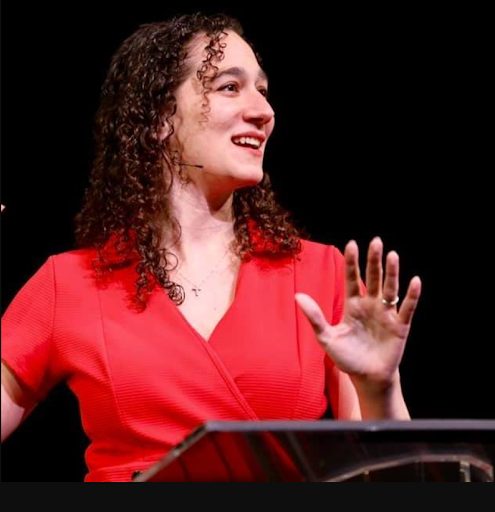
Professor evaluates C.S. Lewis on prayer with Aquinas’ thought
“If God is all-wise and all-good, what is the point of asking Him for things in prayer?”
This is the premise of a lecture on the metaphysics of prayer by Fr. Stephen L. Brock, Professor of Medieval Philosophy at the Pontifical University of the Holy Cross in Rome and Visiting Professor of Philosophy at the University of Chicago. The lecture was hosted by the Jacques Maritain Center and had 94 people in attendance. During the event, Fr. Brock compared the thought of C.S. Lewis and Saint Thomas Aquinas. He proposed that Lewis’ account of prayer is theologically inaccurate in limiting the role of prayer as opposed to Aquinas’ explanation.
First, Fr. Brock considered Lewis’ explanation of prayer. He quoted Lewis, saying, “If it is foolish and impotent to ask for victory in a war on the grounds that God might be expected to know best, it would be equally foolish and impotent to put on a raincoat. Does not God know best whether you ought to be wet or dry?”
Fr. Brock went on to explain that, to Lewis, prayer is a “divinely ordained way of causing things.” Most events are outside of human control, but “just like a plan in which the scene and general outline of the story are fixed by the author … certain minor events are left for the actors to improvise.”
In addition to potentially contradicting God’s all-knowingness, he argued that Lewis’ account limits the role of prayer to minor events, suggesting that “God has a general plan that will be executed, no matter what we do, and that our actions and prayers only fill in details” affecting only “minor events that are incidental to the outcome.”
Fr. Brock then shifted to Aquinas’ conception of prayer. He focused on Aquinas’ idea that prayer primarily affects the one praying: “[Prayer] makes the one who prays fit to receive that which is prayed for.” He likened “the soul in prayer” to “a little chick opening its beak … doing that is what enables it to receive the food that its mother already wants to give it. Good and efficacious prayer is like the opening of our soul’s beak.”
He continued by noting that, while Lewis portrays God’s plan as a general outline, Aquinas affirms that “the eternal plan of divine providence covers every single event that ever occurs, however small.” Fr. Brock then considered in length how this could be true while maintaining free will and the effectiveness of prayer.
During these considerations, Fr. Brock echoed Aquinas on a common pitfall when considering prayer. While it might seem that God’s unchanging plan makes prayer useless, this comes from the false idea “that our prayers fall outside of His original plan. We find it hard not to think that we’re trying to give Him information or to change his mind. We fail to consider that our prayers are part of His plan, too.”
Professor Therese Cory, Director of the Jacques Maritain Center, told the Rover, “Fr. Brock’s talk beautifully illustrated how rigorous philosophy can help us tackle difficult theological questions that are important for the everyday life of prayer. The question of ‘Why pray if God already knows what is going to happen?’ is one that many of us have wondered about. I particularly appreciated the idea he suggested during the Q&A, drawing on Aquinas, that when we ask for something in prayer, even if it was something He was ‘already’ going to do, our prayer opens up room for God to give it to us as a gift, enabling us to recognize His activity as an expression of love for us. I will be thinking about that often!”
The full lecture can be found on the Jacques Maritain Center’s YouTube channel. On December 1, the Jacques Maritain Center will host Professor Daniel Philpott for his lecture “Resurrecting Justice: How Christianity Can Renew Our Political Order.” The event will be open to the public.
Darius Colangelo is a junior majoring in honors mathematics and the Program of Liberal Studies. He loves coffee, misses mountains, and when he’s not dozing off in the Grand Reading Room, he can be reached at dcolange@nd.edu.
Photo Credit: Lumen Cristi Institute
Subscribe to the Irish Rover here.
Donate to the Irish Rover here.