
Tour guides downplay Catholicism, emphasize diversity at Notre Dame
To any prospective student visiting campus, Notre Dame’s tour guides are the face of the university. Hired by the Office of Undergraduate Admissions (OUA), these 140 undergraduates are responsible for giving over 2,500 tours each year to students and their families.
Outside perceptions of the university’s Catholic character and its commitment to the truth are formed from these interactions with Notre Dame students. Tour guides must be equipped to answer questions like, “How Catholic is Notre Dame, actually?”; “Why are dorms single-sex?”; and “What if I’m not Catholic?”
All student employees in the admissions office are trained to handle these questions—but what exactly are they told to say?
OUA hires both student tour guides and student interns to help with the admissions process. While tour guides’ primary responsibility is to deliver up to three tours a week, admissions interns present information sessions to visitors, assist in training the student tour guides, and serve as a contact with prospective students who have questions about the admissions process.
According to the admissions interns page, the university “seeks to attract and recruit a diverse student body who will embody Notre Dame’s mission of being a force for good in the world as both students and graduates.” No mention is made of the university’s Catholic identity or the importance of promoting this Catholic identity anywhere on the description of admissions interns.
The “minimum qualifications” for admissions interns include a “passion for Notre Dame,” a “demonstrated commitment to making it a diverse and inclusive campus,” and the ability to “communicate effectively” with prospective students about a “wide variety of sensitive topics, regardless of religion, race, gender, sexual orientation, nationality, ethnicity, disability or socioeconomic status.”
None of the qualifications mention the word “Catholic,” or “faith” more broadly.
The qualifications listed on the student tour guides page are similar. Tour guides should have an “ability to communicate effectively with prospective students of all backgrounds” and should “exhibit maturity and discretion in response to questions and comments.” The page fails to mention any understanding of Catholicism at Notre Dame or a commitment to the Catholic identity of the university.
The admissions office does not ask whether students are Catholic in the application form or interview process to become a tour guide, according to Leeann Francisco, an assistant director in the admissions office.
“The Notre Dame community is made up of students from a variety of faith backgrounds and religious traditions, which is also reflected among our student tour guides,” Francisco told the Rover. “We are looking for tour guides who resonate with, and embody, Notre Dame’s mission. While many of our tour guides identify as Catholic, we welcome and embrace students from all religious backgrounds to be part of our tour guide program.”
According to Francisco, the formation of tour guides on Catholicism at Notre Dame is reserved to a visit from Fr. Pete McCormick, C.S.C., Assistant Vice President for Campus Ministry.
“Fr. Pete McCormick comes to talk with our tour guides about how to celebrate and share Notre Dame’s distinct Catholic identity. This is always a favorite part of the training process, and one that ensures all students can speak to the unique mission and Catholic character of Notre Dame,” Francisco told the Rover.
The Rover interviewed a former tour guide and current student at the university about his experiences with the admissions office. The student, who stopped giving tours due to time commitment conflicts, told the Rover that he believed the information on Catholicism that tour guides were instructed to give to visitors was inadequate.
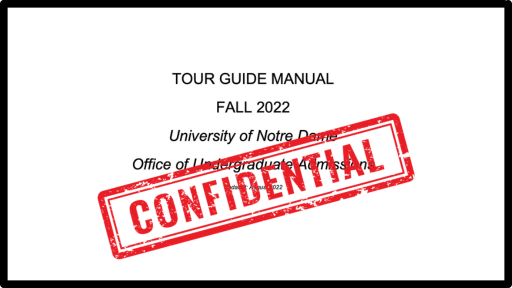
The student referred to a 2022 “Tour Guide Manual,” obtained by the Rover, that was given to every guide by the admissions office. The confidential document contains instructions for tour routes and accompanying scripts.
The manual instructs student guides to open their tours with Notre Dame’s “Spirit of Inclusion” statement, which emphasizes the acceptance of all people, regardless of “color, gender, religion, ethnicity, sexual orientation, social or economic class, and nationality.”
Tour guides are also instructed to give a land acknowledgment as they bring their group to the Log Chapel, a replica of the original chapel built in 1831, which served as the headquarters of missions in northern Indiana. This acknowledgment is noted as mandatory—in contrast with many Catholic elements specified as optional—on the manual: “This land acknowledgement must be mentioned each tour.” The section of the manual discussing the Log Chapel overwhelmingly consists of information on Native American history, with only one bullet point discussing religious activities in the building.
Mentions of Catholicism at Notre Dame in the manual are limited, often emphasizing instead the celebration of other faiths. Specific details tour guides are expected to mention include “interdenominational Christian fellowship,” “non-Catholic faith-based groups,” and celebrations of “other religious traditions,” such as the campus Diwali festival.
Under the “Faith at Notre Dame” section, tour guides are told to “emphasize that faith engagement on campus is unique to each student” and encouraged to share how they have “chosen (or not chosen) to get involved” in faith on campus.
The manual largely fails to devote significant time to aspects of faith in residence halls, such as dorm chapels and priests-in-residence, emphasizing instead the “signature events” hosted by each dorm. The instructions for the Coleman-Morse Center, which houses the Office of Campus Ministry, say, “We want to show pride for our Catholic identity and highlight the ways we celebrate and embrace students from all faith traditions.” The manual mentions the 24-hour study space in Coleman-Morse and the large granite sphere in the lobby, but fails to mention the chapel or the daily adoration available to students.
The former tour guide expressed frustration over these omissions to the Rover: “The only part that mentions Catholicism is in the part of ‘big-letter Catholic’—in the sense of as a Catholic institution and stuff—but also ‘lower-case catholicism’ because it’s also universal and accepts everyone.”
“It’s something that I didn’t really love,” the student added. “Every time they mentioned that the university was Catholic, they tried to make it like, ‘Don’t worry … we’re also a Catholic institution but I swear it’s not enforced.’”
“It really depends on the type of people giving the tour,” the former guide continued. “Most of the people that I knew that were doing tours … faith wasn’t a big part of their life as a student.”
Referring to the training the tour guides received from the Office of Admissions, the student noted, “They don’t really emphasize what I think is more important, which is like, Notre Dame is … a great academic school, it’s a great football school, and it’s also, and most importantly, a great place for you to grow your faith. And at no point in the training … did they tell you to emphasize part of your faith. And I think that’s a problem.”
In the manual, tour guides are reminded to emphasize that “being Catholic is NOT a requirement to go to Notre Dame!” three separate times.
The Rover also attended an information session in McKenna Hall, given by two admissions interns. The students discussed the culture of Catholicism at Notre Dame, referencing the presence of Catholic artwork and statues on campus as proof of the university’s Catholicity.
“Notre Dame is Catholic with a big C and Catholic with a little c,” a student intern told prospective students and their families. “We’re Catholic with the big C in the sense that we are a Catholic university. … We have Catholic values: You’re gonna go on your tour today, and you’re gonna see a statue of Mary, you’re gonna see touchdown Jesus in the library, and you’re gonna see first down Moses as well. We are a very Catholic university.”
“We are also Catholic with little c, meaning universal,” the student intern added. “Not being Catholic should not be a reason why you may not feel accepted here at the university, because we truly are open for everyone. We have one of the largest campus ministry offices in the country that’s open for not only Catholics, but Christians, Muslims, Jewish people, any other religion here as well. We have a Jewish student club … and a Muslim Student Association.”
The student concluded, “We want to make sure that everyone feels very involved and very included here on campus, so that that’s part of our Catholic identity, right? We are Catholic with a big C, and also Catholic with a little c.”
Lucy Spence is a junior from McLean, Virginia majoring in piano performance and the Program of Liberal Studies, with a minor in philosophy. She can be reached at lspence@nd.edu.
Clare DiFranco is a junior from Detroit, Michigan studying accounting and Italian. She can be reached at cdifranc@nd.edu.
Photo Credit: Irish Rover
Subscribe to the Irish Rover here.
Donate to the Irish Rover here.