
Remarks on the Charismatic Catholic Renewal
Cultural Commentary: This piece forms part of the recurring ‘Cultural Commentary’ series, which highlights the perspectives of Notre Dame students on salient issues. To inquire about writing a Cultural Commentary piece, please email ndirishrover@gmail.com.
If these be silent, the stones shall cry out! Thus proclaimed the Christ. But as silence reigns over the waters of what was once Christendom, where shall we find the rocky song? In an age when the Gospel, in all of its radicality, seems foreign to even the pulpit (much more to our sinful hearts), lament is a most seductive temptress. And yet, despite any signs otherwise, the throne of Jesus has surely been established forever and ever—let us therefore be anointed with the oil of gladness! For by turning towards His movements of grace, we stand as a sign of contradiction against this world, proclaiming that our king still reigns. In this spirit of rejoicing, I hope to briefly remark upon the “Catholic Charismatic Renewal” (CCR) as one of the stones crying out to God today.
What should define conservatism? There is only one thing truly worth conserving, and Mary of Bethany found it 2000 years ago at the feet of Jesus. True conservatism seeks the transformation of society and its persons in light of the scriptures and traditions handed down by the body of Christ, which is the Catholic Church. As an outsider peering in, I believe the Catholic Charismatic Renewal, which emphasizes personal conversion through ‘baptism in the Holy Spirit,’ discernment of the charismatic gifts, and a life of constant praise, to be authentically conservative in this sense.
The CCR began when a group of Catholics at Duquesne University encountered the Pentecostalism of the 1960s. The movement quickly spread across America, even championed by Notre Dame, which hosted the CCR’s first international conference in 1971. Understandably, the movement’s unusually Protestant origins have occasioned skepticism among many conservative Catholics. Indeed, a false ecumenism that denigrates Catholicism by hastily elevating Protestant theologies would be truly condemnable. But would we discard the tabernacle simply because it was made with Egyptian gold? Rather, since the head of our Church is Jesus Christ, who purchased the cosmos by the price of his blood, we ought to readily claim all good things as belonging first and foremost to Catholicism. Then, wiping off the dirt of the world, we may discover their underlying truths and elevate them to their proper ends. Perhaps, by distributing some graces among Pentecostal Protestants, God invites the Catholic Church to bring to fulfillment what Protestantism can only initiate, thereby showcasing the Church’s majesty and inviting the lost sheep to come into the fold.
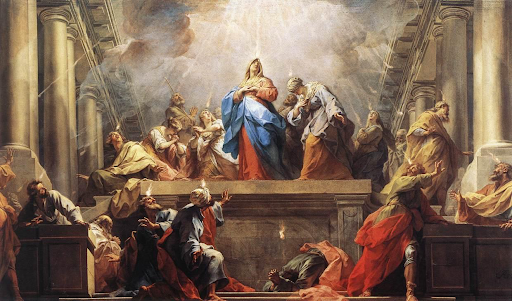
In what way is the Catholic Charismatic Renewal a genuine expression of the faith of our fathers? Christianity has been a religion of Pentecost since, well, the Pentecost. The centrality of the Holy Spirit, who is our gateway to participation in divine life, defined the apostolic, patristic, and medieval ages. In each of these periods, the Spirit manifested God’s power through the charismatic gifts—those graces which equip the saints for the building up of the body of Christ. In fact, the Catholic Church has consistently defended the ongoing and regular occurrence of miracles (continuationism) against Reformed Protestantism, which historically denied the continued presence of spiritual gifts (cessationism). Is it absurd then when Catholics behave accordingly, boldly praying God to work miracles today?
Where else can we find continuity between old and new? Look to the lives of saints like Norbert and Ignatius, and you will see the Spirit bringing about profound conversions among the already-baptized (an experience charismatics term ‘baptism in the Holy Spirit’). Examine contemporary praise and worship music, typical but not essential to the CCR, and you will find parallels in the patristic emphasis on vocal prayer. Find someone to pray over you, and you will encounter the horizontal communion so important in the early Church. Of course, the CCR comes dressed in novel garments, distinct from what has come before. The Lord is indeed doing a new thing, but He nevertheless remains the same Lord who was the encouragement of the martyrs, the wisdom of the scholastics, and the spouse of the mystics. Thus, enduring truths find new breath, giving birth to ‘living tradition.’
The clearest sign of this movement’s legitimacy is the plentiful fruit its vineyard seems to bear. I have personally witnessed the CCR profoundly transform the lives of those around me, drawing them into a profound, personal relationship with Jesus. Some of the most devout priests, parents, religious, and young people I have ever met are immersed in this renewal. I have been impressed and inspired by their rejection of mediocrity, detachment from sin, love of poverty, practice of fasting, profound lives of prayer, charity towards neighbor, fiery thirst for souls, rearing of large families, generosity in vocations, and boldness in gospel piety. These are the fruits God desires to work in every Christian, without exception, and are evidence of the authentic work of the Holy Spirit. It seems hard to dispute that, in these charismatic communities, there abound Catholics full of faith, hope, and love, transformed by the loving gaze of the Most Holy Trinity.
None of this is to say that charismatic communities don’t have their problems; we sons and daughters of Adam always seem to find a way to sin. Nor should an appraisal of charismatic Catholicism preclude essential elements of Catholic theology. This danger is most pronounced in the Mass, which should prioritize the liturgical heritage of the Church, not the charismatic devotion of the lay faithful. Nevertheless, all facets of the Church come with their imperfections, and if the CCR is a holy expression of Catholic theological life, then it ought to be commended and shepherded.
The charismatic movement, as a revived expression of the perennial faith, will also benefit from conversation with the growing traditionalist movement, and vice versa. Indeed, the “traditionalist renewal” is another fruit of the Holy Spirit. Therefore, united by one Paraclete, charismaticism and traditionalism need not be opposed as foils, but may grow together as organic complements. They are both “stones” that the Lord has raised up to “cry out” in this silent age; both of them deserve our appreciation. Some will be more attracted to one or the other, but both find their ultimate validity in glorifying Christ and promoting radical gospel living. The rise of so-called “Tradismatic Trentecostalism” is especially notable. This phenomenon highlights the catholicity of Catholicism, which asks us to be open to the legitimate manifestations of the Holy Spirit in their great diversity. The Charismatic Catholic Renewal is an opportunity for conservative Catholics to rejoice. Rejoice, O Jerusalem, rejoice! Your king reigns forever.
Benjamin Moskalski, current graduate student of the Notre Dame MTS, grew up in a small town outside Charlottesville, Virginia. He is deathly afraid of ice skating. Benjamin can be reached at bmoskals@nd.edu.
Photo Credit: Wikimedia Commons
Subscribe to the Irish Rover here.
Donate to the Irish Rover here.