
A reflection on the progression of society
Cultural Commentary: This piece forms part of the recurring ‘Cultural Commentary’ series, which highlights the perspectives of Notre Dame students on salient issues. To inquire about writing a Cultural Commentary piece, please email ndirishrover@gmail.com.
You were once born. In fact, even earlier than that, you were conceived. You probably do not remember this, but this is not sufficient grounds to reject the idea outright. I confess that I cannot offer you sufficient proof that you were first conceived and then born, but allow me to assure you that this did indeed occur. When you were conceived, you were alive for the first time ever—splendid!—but in the exact same moment, you became dependent. In your unicellular form, your survival depended upon the nutrients and protection supplied to you by your mother’s womb. You were distinct, but literally tethered to the walls that surrounded you through the umbilical cord. Your life, simply by beginning, had become a metaphor of dependence.
You were then, as I say, born, but your dependence on your mother did not change. Children do not know they are distinct beings from their mother until around their sixth month ex utero. You remained wholly and solely dependent on your mother. In fact, you still knew nothing but this utter dependence. Yet your mother, too, was dependent, especially in her postpartum period. Ideally, this period would be punctuated by the presence of a generous and caring husband, a present and doting mother, and other equally loving family members. In supporting you, your mother relied heavily on those around her.
Yet this dependence was not novel on your account—it was simply reiterated by your being born which, I would like to restate, did occur. Prior to your birth, prior to your very existence, she had also been dependent. If she worked, she was dependent on the company she worked for, on the means of her commute, on her coworkers; if she was at home, she was dependent on her husband, who was himself dependent on his job and its requisite dependencies. Your mother and father both depended on the roof above their heads, the roads beneath their feet, their friends, their family, their possessions (do I not depend on my laptop in writing this commentary?)—the list goes on.
The astute reader, such as yourself, may feel disinclined to simply accept what I am implying—namely, that a child is as dependent as his mother. Practically, this does not seem to make sense and you, dear reader, may believe that I, the writer, have spent too long in my ivory tower and should “touch grass.” This is a valid critique, but I hope that, by defining what I mean by dependence, you will indulge my abstract meanderings. Dependence is the name we give to our relationship with causality in society, i.e.: our relationship with causes as they progress from beginning to end. You, as well as I, were born in media res with respect to time. Causes from before we were conceived affected us after we were conceived, and causality will persist after we perish: We are entirely subject to causes generated outside of ourselves. Causality, and its requisite temporality, underscore and support our objective mode of existing—could you imagine a world in which causality did not exist? When I speak of dependence, however, I am not attempting to engage fundamental realities of the cosmos: I am referring to a particular form of this causal dependence. Specifically, it is our dependence on human causes in the context of society. As a member of society yourself, and as I have already discussed, you stand atop roads that were caused, in buildings that were caused, own goods and procure services—all of which were caused. We stand on the shoulders of giants, but all giants stand upon causality.
I could belabour the definition of dependence, as well as its proof, but I think I have argued sufficiently to claim that you are dependent. So am I (I do not claim to be above you). Yet we frequently speak of being “independent” and, even more worryingly, we speak of it positively—why? When we speak in this way, we are generally only speaking relatively—I am now independent from my parents, for example, so I can drink with impunity (a frame of mind tragically repeated every autumn on college campuses). Perhaps independence derives itself from the will. In our example, our soon-to-be-debaucherous eighteen-year-old can now, in his mind, will his own desires with perfect clarity; hooray! But you cannot will yourself out of dependence—you are, as we have illustrated, entirely bound within a web of dependence, a web that defines society writ large. This is not a bad thing; on the contrary, the exercise of your will is greatly strengthened by this dependence—you are dependent on everyone, but so, too, is everyone dependent on you. In other words, the societal space in which the will moves is dependence itself—we do not mean to say we have an independent will, because we do not mean to say we have an impotent will.
The tradeoff of this strong, societal will, as we have already established, is that you are subject to the world around you. At any and every moment, we may be acting on the world, but the world is acting on us. We like acting on the world—it is a show of strength, a rite of passage, a manifestation of our inner self—and we don’t mind the world acting on us in a way that accords with our inner self (or at least, how we perceive ourselves), but we detest the world acting on us contrary to ourselves. We do not want to be changed, we want to be the agent of change. This inner revulsion is shared throughout society, because this dependence is shared throughout society.
We rail against the exterior aspect of this dependence in unison, but we cannot decide how to annul it—all we know is that the oppression of dependence exists presently, in the now. It stands to reason that we strive to look to some other time, whether it be a time past or a time to come; through a sly application of imaginative synthesis, we can conceive of a world, derived from either past or future, which does not have the dependencies which plague our present. This application is sly because it is dishonest. We suppose that we could not conceivably imagine a world outside of our experience, an experience defined by the exercise of our will, but we are more than willing to imagine a world without the requisite dependencies of will. To abstract will from its dependencies is as plausible as extracting ourselves from our experience. Both are mere products of the imagination.
This desire to alienate ourselves from the present pervades society, yet it is not only a delusional desire but an extremely divisive one—people devote their entire lives to convincing others that one form of the delusion is superior to another one. These divisions result in two groups. One group views the past to be as evil as the present, and desires the future; we call these people ‘liberals.’ The other views the future to be as evil as the present, and desires the past; we call these people ‘conservatives.’ Both wear rose-tinted glasses; the conservative whilst looking at the past, and the liberal whilst looking at the future. Ultimately, however, when you view as good or evil is arbitrary. You could view all times as evil, or all as good, and it would not matter—only your opinions on the present would be of any consequence.
If we accept the liberal and conservative as two sides of the same delusion, and do not wish to be ideologically delusional, then we must content ourselves with living and operating in the present. It is true that there are only dependencies in the present, and they can be painful, but happiness also only exists in the present (neither memory of happiness nor hope for happiness will make you happy). This concurrence between dependency and happiness leaves us two options: they must either be resolved or the dependencies will annihilate happiness. This resolution is peace with dependency, finding happiness within dependency. This is the project of a lifetime, and not one for me to expand upon here. Our current political situation is divided on either side of delusion, a delusion to which we continually orient ourselves. Because of this, I find myself extremely perturbed, and cannot help but to ask the question: Where are we, as a polity, actually going?
Rafael Llull is a senior studying in the Program of Liberal Studies. His article can be accurately summarised in a few words by none other than Master Oogway: “Yesterday is history, tomorrow is a mystery, and today is a gift…that’s why they call it present.” Feel free to praise or criticise his pop culture reference at rllull@nd.edu.
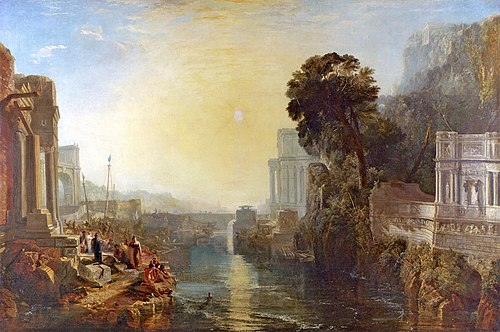
Photo Credit: “Dido building Carthage” by J.M.W Turner, 1815
Subscribe to the Irish Rover here.
Donate to the Irish Rover here.