
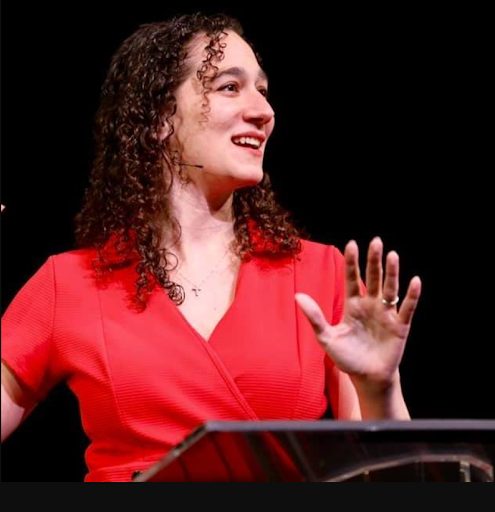
Leah Sargeant on the dependence that marks us all
Leah Sargeant is a mother, wife, writer, and public policy analyst in Washington, D.C. Her book The Dignity of Dependence: A Feminist Manifesto was recently published in Fall 2025 with Notre Dame Press.
Could you give a brief synopsis of The Dignity of Dependence?
My book has two ideas at the heart of it: that women’s equality with men does not depend on our being interchangeable with men, and that the natural state of what it means to be a human being is to be dependent, not to be autonomous.
How did you decide on the title?
Dignity was a word I got push-back on from my agent. Not because he didn’t like it, but because he was worried dignity signaled too hard that this is a book for Catholics only, and would narrow the potential audience. Obviously, I agree that our dignity is grounded in our identity in Christ. Yet, I think the word dignity points to something outside ourselves for a lot of people—versus, for example, the language of rights. I think people are more comfortable with something that can be done in a purely secular, non-philosophical way, which I think is weird personally, but it’s easier for some.
Dependence. This is the one I actually got push-back on at the conference in response to my book, because I think people are more comfortable with the idea of interdependence. But what I’m trying to do is write a book that you can read in good health, and also that will give you something to hold on to in the moments of profound vulnerability, bad health, dying, pregnancy, et cetera. The word interdependence just doesn’t do a good enough job. It’s always grounded in that hope of “But I will get better. I will do things for other people, and then I’ll finally be human.” That’s not a promise any of us have made. Some people are just profoundly dependent their whole life. Some of us hit a point in our life where there aren’t going to be any more returns to strength. I wanted “dependence” to make it clear this book is meant to carry you through those most vulnerable times.
Feminist. I think that, at its core, feminism is about how to be just to women in respect of our being women, given that we are not generic human beings. I view myself as part of that project, and I think it’s borne a lot of good fruit—some fruit I disagree with, but there’s enough in the lineage that I want to be a part of it.
And “manifesto” just warns you that the book has very strong opinions, and you’re going to disagree with parts of it, in case the rest of the title wasn’t clear.
What about the topic of dependence first interested you?
In one interview, someone asked me if I wrote books that are about why I’m wrong. Yes, I do! I wrote a book about converting and learning to pray, which was a response to my being wrong about God. I wrote a book about hospitality and building community, which was a result of my being more idea-oriented than people-oriented, and both needing to correct that. I myself don’t particularly like being weak or needing other people.
I like to glory in my own strength. So I wrote a whole book to try and fix this, and it’s partly because there’s nothing wrong with strength. Strength is something we’re given as a gift to spend for others. But there will always be a moment for each of us where we reach the end of what we can do, lifted up only by our own strength. You can reach that because of your own illness or weakness or debility, or just because your love exceeds your strength, and we have to be comfortable accepting help from others.
How has your vision of dependence changed throughout writing the book?
I think a lot of it is trying to braid different ideas together. The paradigmatic example throughout the book is pregnancy, because that’s the specific form of openness to another’s needs that’s distinctively female. Taking a generically human approach to life means you will shortchange women, because this isn’t something that is shared by men. And then it’s about looking to where you have moments that are also about exposure to need, or exposure of your own needs.
Where this example is so fruitful is the image of a mother brought up by the Church Fathers. We all can look to this image to guide our life. St. Augustine urges us to become mothers of Christ by bringing people to new birth in baptism, as maternity is a moment of love that makes you vulnerable as you care for someone’s need. The goal of my book is to show how this idea is not so alien to everyone else.
How do you see men fitting into the vision of dependence?
I’ll say two ways I see it. The first is that everyone is dependent by virtue of being a human being. You start very dependent as a baby, most of us are very dependent as we die, and then you’ve got dependency dappled all through the middle. One way you can think of it is, how long will it be until I’m “caught” being a human being, and not an imaginary, autonomous person? Even a man who is in good health will get “caught” too, though he is forced to this recognition later than women.
There are also paradigmatic ways that men and women specifically extend their bodies over someone else in love. For women, it’s pregnancy, where you give your body over to your baby as a way to sustain and protect them. And for men, it’s more often physical: you’re standing between your family in danger, domestically in war, or against the danger of hunger by working. It’s important to recognize that the most common invitations are less common, but the need is still there. Men are still needed in peacetime and prosperity, because if men can’t put their strength at the service of someone else, what are men for? How do we make room for men to rush toward others, to apply their excess strength in love for others? The more we default to hiring someone to put something together, hiring someone to build something rather than turning to our community, we miss out on opportunities to look at that repair on the shed every day, and think, “My neighbor did this for me.”
I also think that pregnancy is, in some ways, still the paradigmatic way that men get to urgently lend their strength to someone who needs them. Having a baby makes me weak in the service of someone else who is weak, and I need more and different things from my husband during that time. But with marriage becoming less common, with childbirth happening later in life, that’s a longer range of time when a man who wants to be a dad doesn’t get to help in that particular, intimate way.
How can college students create a greater culture of dependence, especially when it’s so easy to live an autonomous life?
I’ll give two pieces of advice, one that’s more institutional and one that’s more individual. I think it’s good, though uncommon, for schools to co-locate pre-schools and nursing homes on campus. In this weird moment where you get this very age-stratified social group, you have an invitation to think about what else is coming in your life.
The other thing for countering individualism is making yourself more vulnerable. Take on bigger, more ambitious projects. Do something that might fail, where you’re going to have to call someone and ask for help. For me in college, that was often theater. There will be moments of crisis where you have to drop everything to help someone else, or you will have to grab whoever’s nearby for help yourself. I had to get three stitches when I worked on Romeo and Juliet my freshman year—you don’t have to lean into that part. But if you take on something weird with other people, you find yourselves over your skis very quickly, and that’s good.
What advice would you give to ambitious young people, like those at Notre Dame, who might struggle to live the vision of dependence you’re proposing?
It is good to develop the talents you’ve been given, and it’s good to think of yourself as a steward of these talents, and not the owner. Ambition is good when it’s directed towards the idea that God has given me gifts, and I’ve got to find a way to put them to work. If He’s given me this intellect, then there’s a way I’m meant to serve people with this intellect, which is different than “I need to win this particular award.” But I don’t want to counsel people away from ambition or excitement about developing what God has given you.
I think the other thing that goes with this is you need a sense of freedom when your plans don’t work out. One of the places that this can be found is the stories of the martyrs. A story that really struck me is about a priest in Iraq who was captured by ISIS. Even while he was imprisoned, he said that he was freer than his captors. He was free to pray, and he had this peace in God that was apparent even to his captors, as they would even ask for advice about their marriages or ask him to pray for them.
Obviously that’s not the same thing as not getting the job I wanted, but I think, even in those moments there’s something to learn from a man in prison, under threat of death, who is radically free because he dwells in God. I am also free in that way. I’m free to do good, even if a particular way is closed, because I’m free to pray. I’m always free to love other people. For me, that gives a sense of incredible freedom of action. Many doors can close, and yet this one critical door of the heart remains open.
Do you have any impactful stories you can share about when you’ve been served by others in your own dependence?
When I was at the fall conference two years ago, I developed an infection in my leg without knowing it. Within a couple days of getting home, it was painful to walk, and I knew I needed to go to the ER for a small surgery. Though I knew it was something my family could easily get through, people in our neighborhood knew I needed help because I’d been asking for rides, and offered to bring dinner and set up a small meal train. We wouldn’t even have thought to ask, but I was really grateful for them—both the help I had asked for and the fact that I had asked for help would cause such a thing.
What does it mean to you to be pro-life?
There’s a beautiful essay a friend of mine wrote in college about how being pro-life meant providing the freedom to fail. Making people feel free to carry to term in hard circumstances doesn’t just mean telling them everything will work out—because it won’t. It means saying that yes, some things in your life may break as a result of this. Some projects you have will fall apart. But we will be here to help cushion the fall. We aren’t going to tell you the untruth that a baby won’t disrupt anything. A baby is going to break some stuff that’s part of your routine or your expectations. But we will help pick up the pieces and make it something new.
I think there can be a tendency for pro-lifers to point to instances like “this person took one year off school, but then was valedictorian”—the kind of success stories that you can almost grudge someone with. I think it’s good to say, yes, when you welcome an unplanned baby in hard circumstances, the odds are not that your near term future will look successful in a worldly sense. But what it should look like is a lot of people rushing forward to help.
Another big thing for students to think about is the coming apart of the genders that’s happening right now. The truth that needs to be told is that men and women can be different without that meaning that one is lesser. The fear that you can’t talk about differences without ultimately providing ammunition to degrade women or degrade men makes it harder for men and women to love each other or serve each other, and people really need the hope that it is possible to talk frankly about differences without contempt for either.
What does a successful life look like for you?
I used to be a stoic before, and the bit that I still hold on to today is asking what is within my locus of control. There are things I have control over, and they’re mostly internal things about how I respond to the world, what I choose to take on, promises I choose to make, and how I discharge them. But I don’t have total control over my family’s material prosperity, though I can adjust the odds, and I certainly don’t have total control over my physical health, as I found out the last time I was at Notre Dame.
So when I think to my kids and what I want in their lives, what’s most important to me is that they be saints. I love Meg Hunter-Kilmer, who paints an incredibly varied portrait of saints, saying that as long as we cooperate with God’s will and return his love, God can make us saints—whether we’re rich or poor, strong or weak, healthy or very short lived.
Who are some of your favorite saints?
I picked St Augustine as my confirmation saint, in part because of his temptation to Manichaeanism, as I had this sense of wanting to be engaged with the intellectual world and also wanting to transcend the physical world. He had this impulse too, and then had to squash it, so I thought he would be well disposed to help me.
I also love St. Rafael Arnaiz Baron, who is a Trappist saint who couldn’t make full vows because he was too sick. This then raised the question for him: what is my vocation? I’ve come here to give my life to God, and I’m not being allowed to make that gift in the way I anticipated. Though he died young, he’s a saint because he gave his whole life.
St. Rafael has this beautiful story where he’s peeling vegetables in the monastery kitchen and is bedeviled by thoughts that he could be doing something useful and he’s never going anywhere. The answer from the depths of his heart was simple: I am peeling vegetables for the love of Jesus Christ. I will make a vegetable market of heaven.
That’s what I love, in terms of each of us—that wherever we are, if we do whatever we’re doing for God’s sake, it can be sanctified. It’s a big theme in Opus Dei too, that you set the table for the love of God. And I think that answers some questions people have about vocation or work. Whichever job you take, you are free to act out of love.
How has being a mom changed the way that you view dependence?
I think my perspective was most changed during the time before my oldest child was born. Being a mom who didn’t get to meet many of my children because I lost them repeatedly to miscarriage was a very hard, but real, tutorial in what it means to love someone who you won’t get to do the things you want with, who is very weak, and who can’t meet face to face, but who is a person, and who you are invited to love totally as their mother. I try now to hold on as much as I can in loving my children as they grow and change, and having this incredible sense of gratitude and curiosity about them, because I didn’t get to see that story unfold for their brothers or sisters. But who they are is the same kind of person, this person I’m entrusted with by God, known deeply by God, and somewhat mysterious to me, even when they’re five.
Could you say more about how your kids have either inspired your book or your general philosophical outlook?
There’s a bit I have at the very end of the book where I’m pregnant with my second, and I have to squash in my kids. I always have to caution my kids to be gentle, saying that I’m slower, and that I can’t do things as comfortably while I’m pregnant. Since everything about being a small child is wanting to get bigger, my oldest was like, “You can’t do things? But you’re so big!” I loved that.
I also love the awe that children have for babies. My second-born child, when we brought our third home from the hospital, loved him. She’s all over him still, to this day. She looked at him, and then she just laid down on the floor and immediately fell asleep. I think she was overwhelmed emotionally by meeting him, since she was so happy and loved him so much. There’s such a beautiful way in which children are so unembarrassed by how much they love people. We see this in the saints and their ecstasies, in that they fall asleep because it’s exhausting to love someone this much. But for kids, there’s no defensiveness of “I can’t let anyone see how moved I am.” I’m trying to catch that from my kids as best I can.
In what ways do you think your book would have been different if you weren’t approaching it from a Catholic perspective?
I think there’s a turn or a volta in the book in “The Blessings of Burdens” chapter. Up till then, I am more making the case of “you are dependent, you have to acknowledge this because it is true, and you might not want it to be true.”
But the more you try and work against the grain of human reality, the more you don’t secretly become autonomous. You just develop painful compromises to hide your dependence. Chapter Seven is making the case that, not only are you not autonomous, but also that it’s good that you aren’t autonomous. Don’t hope for this!
While I think you can make that argument for dependence as a non-Catholic, you definitely have to make it as a Catholic. There’s no way out, because we are people who are dependent on God for our salvation, for being loved and to be. You could be someone who’s secular, who resents embodiment, but is realistic about it, and says resenting it moment to moment isn’t helpful. But you can’t be a Catholic and resent dependence, because you’re poisoning your love for God.
How has discovering your own dependence shaped your prayer and relationship with God?
The image of maternity is something we all participate in—men or women—because we all have a mother and are carried by her. In pregnancy, you may not know the gender of your baby, you don’t know what their personality is, but you love them simply because they are. And then after birth again, there are some parts of a child’s personality that come out, but mostly you love them because they exist, and certainly not because they’re doing things for you or repaying you.
I think it’s easy to fall into the trap of thinking: how can I pay God back so that I’m not in His debt, or how God could love me if I don’t do anything for Him? Even though it’s not perfectly analogous, the experience of being loved as infants is our tutorial in being loved simply for being, and reminds us that God does not love us for what we can do for him. He loves us because we are. Of course, the tricky thing is, none of us remember being loved as infants, which is a nice thing about living in a culture where there are babies—you get to kind of spy on people and say, “That’s how I was loved.”
Elizabeth Mitchell is a junior in the Program of Liberal Studies and theology. She can be reached at emitche8@nd.edu.
Photo Credit: Word on Fire
Subscribe to the Irish Rover here.
Donate to the Irish Rover here.