
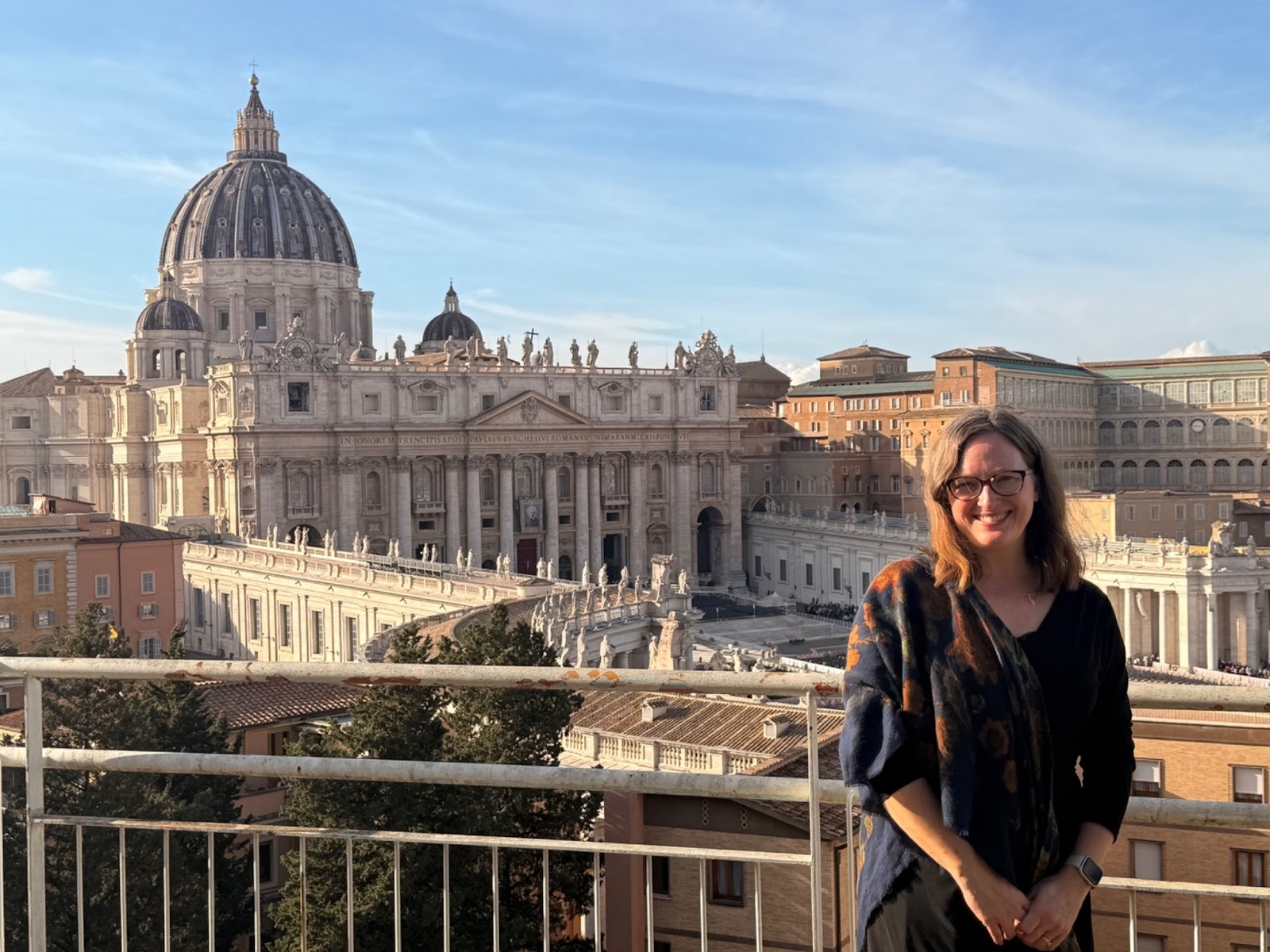
Jennifer Newsome Martin contributes to positio
Pilgrims from around the world packed into St. Peter’s Square in Rome on November 1, the Solemnity of All Saints Day, to witness the designation of St. John Henry Newman as the 38th Doctor of the Church. The faithful included many students and educators who had gathered for the 2025 Jubilee of the World of Education.
During the Mass celebrated by Pope Leo XIV, Newman was designated a Doctor of the Church and named the official co-patron saint of Catholic education, alongside St. Thomas Aquinas.
Newman, a convert from Anglicanism, was an English priest, writer, and theologian of the 19th century who was canonized by Pope Francis in 2019. His writings compass a variety of topics, including education and the university, making him a beloved saint among Catholic educators and students.
There are three requirements for receiving the title of Doctor of the Church: A candidate must be a theologian of eminent learning and doctrine, possess a high degree of personal holiness (including being canonized a saint), and formally be declared a Doctor by the Church.
During the process for Newman’s elevation to Doctor of the Universal Church, scholars from around the world were eager to aid the cause by contributing to a positio, the set of writings which defend the case for a proposed Doctor by establishing his impact on the Church. Submission of the positio is the final step in the process of naming a Doctor of the Church.
Among the Newman scholars invited to contribute to the positio was Dr. Jennifer Newsome Martin, concurrent professor of theology and the Program of Liberal Studies at Notre Dame, and the director of the de Nicola Center for Ethics and Culture (dCEC). Martin wrote a chapter of the positio, coordinating her work with the National Institute for Newman Studies (NINS) in the United States and Fr. George Bowen, the formal Postulator for the cause.
Contributing to such an important document is not only an admirable task, but a high honor for any academic. Martin was one of only 20 scholars who compiled the section elaborating on Newman’s “Eminent Doctrine.” She described her work to the Rover, saying, “My own contribution was a chapter on Newman’s understanding of the sensus fidei, or sensus fidelium (sense of the faithful), that communal ecclesial ‘instinct’ which allows individual believers and the Church as a body to recognize the truths of the faith.”
She continued, “The development of Newman’s doctrine of the sensus fidelium is also closely related to his theology of the laity, which deeply informed the way in which the documents of the Second Vatican Council spoke of the role of the laity in the Church.”
Martin was present for the formal declaratio on November 1 by which Pope Leo XIV declared Newman a Doctor of the Universal Church. The day before, the dCEC had co-sponsored an academic symposium in Rome at the Pontifical Gregorian University alongside NINS.
According to Martin, attendees at the symposium “heard scholarly papers from Newman specialists with simultaneous translation in English and Italian in the morning, and had short presentations from nearly all of the theologians and philosophers who contributed to the positio in the afternoon. … The whole event had the air of joyful, holy celebration.”
On a personal level, Martin spoke of Newman as being instrumental in her own conversion from Protestantism in 2005. In the years since, her appreciation for his writings has only grown. She said, “I admire Newman’s capacity to write beautifully and clearly across many different genres—philosophy, theology, poetry, hymns, novels, sermons, and so forth—and I was compelled by the clarity of his mind which comes through without sacrificing lyricism. His homilies are absolutely extraordinary, both in terms of pastoral content and the highest possible levels of sophistication and aesthetic value.”
Martin told the Rover, “[Newman’s] vision of Catholic liberal education in Idea of University has been enormously influential upon my own teaching and conception of what it means to educate and to be educated: that is, as oriented singularly toward the cultivation of the intellect and the development of what Newman calls a ‘philosophical habit of mind.’”
Martin also emphasized the importance and relevance of Newman’s writings, especially those on education, to the Church today. Newman, she said, “has the capacity to speak across a number of arenas which would be of interest to young people and to Notre Dame students in particular.”
She continued, “I think his high vision of what education is for—on the one hand, the authentic cultivation of the intellect and a philosophical habit of mind (the university principle), and, on the other, the shaping of virtuous moral and character development (the collegiate principle)—speaks well to the integral holistic formation which animates the Holy Cross pedagogical tradition here at Notre Dame and across our tri-campus area.”
Abby Strelow is a sophomore majoring in PLS and theology. She spent fall break painting a watercolor timeline of the Roman Empire, a project she later realized was extraordinarily nerdy. Send her life advice or new niche project ideas at astrelow@nd.edu.
Photo Credit: Jennifer Newsome Martin
Subscribe to the Irish Rover here.
Donate to the Irish Rover here.