
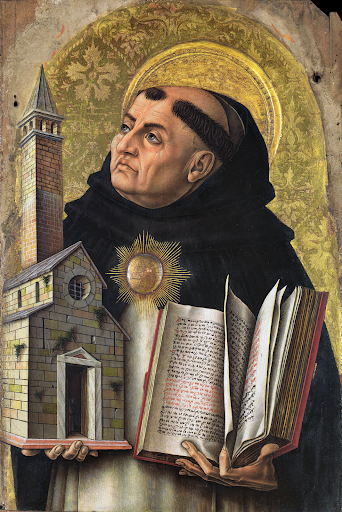
Notre Dame professor reflects on Aquinas’ legacy
In anticipation of St. Thomas Aquinas’ feast day on January 28, the Rover sat down with Jean Porter, Professor Emeritus of Theology, to discuss Aquinas’ philosophy of natural law and justice.
Porter emphasized the importance of reading Aquinas in his historical, scholastic context. She told the Rover, “The best way to approach Aquinas is not to start with his theory but to start with what he’s working with. Aquinas is working within the context of a lot of people who are all trying to bring about some degree of harmony, some degree of intelligibility to traditions that they have from Scripture, classical sources, and patristic sources.”
Porter’s encounter with Aquinas began incidentally when she found him widely cited while pursuing her Ph.D. in Religious Studies at Yale. She began reading Aquinas directly, comparing his texts to how they were often portrayed. She recalled her thought process: “At a certain point, I said, ‘Why am I reading all these other people when I could actually be reading Aquinas?’” Since then, Porter has published numerous works on Aquinas’ theology of ethics.
Reflecting on the concepts that influenced Aquinas, Porter commented, “Gratian, who is the so-called father of canon law, starts his work [saying that] natural law is that which we find in the law of the Gospel, which is to do to others what you would have others do unto you. So there’s a precept. Aquinas goes in the direction that [natural law] isn’t this precept. It’s the principle behind it, which is reason.”
Porter explained that, for Aquinas, natural law is not arbitrary but in fact can be identified with reason, saying, “[Aquinas] says the first principle of natural law is that good is to be sought and done and evil is to be avoided. This is also the first principle of virtue … and the first principle of practical reasoning. That’s not the whole of the natural law, but that’s the key to understanding and integrating the different ways of thinking about the natural law.”
Along with explaining Thomistic principles like natural law, Porter also illustrated how Aquinas’ thought has practical relevance. “Justice for [Aquinas] is the cardinal virtue, which brings into order and provides a normative standard for our relations to both neighbors and to God,” she explained.
According to Porter, Aquinas’ thought also provides a standard for what we owe each other. Porter said, “Aquinas accepts Justinian’s basic definition of justice as a constant and perpetual will rendering to each that which is his right. What does it mean to do justice in relations between individuals? Well, it means to preserve an equality of exchange.”
Porter clarified what this “equality of exchange” means, saying, “In some cases, this is easy to understand. Aristotle’s basic understanding is that you go to the merchant and buy something. You agree on a price, and you make an exchange. Not so easy to understand is if I steal something from you. Our relation has become unequal. I’ve been able to force my will on you without your consent.”
Porter elaborated on the Thomistic idea of atonement after wrongdoing, saying, “In order for this relationship to be restored and for justice to be done, I have to, first of all, make restitution. Secondly, there has to be some way in which we equalize our status. Maybe that’s through punishment. Maybe that’s through some kind of act of contrition.”
As debates over law and justice continue to shape life today, Porter’s reading of Aquinas suggests that his relevance has not faded. By grounding justice in reason, Aquinas offers a framework that, according to Porter, remains capable of clarifying what we owe one another today.
Matthew Mrosla is a sophomore studying philosophy, theology, and the Program of Liberal Studies. If you can prove that we aren’t living in a simulation, he would be very happy to be cured of his current bout of techno-solipsism. Help him find out just how deep the rabbit hole goes at mmrosla@nd.edu.
Photo Credit: Wikipedia
Subscribe to the Irish Rover here.
Donate to the Irish Rover here.