
Military aggression accompanies destructive overfishing
The fishing industry has long been an integral source of economic gain for many coastal nations. China has recently imposed its force on global markets through violations of water domain and overfishing in international waters, thereby depleting natural resources and creating economic strain for other countries. These actions occur amid China’s growing aggression toward South Asian nations such as Taiwan.
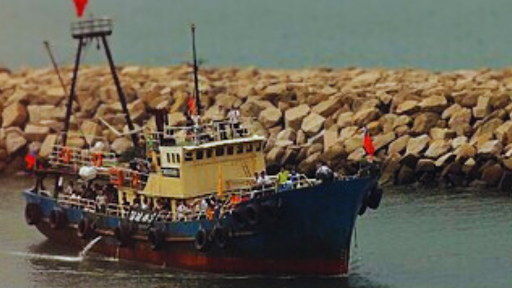
Chinese fishing boats have been spotted overfishing in Latin American and West African waters. They will deliberately turn off tracking systems so as to enter other countries’ domains and trespass into their waters. Destructive fishing practices damage marine life and the ocean floor, causing those waters to become uninhabitable. These practices can weaken or collapse certain seafood industries.
China’s lack of concern for natural resources is not a novel phenomenon. Over the last two decades, it has been depleting fish stocks in its own oceans and near other countries’ territorial waters.
China’s overfishing is not only an environmental issue, but a security issue as well. As Professor of Political Science Victoria Hui explained to the Rover, “The issue is not merely fishing, but the systematic denial of other states’ lawful use of their exclusive economic zones through China’s claim over nearly all waters within the nine-dash line.”
China has also taken more aggressive action in South Asia. According to Hui, “This has included direct interference with Vietnam’s offshore energy activities, including the cutting of survey cables, and obstruction of oil and gas exploration infrastructure. Beyond maritime pressure, China has also constructed numerous upstream dams—many major Southeast Asian rivers originate on the Tibetan plateau—thereby constraining water and resource access for downstream countries.”
Hui suggests the activity is a violation of lawful water territory, pointing to recent fishing boats’ activity as a gradual strangulation of Taiwan’s economy. This pressure on Taiwan specifically could further tensions in the region, according to Hui, and be debilitating for countries that rely on the industry.
Foreign policy experts have warned that China’s control over these civilian vessels could escalate tensions between China and Taiwan. The New York Times estimated that China “could mobilize tens of thousands of civilian ships, including fishing boats, to clog sea lanes and complicate military and supply operations of its opponents.”
China has also continued its military aggression toward Taiwan. On December 29 and 30, China conducted a military exercise titled “Justice Mission 2025.” This was the second naval exercise carried out near Taiwan in 2025. The exercise included the practice of aerial and naval blockades. According to Taiwan President Lai Ching-te, Taiwan remains committed to keeping peace in the region. In late December, President Trump, though he was not informed by China of the military exercise, pointed to a strong and stable relationship with Chinese President Xi Jinping. He did not express concern about potential attacks on Taiwan.
An undergraduate fellow in the Notre Dame International Security Center was more concerned by the exercises than President Trump, telling the Rover, “This looks like another effort by China to build real operational capability by simulating activities that would occur in the opening stages of a Taiwan invasion.”
“They are normalizing these actions in the same way they normalized violations of Taiwan’s air defense identification zone and territorial sea in the past few years. Given the dual-use nature of China’s civilian fishing fleet, it shouldn’t be surprising that they are practicing mobilizations at this scale, although it should still be pretty concerning,” he concluded.
Kevin Andrews is a junior in Keough Hall, majoring in political science and economics. He can be reached at kandrew6@nd.edu.
Photo Credit: Wikipedia
Subscribe to the Irish Rover here.
Donate to the Irish Rover here.