
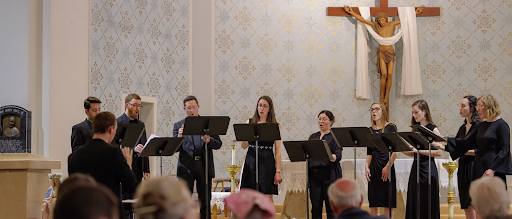
St. Hildegard Project seeks to renew liturgical music landscape
Within the suburbs of South Bend is an assemblage of musicians with a sacred mission. The St. Hildegard Project, a non-profit choral organization, aims to cultivate the Roman Catholic sacred music tradition through liturgical ministry, performances, and outreach.
Jerome Cole, the founder and executive director of the St. Hildegard Project, told the Rover that the ensemble seeks “to share the rich treasury of the Church’s sacred music through teaching and performance.” Cole, who also serves as the music director of St. Joseph Catholic Church in Mishawaka, founded the project in 2022.
Initially a small choir of half a dozen voices, the project has expanded since its inception to include sixteen singers. A wide range of people from the South Bend community, including Notre Dame faculty and staff, are involved in the project.
In addition to their daily endeavors directing music for local parishes, completing graduate coursework, attending Moreau Seminary, parenting, and teaching at Notre Dame, Holy Cross, and other local schools, the ensemble members provide music for numerous Catholic liturgies and perform three concerts annually. They host workshops around the diocese and have also been invited to share their music at the de Nicola Center Fall Conference for the past several years.
Daniel Tucker, who serves as the choir’s artistic director and the director of liturgical music at the Cathedral of St. Matthew, wrote to the Rover that the St. Hildegard Project is centered around prayer, not performance.
“Most importantly, I think [the project is] to provide music for the sacred liturgy,” he explained. “The liturgy—Mass, Vespers, et cetera.—is our music’s ‘natural habitat,’ and we much prefer singing for liturgy to singing at a concert, as fun as the concerts can be.”
Tucker continued, “We serve the community by passing on to the rest of the faithful the Church’s treasury of sacred music (principally Gregorian chant, and also Renaissance polyphony) which the Second Vatican Council said is the Church’s greatest artistic treasure, and something that needs to be diligently preserved and fostered.”
In accord with this mission, the St. Hildegard Project recently recorded and released an album of Gregorian chants for weddings and funerals, titled In Te Speravi (“In You Have I Trusted”). Cole said that Gregorian chant, a tradition of sacred music that consists of unaccompanied, monophonic Latin song, is “the foundation of [the] group’s repertoire.”
For Madeline Thompson, a Notre Dame alumna and soprano in the St. Hildegard Project ensemble, the choir offers a unique opportunity for blending prayer with professional musicianship.
“It [is] overwhelmingly evident to me that this is the best choir I have ever sung with,” she told the Rover. “I [am] incredibly humbled to be a part of such beautiful music making, all for the glory of God.”
As the name suggests, the St. Hildegard Project fosters a particular devotion to St. Hildegard of Bingen and her compositions. Hailing from medieval Germany, St. Hildegard was a Benedictine abbess well known for her deep spirituality, as well as her vast knowledge of theology, botany, medicine, and music. A prolific composer, St. Hildegard’s chants are the earliest known Gregorian compositions that can be traced back to a single composer.
“Although our mission is to perform and teach all of the rich treasury of Catholic sacred music, we have indeed honored our patron, St. Hildegard, the last couple years by chanting vespers and performing several of [her] pieces on her feast day at a beautiful local church, St. Monica’s [in] Mishawaka,” Cole told the Rover.
Nonetheless, the St. Hildegard Project also maintains a broader focus. “More important for us than devotion to a particular saint is devotion to Our Lord in His Church and to rendering right worship to Him in accord with the Catholic liturgical and artistic tradition,” Tucker said.
Through the music of St. Hildegard and other composers, the St. Hildegard Project seeks to increase awareness of and participation in the rich Catholic tradition of sacred music.
“The Catholic Church possesses a rich patrimony of sacred music that is at risk of being lost if it is not actively promoted and, more importantly, performed,” Thompson told the Rover. “This music exists to glorify God and sanctify souls. It is the responsibility of the faithful to preserve and pass down the tradition of sacred music to each generation, so that others may continue to benefit from both performing it and receiving it as a gift.”
More information on the St. Hildegard Project, including concerts, liturgical events, and recordings, can be found on their website.
Madeline Page is a sophomore studying biology. She enjoys listening to Gregorian chant whilst completing her scholarly endeavors; the beauty and intensity of the music help her to pretend that she is conquering dramatic feats of great importance, rather than simply memorizing vertebrate phylogeny. Playlist recommendations can be sent to mpage4@nd.edu.
Photo Credit: hildegardproject.org
Subscribe to the Irish Rover here.
Donate to the Irish Rover here.