
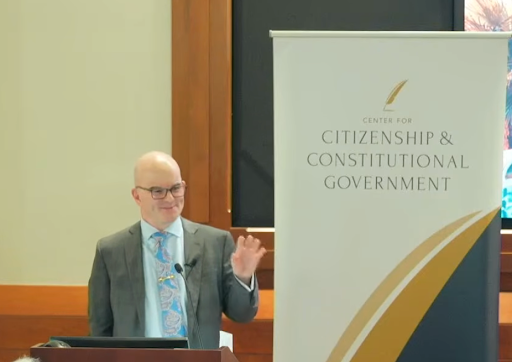
Dr. Carl Trueman is the Center for Citizenship and Constitutional Government’s (CCCG) 2026 visiting fellow. His recent work includes The Rise and Triumph of the Modern Self, and he will soon release a new book, The Desecration of Man: How the Rejection of God Degrades our Humanity. On March 19, Trueman gave a lecture to introduce this upcoming work, titled, “All That Is Sacred Must Be Profaned,” a reference to Marx’s Communist Manifesto.
Trueman is an ordained minister in the Orthodox Presbyterian Church and a professor of biblical and religious studies at Grove City College, as well as a contributing editor to First Things and a fellow with the Ethics and Public Policy Center. Though he originally studied Reformation history, Trueman’s most recent work examines expressive individualism and identity.
In April of 2023, Trueman gave his first lecture at the University of Notre Dame through the CCCG. The talk centered on his book Strange New World, which chronicled the road to the sexual revolution. It was then that CCCG director Professor Phillip Muñoz offered Trueman a year-long fellowship in South Bend. Whilst at Notre Dame, Trueman is drafting yet another book. This one is about St. Thomas Aquinas’ virtue ethics, specifically geared toward Protestants. He told the Rover, “I think we live at a time when the recovery of two things—natural law and virtue ethics—are very important for all churches today.” He continued, “While natural law has enjoyed something of a revival in Protestant circles in recent years, virtue has been somewhat neglected.” Trueman said that this book will be an attempt to encourage Protestants to think “more about how Thomas Aquinas, one of the great theologians of the Christian church, can speak to Protestantism today.”
Along with lectures and writing projects, Truman recently finished teaching a one-credit, five-week-long course called “The Abolition of Man.” Students read C.S. Lewis’ book of the same name, as well as excerpts from authors including Aleksandr Solzhenitsyn, Friedrich Nietzsche, and Mary Harrington.
Mike Mora, a senior who took Trueman’s class, reflected on his experience to the Rover in writing: “In every age, the Church has been called to stand firm. In the early Church, the battle was over Christology. In the 16th century, the lines were drawn over soteriology. Today, the assault has come upon anthropology itself. Dr. Trueman’s course challenged me to think far more intentionally about how the Church can defend the dignity of the human person in our radically anti-human age.”
Sophomore Tad Bates wrote to the Rover, “My favorite aspect of the ‘Abolition of Man’ class was Professor Trueman’s careful articulation of what it means to be human, individually and collectively. He drew on a sound biblical anthropology and traced the divergence of Western civilization from that into the ideologies we cling to today. This challenged and clarified many of my beliefs about technology, work, rest, gender, marriage, community, and the incredible value of human life.”
In an interview with the Rover, Trueman spoke of the importance of Lewis’ book in his own life: “Sometimes, you read a book that doesn’t, in some sense, teach you anything new, but helps to clarify thoughts that you have already had. And that was my experience of reading The Abolition of Man.” He continued, “When I read The Abolition of Man … the third chapter made me realize that a lot of what I was intuitively feeling about the impact of technology on what it means to be human was fundamentally correct—that I was sort of onto something, that I was rediscovering something … that Lewis articulated so brilliantly in the 1940s and that many others have articulated since.”
One of the first readings in the class was a passage from Nietzsche’s The Gay Science, where a madman proclaims the murder of God to deaf ears. Trueman told the Rover, “[Nietzsche] makes it very clear in that passage that if you kill God—if you get rid of God—you get rid of human nature as well. You need to redefine what it means to be human at that point. Nietzsche understands that the struggles over what it means to be man in modernity are at root theological, and that’s what I wanted to get at in my new book.”
The Desecration of Man, Trueman’s upcoming publication, is an attempt to further cultivate the seeds that Lewis planted. He explained, “One of the things that I felt was muted or perhaps missing in [Lewis’] book was what I call the aspect of desecration, that what’s going on with the nature of man at the moment—what’s going on with our attitude towards what it means to be human—is not simply the result of an economic or technological process. It’s something that … has to be accounted for theologically.”
He continued, “I use the category of desecration because I don’t think disenchantment is a fully adequate account of what’s going on. We need to understand that there is an exultant, ecstatic delight taken in the destruction of what it means to be a human being.”
During his recent lecture, Trueman expanded on these thoughts. He used the rhetoric of abortion as an example of desecration: “Sometimes we have to do things we’d rather not do, and if we’ve got to do those things, then let’s make it safe, legal, and rare. That’s quite a striking contrast to the language used in 2024 by the pro-choice lobby, which was that of celebrating abortion as a human right.”
“It seems to me that the passion surrounding something like abortion in the modern world is not simply explicable in terms of disenchantment. Something else is going on.”
He claimed that expressive individualism is, itself, a form of desecration, “because the values—of course, the traditions—that were being transgressed [by expressive individualism] were by and large formed in the crucible of Christianity.”
Expressive individualism, however, is not the worst form of desecration: “Killing—murder—is the ultimate transgression, and … putting a theological angle to this, it’s also the ultimate desecration. It’s the destruction of the image of God that’s powerful. And how do you demonstrate your superiority to God? You smash his image.”
On a more positive note, Trueman said, “If the problem is disenchantment, it seems to me, the answer can be rather vague. The world’s disenchanted, we need to re-enchant it somehow. What does that look like?” He continued, “If the problem is desecration … the answer is consecration.”
Though he acknowledged that consecration is different within various religions, Trueman focused on the Christian view: “The answer is the Church; the answer is the correct creed. The answer is a liturgy that grows out of and reinforces the teaching of that creed and a code that leads us in our daily lives through things like hospitality, to treat other people as human beings.”
Trueman added that he appreciated seeing his students implement his teaching in real life: “When the students invited me to a reunion dinner next Sunday night, part of me thought, ‘Yes!’ … They got the point of the course.”
Despite his hope for a solution, Trueman concluded the lecture with his self-proclaimed “Presbyterian doom and gloom,” saying, “In other words—put it this way—we are on the brink of using the exceptional abilities that come from being made in God’s image to make ourselves into nothing exceptional at all.”
Jack Krieger is a sophomore studying economics, theology, and constitutional studies. Email him at jkrieger@nd.edu.