
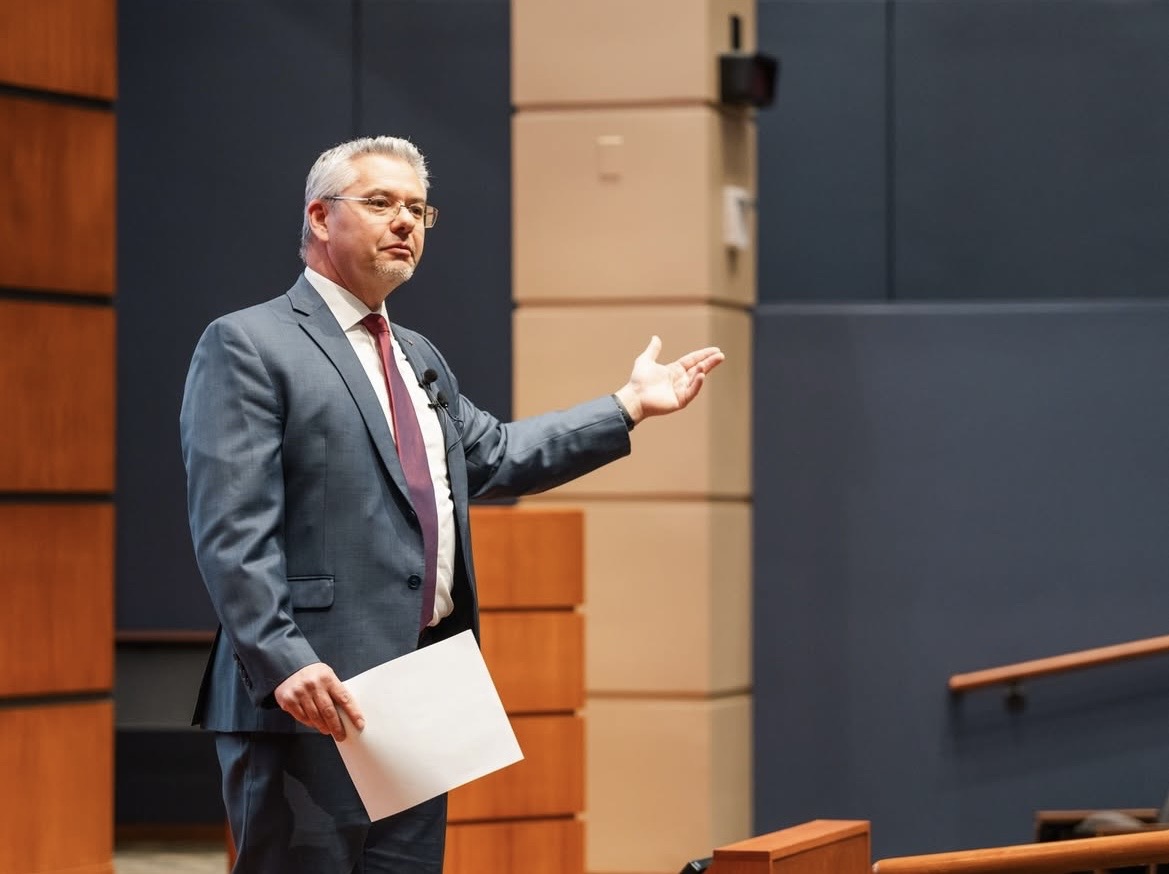
To celebrate the United States’ semiquincentennial and the two documents that led to both her unique equality and prosperity—the Declaration of Independence and Adam Smith’s Wealth of Nations—, Tocqueville Professor of Political Science Vincent Philip Muñoz and John T. Ryan Jr. Professor of Business Ethics James Otteson joined together to lead a course on their contents.
Around 150 students registered for the course in person, and more from the Notre Dame community tune in online. The lecture hall is open to anyone, and each class is livestreamed before being archived on the Center for Citizenship and Constitutional Government’s YouTube page.
The course, titled, “1776: The Ideas that Made the Modern World,” is split into two halves, one for each document. The first half, covering the Declaration of Independence, features lectures by Muñoz on the purportedly self-evident clause that all men are “created equal” and “endowed by their Creator with certain inalienable rights.” Muñoz’s segment of the course will conclude on February 17.
Muñoz told the Rover that he hopes the class will foster “an appreciation and understanding for the principle that all human beings are endowed by their Creator with natural rights and that, in this fundamental sense, we are all equal.”
The second half of the course, taught primarily by Otteson, will resume in late March. It will cover Adam Smith’s Wealth of Nations, which Otteson introduced at the first lecture by displaying charts chronicling the meteoric rise in per capita wealth since the release of Smith’s book. Called by many the ‘Founder of Economics,’ a term that Otteson endorsed, Smith wrote an economic theory that formed the basis of the United States economic system and is credited, in large part, for the prosperity brought about by free markets.
Otteson remarked that Smith’s most pertinent idea for 2026 is that “a system of political economy should enable the least among us to rise.” His portion of the course will investigate how Smith’s principles led to billions rising out of poverty.
When asked about the most rewarding part of the course, Muñoz responded via email, “That so many ND undergraduates, parents, and alumni are so interested in learning about the Declaration.”
Otteson echoed the statement, saying, “The biggest surprise has been how many people—not just students, but others in the Notre Dame community—are interested to be part of these discussions.”
Denis Burke, a ’73 alumnus who lives in South Bend and has been attending the lectures, told the Rover about his excitement for the class. “As a government major and lawyer, there are few things I find as monumental as the Declaration of Independence. As a student of economics, there is little more historic than the Wealth of Nations. These two events converged in this historic year.”
Burke added, “The first draw for me to this class was, frankly, the professors.” He continued, “I would say [Otteson] has ‘written the book’ on the subject, but this would have to be made plural as his publications are legion.” Some of Otteson’s most notable publications include 2014’s What Adam Smith Knew: Moral Lessons on Capitalism from its Greatest Champions and Fiercest Opponents and 2002’s Adam Smith’s Marketplace of Life.
Another alumnus, Patrick McCarthy, ’93, is deeply involved with politics and has worked on several successful political campaigns, including Donald Trump’s victory in the 2024 presidential election. He told the Rover, “I work with very talented and bright people who are at the top of politics in the country, but we don’t get to step back and think about the core beliefs and philosophy that [are] the foundation of this great country very often.” He continued, “This class is a great opportunity to do just that.”
Reflecting on what he hoped students take from the class, Otteson told the Rover, “These are two of the most important publications in the second millennium. One inaugurated a new political order, the other, a new system of political-economy.” He added, “Sometimes ideas really can change the world.”
Caleb Vaughan is a junior student of chemical engineering. Volunteer valentines are accepted at cvaugha2@nd.edu.