
Students and cast celebrate latest comic production
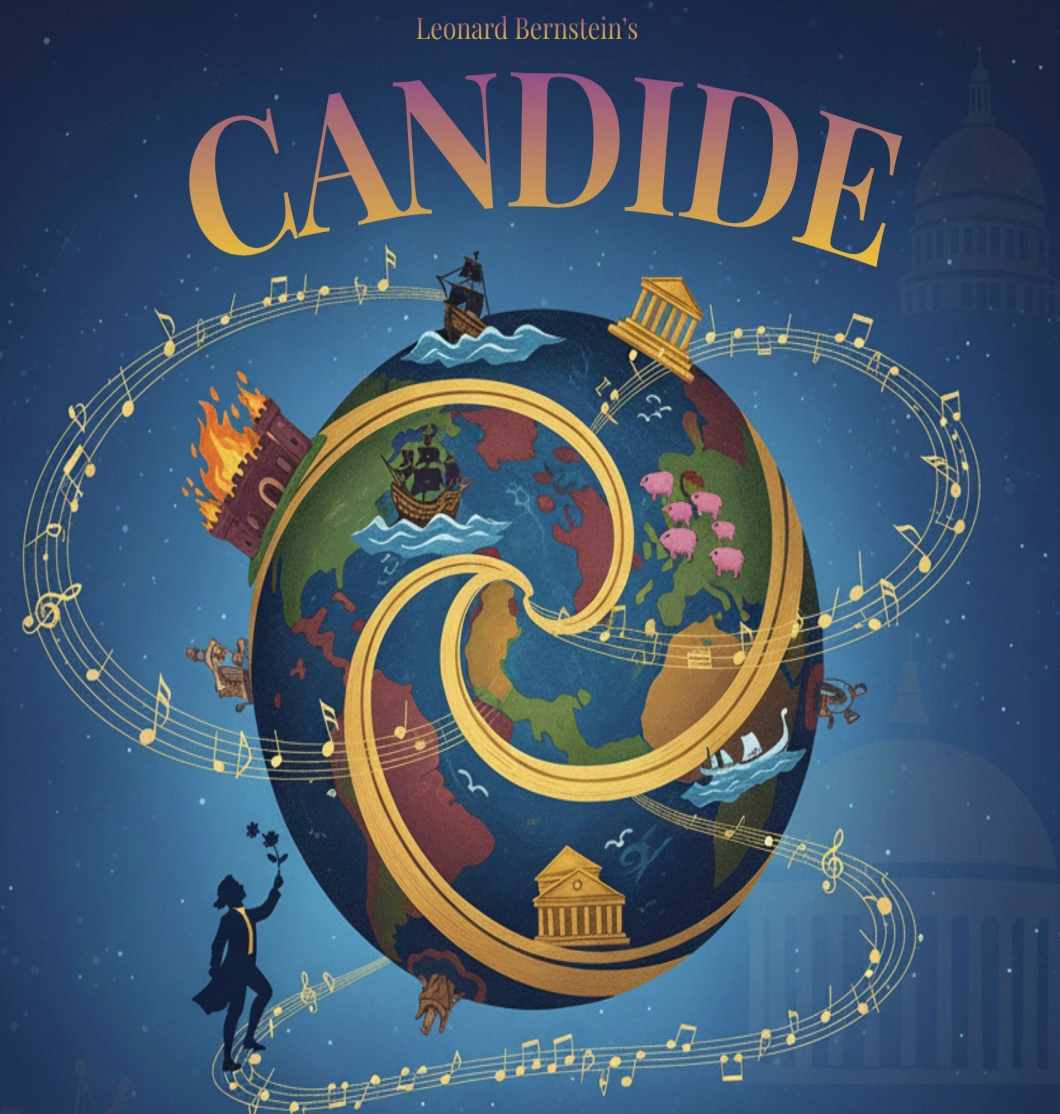
As Notre Dame found itself in the coldest of all possible South Bends, Opera Notre Dame invited theatergoers to question what else is wrong in the world with its production of Leonard Bernstein’s Candide at the DeBartolo Performing Arts Center (DPAC) on December 5 and 7.
The performance follows the group’s staging of Henry Purcell’s Dido and Aeneas in February of 2025. Director and conductor Dr. Dror Baitel told the Rover, “This is the first time Notre Dame Opera presented a full scale production with an orchestra since Covid.”
First performed in 1956, Candide is a comic operetta, providing a contrast to Purcell’s 17th-century Baroque tragedy. The score was composed by Leonard Bernstein, widely known for the iconic musical West Side Story. Like much of Bernstein’s work, Candide shows a wide variety of musical influences, including the classical operatic tradition, medieval chant, and Latin dances.
The show is an adaptation of the 1759 novella by Voltaire, which satirizes Gottfried Leibniz’s philosophy. Leibniz held that we live in the “best of all possible worlds,” since evil only serves to bring about an even greater good.
For Voltaire, this philosophy was unsatisfactory. In the novella as well as in Bernstein’s operetta, the protagonist Candide and his companions encounter immense suffering, including war, rape, shipwreck, an earthquake, and near execution. All the while, Candide’s mentor Dr. Pangloss serves as a mouthpiece for Leibniz’s ideas, driving Candide to despair. Ultimately, Candide settles on a farm and concludes that the best response to evil is to cultivate good.
In her notes in the show’s program, Rev. John A. Brien Professor of Philosophy Barbara Gail Montero wrote, “Life, Voltaire believed, was rife with random catastrophes and unconscionable cruelty. Music, however, tends to bring out the best in humanity. And Bernstein’s luscious score to Candide is a perfect example of this.”
Montero continued, “We invite you to ponder whether we, like Candide, can still, despite murder and mayhem, adversity and avarice, find a way to make our garden grow.”
Many of the cast were members of Notre Dame’s Sacred Music Program, which offers degrees and classes in organ, voice, and choral conducting, among other subjects.
The cast also represents a variety of backgrounds and experience levels. Freshman cast member Madeline Anderson spoke to the Rover about being in the show: “I had a wonderful time working on Candide. … Working with so many incredible people, like our director and the graduate students, really filled me with joy and passion for opera as an art form.” Anderson called her first operetta at Notre Dame “a very collaborative and supportive environment, especially for beginners to opera like myself.”
“I think people think opera is a dying genre,” Anderson continued, “but being in a production with so many young, talented, and passionate artists really shows that opera is alive. I hope everyone who saw Candide saw how much fun we had putting it on and enjoyed an art form they hadn’t watched before!”
For many students, watching the operetta was a new and positive experience. Freshman Robert Myler told the Rover, “[Candide] was really morbid but had a comic overtone, which made it hilarious.” As for Voltaire’s less-than-subtle satire of the Church, Myler did not think it detracted from the show: “Honestly, that was one of my favorite parts. … I know it doesn’t paint the Church in the best way, but it was still funny.”
Dr. Baitel expressed his hope for the future of Opera Notre Dame, saying, “[W]e look forward to return to DeBartolo in future seasons with more exciting programming.”
Vicent Perez is a freshman studying architecture with a minor in music. He thinks Voltaire would be more of an optimist if he had the stuffed pita from Garbanzo. He can be reached at vperezra@nd.edu.
Photo Credit: Notre Dame Department of Music
Subscribe to the Irish Rover here.
Donate to the Irish Rover here.