
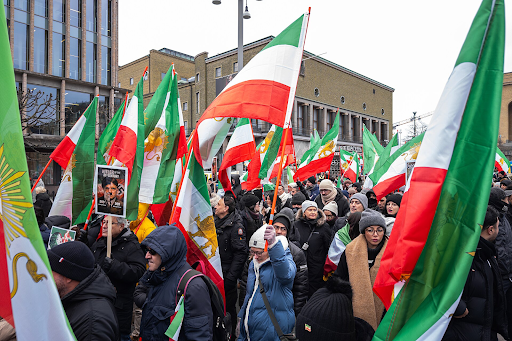
Iran has returned to the center of global attention amid widespread protests over an economy in free fall and concern over its nuclear program. The recent brutal suppression of protests by the regime’s paramilitary force, the Iranian Revolutionary Guard, and U.S. strikes on nuclear facilities during Operation Midnight Hammer have raised fears of a broader regional war breaking out.
The Irish Rover sat down with Professor Alan Dowty to discuss the forces shaping this moment and what may come next.
Alan Dowty is a professor emeritus of political science at the University of Notre Dame and a lifelong scholar of Middle Eastern politics. He has published numerous books and articles on Arab-Israeli politics as well as international relations within the Middle East.
Editor’s note: This interview was edited for the sake of brevity and clarity.
Irish Rover: Many people are closely watching the recent protests in Iran. Why has the regime been able to withstand unrest, even when demonstrations have become widespread?
Professor Dowty: As long as the regime has the loyalty of the Revolutionary Guard … they can put down protests rather brutally. Many Iranians have been talking about the inevitable collapse of the regime. Not this year, maybe not next year, but they’re already speculating about what might replace the system, on the assumption that it is in fact failing.
The economic situation that sparked this uprising … is a symptom of a country coming apart. But again, as long as the Ayatollah can maintain control of the armed forces, they’re able to survive.
Much of the current U.S. policy debate centers on Iran’s nuclear program. What do you see as the biggest misconceptions about Iran’s capabilities and intentions?
There isn’t any real doubt about what Iran was intending to do from the time that Ali Khamenei, the second supreme leader, took office in the last decade of the 20th century. It was very clear what they were aiming to do under the guise of enriching uranium as a fuel … by going beyond the necessary amounts for nuclear power.
Then, the U.S. had the Iran Nuclear deal under Obama’s presidency in 2015, which put Iran in a box. The main critique of that agreement was not that it left the Iranians a path to a bomb … but that the agreement didn’t focus on other subjects which the critics thought should be covered, like Iranian support of terror … with its axis of resistance.
And when President Trump, frankly, made the mistake of withdrawing from that treaty, this gave Iran the excuse to resume their enrichment program.
Up until Operation Midnight Hammer this last June … Iran was producing uranium enriched up to 60 percent; technically not weapons-grade, but according to the experts that I’ve heard on this, it could produce a primitive weapon, nevertheless.
After the June strikes, what do you see as the central unanswered question surrounding Iran’s nuclear program?
The big puzzle after the strike in June is what happened to the roughly 800 to 900 pounds of 60 percent enriched uranium, which they had acquired. All of this, of course, was being observed by the IAEA, the International Atomic Energy Agency, which, at that time, under the agreement, was monitoring everything they were doing.
There’s a big question about what happened to the enriched uranium. Is it, in fact, buried … under the Fordow, Natanz, and Isfahan sites, or did they spirit it out of there in advance?
It hasn’t been accounted for, in short, and that’s what gives me some sleepless nights.
What would a realistic path look like for reducing tensions and avoiding a broader war, especially given Israel’s concerns and the position of other regional states?
It seems to me that many of the Middle Eastern governments, including, I think, a large part of Israel’s, are following a strategy of continuing to put pressure on Iran, particularly on the nuclear issue, to negotiate, and increase the pressure in destabilizing the regime. The best-case scenario … is that eventually Iran’s government will crack and fall apart on its own without the need for a regional war, which would be costly to everybody.
The U.S. needs to build more pressure to get the IAEA back in Iran and verify what they are or are not doing, and make it clear to the Iranians that they would also gain from this by removing the threat of a war that would further weaken them.
Zachary Nicholson is a first-year finance student. He can be reached at znichols@nd.edu.