
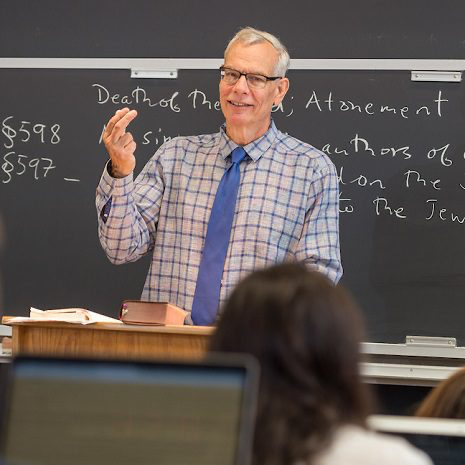
In early February, the Vatican invited theology professor John Cavadini to present to the Dicastery for Laity and Family Life on the criteria for authentic lay formation. Pope Francis formed this dicastery, an administrative department within the Roman Curia, in 2016. According to the dicastery’s website, the assembly considers “the formation of the laity in Christian life and the experience of World Meetings.”
Cavadini, a professor of theology and the director of the McGrath Institute for Church Life, spoke to the dicastery about issues prevalent in current approaches to lay formation. At the end of the assembly, he had the opportunity to speak with Pope Leo XIV.
Cavadini recently sat down with the Rover to explain some of the contents of his presentation. He noted that the goal of lay formation is to deepen the spiritual lives of the laity, to form them “more and more … into the full stature of Christ.”
He commented that most parishes rely on activities outside the liturgy to form their parishioners. “A lot of times this programming really attracts only a small percentage of the people in a parish or a diocese,” Cavadini explained. “But somehow all the formation gets focused on these programs, so it doesn’t reach very many people.”
Cavadini’s proposed solution is to create a parish community that incorporates programs such as these but is ultimately centered on the Mass: “It should be a whole culture of formation, so that someone who doesn’t do any programming but comes to Mass … is formed by participating in the liturgy.”
“An authentic culture of formation should be biblical,” Cavadini said. “And the liturgy is the primary place where people hear the Word of God, not only in the readings, but also…[in the Canon of the Mass and]… in the homily.”
Emphasizing the Mass’s spiritual impact, Cavadini said, “It’s classical sacramental theology that Christ is at work in the liturgy. It’s Christ’s sacrifice. It’s Him, offering Himself in the person of the priest. But it’s still Him, and it’s Him who’s speaking to us in the Word. So He’s forming us.”
Cavadini stressed reverence as a means of both honoring the gravity of the Mass and forming the laity. “[People are] formed in reverence if they see reverence … in the priests and the ministers and everybody associated with the sanctuary,” he said.
But not every Mass forms the laity in reverence, Cavadini explained: “The celebration of the liturgy often isn’t reverent, or is minimally reverent. There’s lots of casual stuff that happens. … And so you’re forming people … away from an awareness of the mystery of Christ’s sacrifice made present.”
Cavadini noted that every aspect of the liturgy is an opportunity to show the laity that there is “something solemn, something transcendently awesome” about the Mass.
“People from the congregation [of my home parish] would come up and light the candles on the altar with matches, as though these are just ordinary candles. They’re not. And then after Mass, they come up and just blow them out,” Cavadini said. He explained, “This is not reverent—these candles are ritually placed and ritually significant, and they need to be lit by the right ministers at the right time with the right reverence.”
Cavadini pointed out that liturgical music also impacts the laity. He emphasized that the lyrics greatly affect the laity’s disposition towards the faith. “Look at the hymns of Isaac Watts, or the hymns of Charles Wesley. My gosh, he wasn’t even Catholic, but ‘Love Divine, All Loves Excelling?’ You can’t … sing that hymn without feeling deeply moved,” said Cavadini.
In contrast, Cavadini described much of contemporary music as “insubstantial.” He expressed a concern that if one uses lyrics that do not approach the mystery of the Mass reverently, “then you’re going to start losing a sense of the mystery of it, and you’re going to end up … much more casual, much less … reverent.”
Additionally, Cavadini identified devotional practices as instrumental to the formation of the laity. He recalled the influence that Eucharistic Adoration had on his formation: “I remember my grandmother very sternly telling me … ‘When the Eucharist is exposed [during Eucharistic Adoration], you’re supposed to genuflect on two knees, and not just on one.’ And that was rigidly enforced—and I still do it—but it taught me something … in my own body. I was apprehending the mystery present.”
He mentioned that there are many different devotions and liturgies that can form the laity, contrasting various liturgies he has encountered. Cavadini described how one priest celebrated “the regular, ordinary liturgy” in such a way that “you just felt the reverence—it was … almost consoling.”
Cavadini compared this experience to his experience with the Zaire Rite of the Mass in the Democratic Republic of the Congo: “You could say they have a kind of ritualized rhythmic movement. … It’s rhythmic and it’s cool, but it’s also reverent. So reverence comes in different idioms.”
Cavadini told the Rover that he expects the dicastery to publish a document synthesizing the ideas presented during the assembly. This document will then be disseminated through the Church and received in each diocese where, Cavadini said, “People would be … obliged to consider it seriously” as an exercise of the Magisterium.
Robert Myler is a freshman majoring in the Program of Liberal Studies and classics. He enjoys cross country skiing and wants the temperature to stay well below freezing until March at least. If you fell for the fake spring a week ago, email him at rmyler2@nd.edu.