
The question of when life begins has profound implications for the ethics of abortion. On Wednesday February 15, in a talk entitled “When Does Life Begin? Thomist vs. Dualist Perspectives,” Dr. Jason Eberl, Professor of Philosophy and Director of the Albert Graegi Center for Bioethics at the University of St. Louis, provided a clear answer: ensoulment occurs at the instant that fertilization is complete.
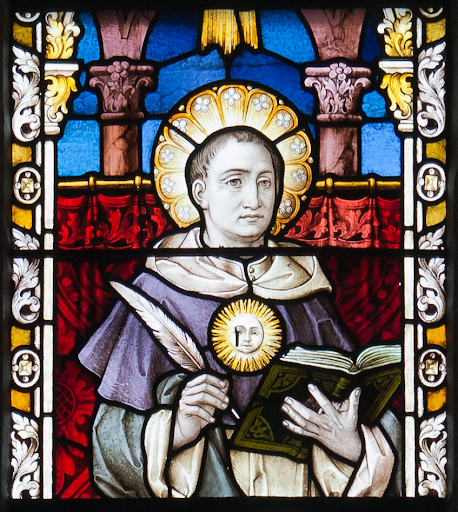
Eberl outlined the two positions that have characterized the ensoulment debate since ancient times. Plato articulated what is now called dualism: a person is his soul, temporarily entrapped in his body. Aristotle, and later Thomas Aquinas, argued that humans are rational animals, a composite of soul and body—an idea now known as hylomorphism.
In the fall, the Jacques Maritain center hosted Dr. Richard Swinburne, who argued for the dualist perspective. Graduate Maritain Resident Alexa Kawlewski noted that Eberl’s talk was largely a response to Swinburne, with Eberl “presenting a different, more Thomistic perspective.”
Eberl began with common ground. Dualism and hylomorphism agree that a body must be sufficiently organized to be rationally ensouled.
Disagreements arise when considering what “organized” means. Eberl first ruled out the “performance theory:” that to become ensouled, the body needs to be able to “perform” certain capacities. Since newborns lack numerous human capacities such as speech, this would place ensoulment anywhere from two months to three years after birth. Eberl made reference to Michael Tooley’s book Abortion and Infanticide, which argues that performance theory, used to justify abortion, would also justify infanticide, an unacceptable ethical consequence.
Instead, Eberl argued for “endowment theory:” a body must have the intrinsic potentiality to carry out the capacities of the soul to have that soul. A fetus is not “potentially a person, it is a person with potential.” Even at the moment of conception, the fetus begins to develop. Of course, the fetus is reliant on the mother during gestation. But even though “it’s not just doing it on its own, [there] is an internal drive” toward development that reflects the child’s intrinsic potential.
While Aquinas himself did not think ensoulment occurred at conception, Eberl explained that Aquinas was operating with minimal knowledge of human reproduction. In the 14th century, it was entirely unknown that an individual fertilized egg developed into a human. Philosophers instead believed that it was some mixture of bodily fluids in intercourse that led to the development of a human being.
Accordingly, Eberl acknowledged that while Aquinas certainly opposed abortion, he and many who place ensoulment later may not have considered it homicide shortly after conception. However, Eberl argued that modern advancements in embryology support the possibility of ensoulment occurring at conception.
Maritain Center Director Therese Cory commented to the Rover, “Prof. Eberl was able to give us a great picture of how Aquinas’ metaphysics and up-to-date scientific knowledge work together to affirm the intrinsic dignity of the human person at all stages of development.”
In a comment to the Rover, senior Chris Winter applied Eberl’s comments to the question of abortion. “The question here is when a biological person becomes a metaphysical person,” he observed, adding that personhood is uncontroversially intertwined with human rights.
Lastly, Eberl remarked that, beyond mandating hylomorphism and acknowledging that God endows human bodies with their souls, the Catholic Church has no official teachings on when ensoulment occurs.
Students were left with much to consider. When asked “When does life begin?” first-year Ian Diez hesitated: “Can I think about it for two minutes?” “How about two weeks?” fellow first-year Sabrina Richter quipped.
Diez ultimately leaned towards Eberl’s perspective, noting an intuitive simplicity to the old pro-life adage: “Life begins at conception.”
Daniel Balof is a sophomore studying mathematics and philosophy. He is unsure as to whether or not he has a soul. Weigh in by emailing dbalof@nd.edu.