
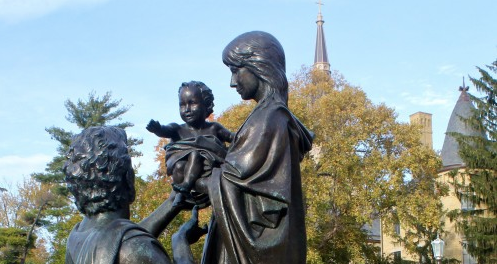
Engraved on the Holy Family statue outside Coleman-Morse are the words of Pope St. John Paul II: “As the family goes, so goes the nation, and so goes the whole world in which we live.” This year’s fourth annual Engaged and Married Couples Retreat, organized by Marriage Preparation Coordinator Suzy Younger and Notre Dame Campus Ministry, aimed to provide engaged students with the tools to develop a holy marriage in line with this proclamation.
The retreat, which took place on Saturday, March 28, ministered to 19 couples and focused on the question, “What makes love last?”
Notre Dame’s Campus Ministry website states that “Marriage Preparation at the University of Notre Dame is meant to help prospective spouses reflect on the nature of the sacrament of Marriage as a life-long sacramental and vocational commitment.” According to the website, at least six months prior to their wedding date or graduation, couples can begin meeting with Younger for formational sessions. Topics such as the sacramentality of marriage, the theology of the body, fertility awareness, finances, and family boundaries are covered.
Younger oversees these individualized preparation sessions for engaged couples, as well as meetings with individuals and couples who are discerning marriage but are not yet engaged. Campus Ministry also provides assistance with completion of the Pre-Nuptial Investigation paperwork and works in partnership with the Family Resource Center and the Married and Parenting Students Club.
When asked about the experience of being engaged while studying at Notre Dame, seniors Jackie Nguyen and Josh Weimer commented in a joint email to the Rover, “[It] has been really incredible. The amount of support both through Campus Ministry and other couples who are our beloved friends entering into engagement and marriage soon has been monumental.”
Younger elaborated on the retreat’s central question, ‘What makes love last?’ She told the Rover, “We seek to explore that question in light of Dr. John Gottman’s psychological research on the seven principles that make marriage work and the Catholic Christian theology of the Sacrament of Marriage.”
She continued, “Through the integration of psychology, biology, philosophy and theology, we hope to draw each participant into a deeper friendship with God, with their very self, and with their (future) spouse so that they may have the healthiest, holiest, most joy-filled marriage possible.”
Throughout the day, couples participated in a series of formation sessions led by Younger and Adam Smith, a Catholic marriage and family counselor from the local Smith Counseling Services. During the retreat, couples were introduced to practical strategies for cultivating a holy marriage and had one-on-one conversations designed to strengthen their relationship. Couples also had the opportunity to enjoy fellowship with other engaged students.
Senior Brian Buttner, who attended the retreat with his fiancée, Notre Dame alumna Jennifer Tennant, told the Rover that “the retreat ultimately is a method for educating young couples on productive ways to handle inevitable quarrels. … An important distinction for marriage prep is that the sessions are not tests we pass or fail, but rather tools for us to better evaluate our relationship and sincerely use engagement to grow together rather than simply checking boxes.”
“In an age of relational ambiguity, especially between men and women, Catholic marriage establishes a joyous and stable communion which models that of the Trinity,” Tennant told the Rover. “It can withstand all storms because of its sacramental graces and sculpts great saints if the couple enters into the sacrament well.”
She continued, “Retreats such as this … provide spaces for couples to thoroughly prepare themselves to validly give and receive this sacrament and build a robust foundation for their lives together.”
The retreat concluded with a reflection on marriage offered by Father Bill Dailey, C.S.C. and a time of Eucharistic Adoration and Confession. Participants left the retreat with a personalized 100-page binder, containing activities and date-night prompts to further nourish their relationship.
“I believe that the most fruitful part of the retreat for students is to have practical skills to nurture their fondness and admiration, manage conflict, and build a shared mission and vision for their life,” Younger noted.
Since the retreat’s inception in fall 2023, it has aided in the formation of 95 undergraduate, graduate, and law school student couples. Although the retreat is primarily oriented toward Notre Dame students, participants from St. Mary’s and Holy Cross are welcomed as space is available.
Younger compared the retreat to the formation seminarians receive before entering the priesthood, saying, “When we look at the incredible formation our priests are receiving to prepare for their vocation to the priesthood and to receive the Sacrament of Holy Orders, it is equally important that we give a similarly robust and integrated formation for couples preparing for their vocation to marriage and to receive the Sacrament of Matrimony.”
Campus Ministry also supplies resources to students who are single or dating. Younger hosts a semesterly “Dating Under the Dome” talk, exploring what discerning a vocation to marriage looks like in the college setting. Last semester’s topic was “In the Waiting” and discussed ways to redeem the time spent waiting for clarity on vocation. This semester, Younger hosted a talk titled “Red Flag? Or No Big Deal?” on April 14.
Nguyen and Weimer emphasized the significance of Campus Ministry’s support during their engagement: “[We] decided to begin meeting with Suzy prior to getting engaged to receive as much counsel during our dating discernment process as we could, and it was one of the best decisions we made.” They continued, “Inviting the Lord into our dating relationship through Suzy helped prepare us to receive the gift of engagement—and marriage—with utmost readiness (or as much readiness as we could have). The retreat was a great way to learn practical ways of managing conflict, interacting with one another, and building our shared unity.”
“We are the domestic Church, and the strength of society and of the Church depends upon the strength of the family,” Younger affirmed. “This … begins with creating [a] strong and lasting, faithful marriage.”
Madeline Page is a sophomore studying biology. One of the many reasons she is grateful to be a human is that courting behaviors do not include the ripping off of heads, as with praying mantises. To discuss more humane methods of dating, email mpage4@nd.edu.