
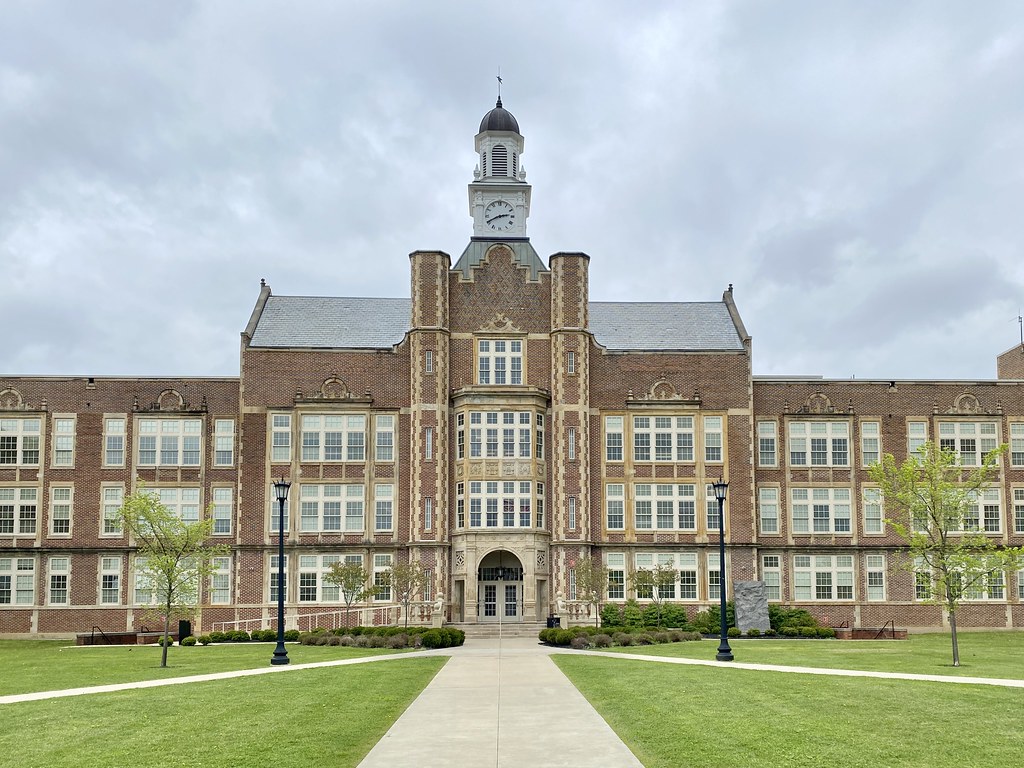
“Please introduce yourself with your name, grade, and pronouns,” my theater director said as he passed out the scripts for our first rehearsal of “Mamma Mia.” “Mamma Mia” is fun—classic music, great lines—but alas, it also includes pre-marital sex as a constant plot feature.
Uncomfortable situations like this were typical throughout my 12 years of public education. Stories like mine can push parents towards private Catholic schools; a religious education promises shelter from the moral storms that their children might otherwise face.
But to what extent should we be shielded? Catholic education can spare students from exposure to anti-Catholic beliefs—but can one learn to properly love those who hold them, as Christ commands, without such encounters?
My intent is not to defend the rigor of all public schools, but rather, through my own experiences, to argue for their distinctive—and often underappreciated—value as a training ground for the world’s spiritual battlefield.
My theater director was in an openly homosexual relationship—his partner helped with costuming. Over four years in the department, I became frustrated with my director, with the immoral content of the productions that he chose and his purposeful and repeated introduction of LGBT ideals.
And yet, I also saw the extent to which he cared for the LGBT students within the department, offering genuine love for students who were confused and hurting.
Separately, I saw how he gently mentored the special needs students, encouraging them to participate fully beside their peers, and ensuring that each got a chance to have a moment in the spotlight. In short, I saw him: a man who truly cares for his students, despite his distance from the truth.
I was presented with similar situations in the classroom. There was a girl in my AP Biology class who once attended my Catholic parish. Her family had drifted from the faith, instead latching on to left-wing ideologies. She went by she/they pronouns, was involved in our town’s Pride organizations, and staunchly supported abortion.
But as I got to know her, the once-blinding glare of her opposing worldview dimmed, teaching me to see her not as an opponent but as a student who shared my unusual fondness for insects and gleefully held our teacher’s Madagascan hissing cockroaches with me (to the horror of some of our classmates). I saw my friend who cheered louder than anyone else when I announced to the class that I was going to Notre Dame. When I look at her, I see a girl whom the Lord loves—and whom I love, too.
It is this realization that ultimately showed me the value of public education. Yes, some views and lifestyles I encountered were contrary to Catholic teaching—but the people who held them were still His. Encountering others with markedly different views taught me to see them as such, to love them and let the Lord love them through me.
In the Gospels, Christ consistently exhorts us to carry His light into all the dark places: to welcome the foreigner, eat with the tax collector, kiss the leper. Sharing His love is not a nicety, but a necessity.
“Go, and preach the Gospel to all nations,” Christ tells us (Matthew 28:19). How can we share His word if we don’t know how to converse with unbelievers? How can we preach the Gospel to all nations if we don’t encounter the world?
It is easy to be Catholic at a Catholic school. But it is also easy to forget that, beyond the shadow of Our Lady extending from the golden dome, living the faith is not nearly so simple. Public school is a microcosm of the real world, in which the majority of those one encounters do not live their lives in accordance with Catholic morality. Public education can prepare students for such encounters, teaching them to juggle the authentic expression of their faith with genuine love for the outsider. Unfortunately, I think that this distinctive value is often overlooked and undervalued, especially in Catholic circles.
I do not pretend that public education is perfect—far from it. There are real benefits to a Catholic education, and real challenges with a public one. However, I maintain that there is a unique good that can come from public education: learning the art of loving encounter. I am aware that attending public school can be difficult, frustrating, and sometimes saddening. But so is life; so is true encounter with a broken world.
I am incredibly grateful to attend a Catholic university. Still, I firmly believe that 12 years in public school were integral to my faith formation. Through my experiences in the public school system, I began to see “the other” not as alien, but as someone who still bears the likeness of our Lord. I learned how to encounter them, and most importantly, how to love—and let Him love through me.
Byline: Madeline Page is a sophomore studying biology, theology, and journalism. She can be reached at mpage4@nd.edu.