
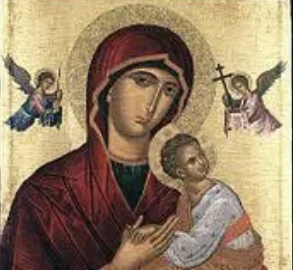
On this year’s Feast of the Annunciation, the McGrath Institute for Church Life (MICL) released a new short film titled “Mary, Icon of the Church.” Featuring Professor John Cavadini, the film dives into major Marian Dogmas and their relevance to Catholic devotion and life today.
“We really wanted to create a film that both in content and form led someone into devotion to Mary,” Corynne Staresinic, a research fellow at the MICL’s Sullivan Family Saints Initiative and the primary researcher behind the film, told the Rover. “The conversation started last spring; then, in the summer, we started to draft a plan for the film and began working with [Professor] John [Cavadini].”
The film is divided into three acts, each focused on a different Marian Dogma. “Act One, we focus on Mary as the Mother of God with her title Theotokos; Act Two, on the Immaculate Conception; and Act Three on Icon of the Church, where we get into the Assumption or Dormition of Mary,” Staresinic explained.
She continued, “We wanted to take the three doctrines of Mary that are often misunderstood or kept at a distance and bring them fully into focus, so that people can have a deeper understanding of what they mean. These three titles capture who Mary is in the life of the Faith.”
“I thought it was an absolutely beautiful film,” remarked Isabelle Glunz, a freshman who saw the film at a dinner hosted by the MICL. Glunz told the Rover, “It very well portrayed the Catholic Church’s love for our Mother, and it showed the universality of this devotion to her and honored her role in salvation history.”
The film prominently features depictions of Mary from across campus, including medieval artwork in the Raclin Murphy Museum of Art, stained glass and sacred paintings in the Basilica of the Sacred Heart, and the Marian statue at the Grotto of our Lady of Lourdes. In addition, three off-campus icons of Our Lady of Vladimir, Our Lady of the Immaculate Conception, and the Dormition of Mary appear throughout the film.
The film draws on pre-existing theological concepts to explain Mary’s role as the Icon of the Church. “A lot of the thinking and research on Mary was grounded in a text called ‘Mary: the Church at the Source’ by Hans Urs von Balthasar and Joseph Ratzinger,” Staresinic explained.
She continued, “It [gets at] the deeper thesis, which is that in order to understand the Church, Mary is the embodiment and archetype of the Church. When each of us belong in the Body of Christ, we’re called to live just like Mary did, to receive God into our whole lives [and] being just as she did. [Mary] teaches and shows us what it means to be the Church, and this is where the devotional aspect comes in.”
Gabriel Wollak, a freshman studying philosophy, told the Rover that he was drawn to the film’s emphasis on devotion to Mary. “I think what Cavadini wanted to convey to those watching is to grow in devotion to Mary, and that requires the Dogmas. The Dogmas are all oriented towards how we should devote ourselves to her—how we should understand her. She’s the God-Bearer, and having that understanding and then growing in devotion to Mary is so fundamental to living a deeply spiritual and fruitful life.”
Luke Fisher is a freshman from Detroit living in Siegfried Hall. He is majoring in theology and also struggling his way through the Program of Liberal Studies. If he’s not trying to get his classes to move outdoors or calling philosophers “cuckoo for cocoa puffs,” you can usually find him doing the chapel crawl around campus. To join in (or chat), reach out at lfisher8@nd.edu.