
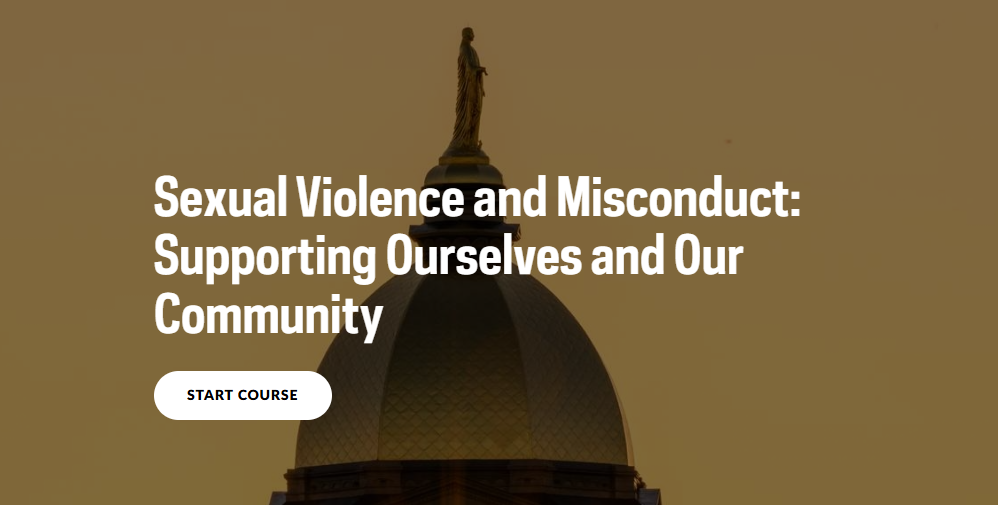
The University of Notre Dame’s annual “Violence Prevention” module has taken a noticeable turn this year, prompting concern from students who say the content conflicts with the institution’s Catholic identity.
In previous years, the training focused primarily on emergency preparedness, including the “run, hide, fight” protocol to active‑violence situations. This year features an additional course alongside the annual Active Violence Preparedness course, titled “Sexual Violence and Misconduct: Supporting Ourselves and Our Community,” which centers on sexual misconduct, consent, and interpersonal behavior. The Office of Institutional Equity (OIE) told the Rover, “The University is dedicated to caring for students and their needs in the context of our Catholic mission.”
But Catholic students have expressed concern about portions of the training they believe conflict with Catholic teaching, particularly a section addressing “digital intimacy.” The module describes “sexting” as “sending and sharing intimate content” and presents it as “a common part of modern relationships.” The training goes on to list what it calls “positive reasons” some individuals engage in digital intimacy, including “sexual exploration and expression,” “casual flirting and fun,” and maintaining connection with partners “during periods of time when they cannot meet physically.”
Caroline Cure, joint-president of Students for Child-Oriented Policy (SCOP), told the Rover that when the module shifts from neutral description to positive framing, “you make it okay,” especially to students who “are getting this material from a Catholic university and thinking, ‘Oh! This is okay!’”
The Catechism of the Catholic Church (CCC) teaches that sexual expression belongs within marriage and is ordered toward both the unitive and procreative dimensions of the marital relationship. It identifies lust as a “disordered desire… when sought for itself, isolated from its procreative and unitive purposes” (CCC 2351) and describes masturbation as “an intrinsically and gravely disordered action” (CCC 2352). Considering these teachings, students expressed discomfort at the module’s portrayal of sexting as inconsistent with the moral framework the University publicly affirms.
Ely McCrae, president of EthosND, told the Rover that the module left him “confused,” not because consent education is unimportant, but because the training “went beyond that … if you are completely aligned with Catholic teaching, then consent is given.” McCrae questioned why a Catholic university would present digital intimacy positively without grounding the conversation in its own moral tradition. “Notre Dame’s administration has good intentions,” he said, “but I’m confused about their lack of prioritization of core Catholic doctrines in this module. The Catechism should be the first source and then secular research can follow.”
The OIE also clarified that the University’s prevention efforts emphasize, “respect, agency, and accountability across all relationships,” and that the module was developed using “research-backed content from Active* Consent … in consultation with student affairs.”
Active*Consent is a research organization that both provides research and seminars on “societal issues like consent, sexual harassment, [and] … young people’s sexual experiences and attitudes since 2013.” They primarily serve to provide young people with the resources they need for sexual safety.
However, their research spans broader than just sexual consent. Active*Consent has done research on pornography’s influence towards students. While Active*Consent’s research often presents itself as descriptive rather than ideological, the organization consistently includes purported benefits of pornography alongside its documented harms.
In their study “Development of a Measure to Assess What Young Heterosexual Adults Say They Learn About Sex from Pornography,” Active*Consent notes that “some qualitative research indicates that, for young people, pornography may be considered a valuable source of information about sex.” The study cites reasons such as facilitating “sexual experimentation,” offering “practical information about sexual acts,” and providing guidance on “body function, genital aesthetic, sexual identity, and understanding of queer sexuality.”
A second study “Toward a Model of Porn Literacy: Core Concepts, Rationales, and Approaches” similarly highlights what it calls the “positive effects” of pornography, asserting that it “provides an outlet to learn about sex that positively affects their lives.” Taken together, these articles treat pornography as a routine and morally neutral component of sexual development. Both studies are linked directly on the Active*Consent website—the same program that heavily informed the content of Notre Dame’s updated consent module.
Catholic students did not miss the implications of this module. Andrew Blake, joint-president of SCOP, noted that praising “digital intimacy” in a sexual‑violence module is “ironic,” because sexting inevitably “leads to the objectification of the person … one of the roots of sexual violence.” McCrae added that modules like this “make the struggle of members—even in my own small group—question Catholic sexual morality, and it makes them struggle with it more.”
In response to student concerns, OIE released a message to the Rover from Father Gerry Olinger, C.S.C. and assistant vice president for Institutional Equity Erin Oliver written on September 2, stating that the module aims to “strengthen our community and reinforce a culture that honors the dignity of every member.” They added that “interpersonal violence is antithetical to the kind of community we want to build, and acts of sexual violence, discrimination, or harrassment are not tolerated.”
As students continue to complete the training, questions remain about how Notre Dame intends to balance legal compliance, student safety, and its commitment to Catholic moral teaching.
For young men on campus struggling with sexual addictions, EthosND offers a confidential community of support and prayer.
Abigail Smith is a senior Program of Liberal Studies, theology, and classical linguistics major. When she is not reading for class, Abby can be found singing with the Liturgical Choir and poorly playing spikeball with her friends. Contact her at asmith78@nd.edu.
This article was updated on September 30, 2026 to correct a potential misunderstanding that the Active Violence Preparedness module was replaced with the Sexual Violence prevention module. The new module is an additional mandatory training, not a replacement. Both are required for students.