
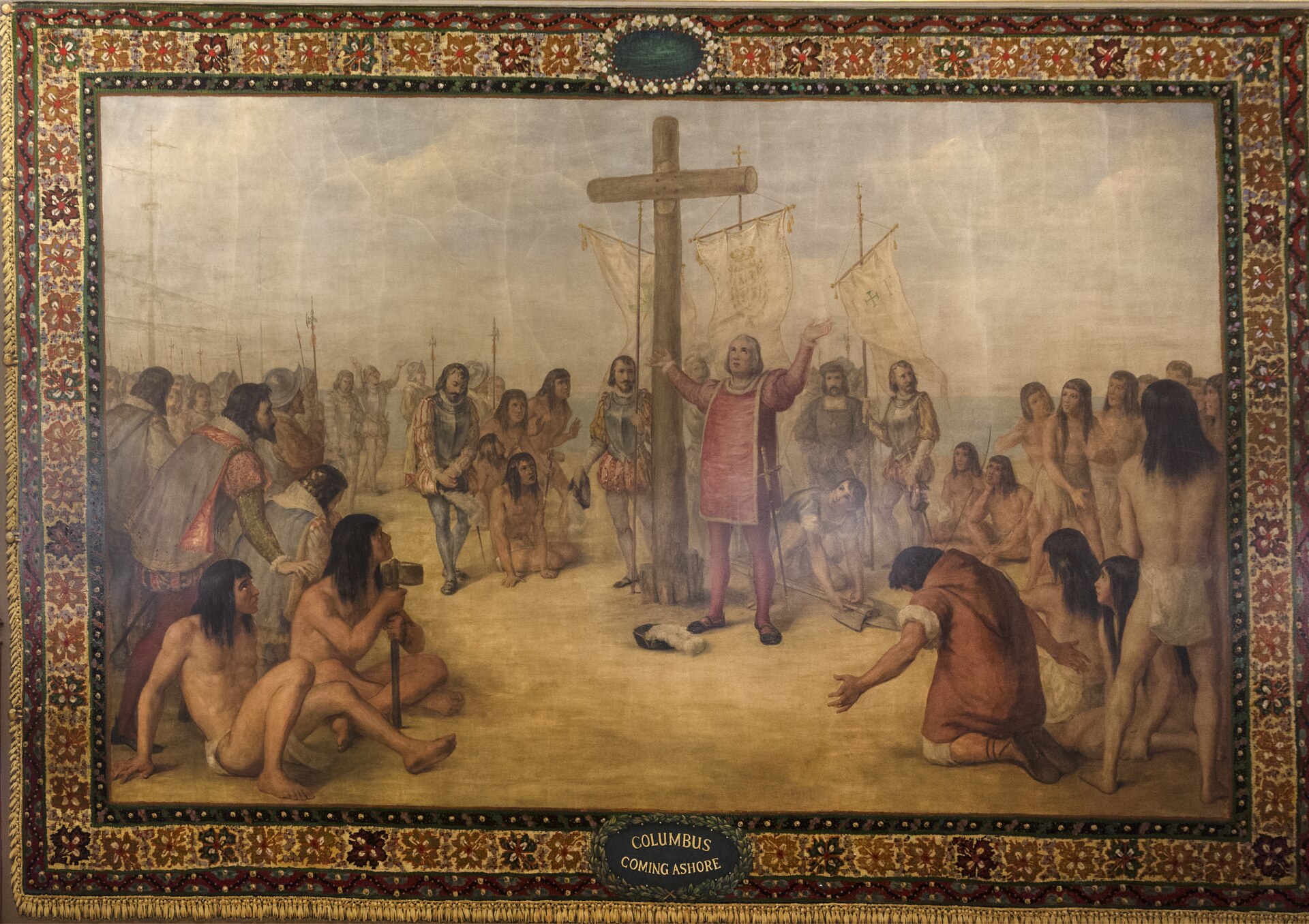
Beneath the glow of the Golden Dome, a series of controversial murals hides behind unassuming tapestries. In 2020, then university president Father John Jenkins, C.S.C. veiled Notre Dame’s Columbus Murals in response to student and faculty opposition. Six years later, his decision is still contested on campus.
The Columbus murals were painted between 1882 and 1884 by Vatican artist and Notre Dame professor Luigi Gregori. Adorning the second floor walls of the Main Building, the series of 12 murals depicts scenes from Columbus’ voyage, including the arrival in the New World, interactions with Queen Isabella of Spain and other Catholic figures, and interactions with Native Americans.
At a time when anti-Catholic and anti-immigrant sentiments were widespread, the murals were intended to demonstrate the critical role that these groups played in the foundation of America. At the time, Columbus was regarded as an American hero, and his status as both an immigrant and a devout Catholic was undisputed. When Father Edward Sorin, C.S.C., commissioned the murals, he hoped to “[send] the message to the Notre Dame community that they too, though largely immigrants and Catholics, could be fully and proudly American,” Fr. Jenkins wrote in his 2019 “Letter to Campus Regarding Columbus Murals.”
This view of Columbus as a figurehead for American Catholicism was echoed by then Pope Leo XIII. “Columbus is ours,” he wrote in his 1892 encyclical Quarto Abuente Saecolo addressing the quadricentennial of Columbus’ voyage. “Columbus threw open America at the time when a great storm was about to break over the Church.”
However, Columbus’ reputation has been tarnished since the nineteenth century; his practices of forced labor and violence towards Native Americans have prompted questions and controversy.
In response to an open letter calling for their removal, Jenkins covered the murals with tapestries depicting Christian, Marian, and Potawatomi inspired imagery in 2020. Each semester, the murals are temporarily unveiled to allow for academic engagement, a decision that some students argue fails to fully acknowledge history.
“It is a mistake for the university to veil the Columbus murals,” the Notre Dame College Republicans told the Rover. “The university should embrace the Catholic role in America’s genesis rather than distance itself from it. It is understood that Columbus’ arrival on this continent contributed indirectly and directly to immense suffering, but the actions of many of history’s heroes were devastating to some.”
“It appears that the university is more preoccupied with diversity than with tradition because they are uncomfortable with the history of this nation,” the club continued.
Max McNiff, the Grand Knight of Notre Dame’s Knights of Columbus chapter—an organization of Catholic men named after Columbus—also expressed disapproval of the murals’ veiling.
“Ironically, the university, in an attempt to give a voice to the oppressed and marginalized, is suppressing the figure who did just that,” McNiff told the Rover. “For many Catholics coming to America for the first time, they were viewed with great suspicion by the country in which they sought refuge. [They] sought to demonstrate their allegiance to America, but were excluded from civic life, and Columbus was the figure they stood behind to defend their claim to American heritage.”
“For [the Knights] today, Columbus represents the Catholic heritage that America has inherited since her founding,” he said.
Junior Patrick Bunal also expressed disapproval. “I’m inclined to think that the decision is incorrect,” he explained in a written statement to the Rover.
However, Bunal stated that he understands its controversial nature, explaining “ … [Outside of universities] where [the murals would be] more prone to being misunderstood as legitimate history, instead of being symbolic of how you can be Catholic and American, I would sympathize more with veiling the murals.”
Although dissent is present, many students approve of Fr. Jenkins’ decision, citing the need to acknowledge the discomfort that the murals prompt for some students.
“Welcoming a diverse student body means including a variety of perspectives, which means historical traditions should be examined, not discarded entirely, and expanded so that all students see themselves reflected accurately in the story of our nation and Notre Dame,” the Notre Dame College Democrats said in an interview with the Rover.
The club continued, “We understand the difficulties of reckoning with the past of a growing, learning, and rapidly changing nation. However, we believe it is important to learn about the ‘bad’ in our history and provide the means to rectify our mistakes. In our case with the Columbus murals, this means covering them with a tapestry that represents the Native American communities negatively impacted by the consequences of the Columbus voyages.”
Disputes over how best to acknowledge both the good and the bad of America’s history are not confined to Notre Dame. In Columbus, Ohio—the capital city named for the controversial explorer—the statue of Columbus adorning the city hall steps was removed in response to public outcry in 2020. Although a “Reimagining Columbus” council was formed to determine a new place for the statue, no progress has been made thus far.
The removal of monuments portraying other controversial historical figures, such as Robert E. Lee and a purportedly pro-segregationalist Texas Ranger, are under scrutiny in other parts of the country, as officials seek to strike a balance in acknowledging all aspects of American history.
Notre Dame’s Columbus murals will next be uncovered for academic engagement from October 26 to October 30. More information on the murals and their history can be found on their website.
Madeline Page is a junior studying biology. She loves the giant leaves that litter the ground during autumn at Notre Dame, so she collects them, presses them, and keeps them in a folder. She has no idea what she will do with all her leaves. To give her suggestions (or tell her where to find a really big leaf), email mpage4@nd.edu.