
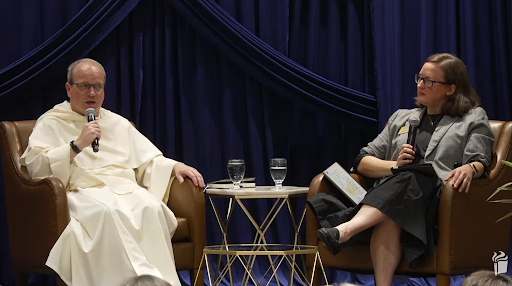
The de Nicola Center for Ethics and Culture (dCEC) hosted its 26th annual Fall Conference from October 1-3 with the theme, “But Where Can She Be Found? Wisdom from Age to Age.”
The dCEC is committed to strengthening the Catholic moral and intellectual tradition on campus through teaching, research, and public engagement, engaging in dialogue with “the most pressing and complex questions of ethics, culture, and public policy today,” per the center’s website. To this end, among other initiatives, the center held the first Fall Conference in 2000 entitled, “A Culture of Death,” which examined the culture of death identified in Evangelium Vitae. It has since grown to become the largest annual academic event at Notre Dame.
This year’s Fall Conference brought over 120 speakers from around the country to present on the relation of wisdom as shaped by an ancient and ongoing Western and Christian tradition with the “hegemony of mastery, technique, and mere information” of our modern age.
Father Thomas Joseph White, O.P., current Rector Magnificus of the Pontifical University of St. Thomas Aquinas, delivered the first keynote lecture titled “Beauty, Wisdom, and Christ: a Trinitarian Perspective on the Human Vocation.” He urged the audience to “consider God as Beauty and the beauty of creatures in light of God,” relating to Aquinas’ definition of the virtue of Wisdom that “consists in understanding all things in virtue of their explanatory first cause and final end,” who he defines as God.
Fr. White asserted that to know God, we must turn to His Son. “In [Christ’s] human beauty, we begin to be beatified, to turn our own faces towards God inwardly and upwardly,” he stated. This, however, can only be done in prayer: “Mental prayer is an integral part of the search for the truth.”
The second and final keynote address was delivered by Professor Michael Hurley of Cambridge University. His presentation, titled “What Only Poetry Knows,” related Gerard Manley Hopkins and Saint John Henry Newman to metaphysics, best summarized in the words of St. Newman: “Thought and speech are inseparable from each other. Matter and expression are parts of one: style is a thinking out into language.”
Freshman Tess Anastasi told the Rover, “It was very interesting how he discussed how poetry can express certain truths about life that can’t be expressed through straightforward facts alone. It helped me obtain a different perspective on poetry and to understand how it can help us discover meaning and develop wisdom.”
Kolbe Barta, a sophomore in Duncan Hall and Sorin Fellow, praised the Fall Conference, calling it, “one of [his] favorite events every year.” He told the Rover, “This year’s presentations taught me about wisdom, the courage to seek it, and how discussion about prudence and other virtues still shapes conceptions of wisdom today.” He further emphasized the value of the conference not only to himself, but to the university at large, saying that “The Fall Conference is vital, not only to some theology and philosophy professors, but to Notre Dame at large, to situate ourselves within, and engage seriously with this Catholic tradition that animates our home.”
Jaden Lukose, a sophomore in Alumni Hall, noted to the Rover how the Fall Conference not only proves valuable for Notre Dame, but also for other universities and communities. He remarked, “The pursuit of truth is an essential part of Notre Dame’s mission statement, and the Fall Conference is a wonderful opportunity that invites professors, students, and other people from outside the university to join in this mission. The conference stimulates an environment that makes it possible to better understand the human person and human flourishing.”
The Hillbilly Thomists, a band of Dominican friars which includes Fr. White, concluded the conference with an intimate performance of their charting bluegrass music in Washington Hall. They derive their name from a letter of Flannery O’Connor, who wanted to be viewed as a “hillbilly Thomist,” rather than a “hillbilly nihilist,” as readers may have concluded from her southern gothic style, reflecting her fusion of Catholic wisdom and personal setting.
The four priests played original music on instruments including the guitar, banjo, piano, harmonica, a washboard, and even the spoons. Following the conclusion of the concert, the dCEC hosted a reception in the Morris Inn ballroom. The reception featured drinks, desserts, and an opportunity for conference attendees to meet the Hillbilly Thomists.
Prior to the start of the concluding concert, the dCEC revealed that next year’s Fall Conference theme will be eschatological, examining the last things.
Joseph Kurkowski is a freshman in Morrissey Manor studying physics. He is an avid runner who enjoys singing for the Lit Choir. Feel free to reach him at jkurkows@nd.edu