
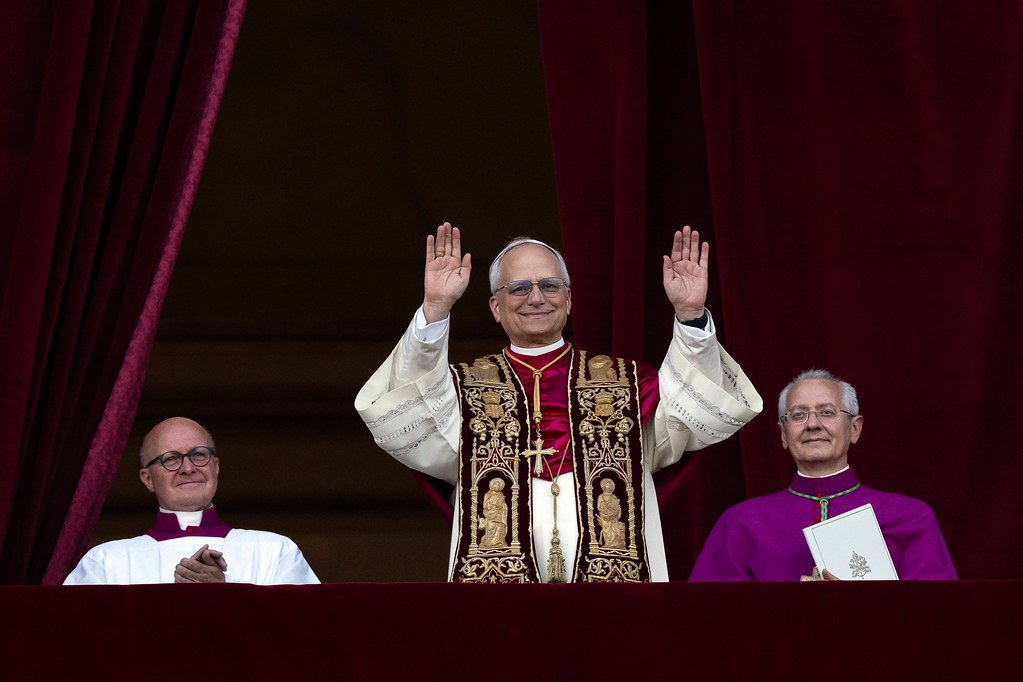
An interdisciplinary group of faculty and graduate students recently established the Magnifica Humanitas Working Group centered on Pope Leo XIV’s newest encyclical of the same name, which provides a Catholic response to the rising influence of AI, digitalization, and robotics.
Published in May of 2026, the Holy Father’s encyclical has inspired deep discussion across disciplines about human dignity and ethical technological practices amidst the rise of Artificial Intelligence (AI) and specifically large language models (LLMs) like ChatGPT. Once dismissed as “stochastic parrots,” LLMs are now replacing jobs, disrupting study, and altering human interaction.
Sponsored by the Initiative for Data, AI, and Computing as well as the de Nicola Center for Ethics and Culture, the group is led by Notre Dame faculty members across multiple disciplines. Law professor Paolo Carozza, engineering professors Megan Levis Scheirer and Walter Scheirer, and theology professor Paul Scherz formed the group to integrate their individual research in Catholic responses to technological upheaval.
Speaking to the group’s mission, Levis Scheirer told the Rover that they are “working to build a community of practice and research around the encyclical and feel Notre Dame is well positioned to be a field leader in research related to Magnifica Humanitas.”
Levis Scheirer emphasized the need for Catholic Social Teaching (CST) in addressing the challenges posed by AI and rapid technological change: “Catholic Social Teaching has a long history of responding to previous technological upheavals, such as the Industrial Revolution, and is no less relevant in the digital age.”
Levis Scheirer researches technology ethics with the Institute for Social Concerns and the College of Engineering. Her involvement with the working group includes engagement with CST principles and computer science. “We have been translating Subsidiarity and other principles of Catholic Social Teaching into design proposals for software engineers,” Levis Scheirer said, citing paragraph 31 of the encyclical which states: “According to this principle, whatever can be carried out by individuals, families, intermediary organizations and local communities should not be carried out by higher-level authorities.”
“This means that we might imagine community control over data and algorithms versus the total control exercised by the frontier labs,” Levis Scheirer added.
Computer Science Ph.D. student Louisa Conwill, who collaborates with Levis Scheirer to incorporate CST principles in engineering design, told the Rover, “The hope with this working group is to bring together people across the university who are thinking about the same questions from different disciplinary perspectives into dialogue so we can collaborate more effectively,”
“The approach that my research takes in operationalizing the principles of Catholic Social Teaching into concrete technology designs can be easily translated into thinking about the design of AI systems,” Conwill added.
Beyond computer science, the group also intersects with the law. NDLS Professor Paolo Carozza, an expert in human rights and technology law as well as the co-chair of the Meta Oversight Board, told the Rover, “Law exists to serve the dignity of human persons and the communities in which they live and flourish. As AI calls into question what it means to be human, what are our responsibilities to one another, and how we can order our lives together, it necessarily also calls into question the purposes and possibility of law as well.”
Carozza continued, saying that “the encyclical helps us to understand the conditions needed to ensure that the institutions and practices of law, and the rule of law, continue to benefit humanity.”
The encyclical does not condemn AI as evil, but provides “a comprehensive and integrated set of criteria for discernment that can allow us to develop and direct these technologies in ways that will allow them to serve human dignity rather than degrade us as human beings,” according to Carozza.
“I share Pope Leo’s assessment that AI is ‘a valuable tool that requires vigilance.’ I do worry that we are not taking the ‘vigilance’ part of that judgment seriously enough, and I believe that the need to do so is urgent,” Carozza said.
Conwill similarly appreciated the encyclical’s prudence in its approach to AI and other similar technologies. “There’s a temptation when we see the harms and dangers of technologies like AI to take a Luddite approach and say that the only path forward is to get rid of the technology entirely. That’s not what Magnifica Humanitas says at all. Pope Leo calls out many societal concerns with AI, but … he’s advocating for a world where AI is built in a way that encourages greater participation in its design and development and respects the dignity of every person.”
Joshua Barnard is a junior studying history and theology at the University of Notre Dame. He lives in Dunne Hall and can be reached at jbarnar2@nd.edu.