
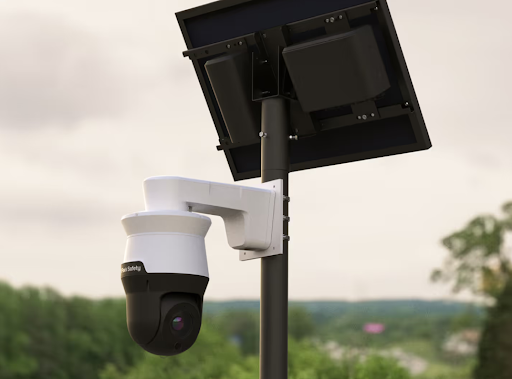
The South Bend Police Department stated in a Facebook post from 2023 that it “has never shied away from embracing technology to help fight crime.” They have remained true to their word—South Bend is now home to 53 automated license plate readers (ALPRs), all but one of them Flock Safety units. The city accounts for nearly two percent of all of Indiana’s ALPRs.
Although Flock Safety offers other products, including video-surveillance cameras, gunshot detectors, and first responder drones, local police departments primarily deploy ALPRs—small, black, AI-powered, shoebox-sized cameras usually mounted high up on streetlamps. Flock Safety dominates the ALPR industry, accounting for roughly 82 percent of the mapped total among competitors like Motorola Solutions, Genetec, and Leonardo.
Flock cameras are generally used to identify vehicles. Many are designed to take pictures of vehicles’ license plate numbers and assist in identifying the make and model of these cars. ALPRs do not actually record and store videos—they only take snapshots of moments in time.
Pictures are enough, however, for law enforcement to reconstruct a vehicle’s movement, as they can map their location with time stamps and cross reference them with other cameras. Pictures are taken together in short bursts, which provides something functionally equivalent to a short video clip.
ALPRs in South Bend offer much promise in regard to solving crime. They have proven enormously useful in identifying cars involved in crimes around the city. Current South Bend mayor James Mueller said, “These are tools that are part of our crime-fighting efforts and they’ve been very effective.” In 2024 alone, Flock cameras assisted the police department in 151 cases, including 50 percent of all homicide cases.
With the mass installation of ALPRs and security cameras across the country, though, public outrage over infringement on civil liberties has arisen. Mueller acknowledged the privacy concerns in South Bend, saying, “You’ve got to make sure that you’ve got the right guardrails. … We believe we have those here locally.”
Many Indiana counties are yielding to public concern over privacy violations and reconsidering the merits of Flock cameras surveilling their citizens. Kosciusko County, located Southeast of St. Joseph County, voted on September 10 to remove all Flock units.
On September 8, Starke County also announced the end of their contract with Flock. Sheriff Jack Rosa of Starke County said, “there were just too many questions for us to keep on doing it. It just wasn’t in the best interest of the public.”
Backlash has been brewing across the country; many citizens feel uneasy knowing that their vehicles are constantly surveilled. Vandals have been active in 36 states, some destroying ALPRs with guns and saws. The prospect of the AI-powered devices operating beyond human oversight has only fueled public concern.
Some oppose ALPRs on legal grounds, citing citizens’ “God-given right to privacy recognized in the Fourth Amendment.” Law enforcement’s newfound ability to track citizens as they move from place to place in their vehicle strikes critics as a blatant violation of their privacy.
Flock Safety is not unaware of the concerns over citizens’ civil liberties. Plastered across their website are mottos that assure the visitor of their dedication to the privacy of communities under the surveillance of Flock cameras. Under a section titled “Raising the bar,” they report that their revised recommendation for data storage has been decreased from 30 days to 7. Flock has also touted “increased transparency around data ownership, security, and agency policies.”
Flock partners primarily with local law enforcement, providing them with powerful surveillance information. This information, placed in the hands of local officials, raises little concern among most citizens. However, Flock does not regulate the information collected on citizens past the use of its customers.
The company employs a hands-off approach in the dissemination of the information gathered using their products. In fact, the Chief Communications Officer told the press that “It is not Flock’s job to police the police.”
Chief among the concerns of critics is the distribution of data to federal agencies, particularly Immigration and Customs Enforcement. Information collected from Flock is not automatically shared with the federal government, and Flock’s website states, “sharing only happens if an agency chooses to participate.”
Therefore, communities could safeguard information from the federal government, and Flock would honor their request. The privacy of citizens’ data is ultimately up to the customer—the local agency—rather than the people themselves. This means that should a local agency wish to share information with the federal government, it would have the ability to do so.
In practice, though, the information is rarely restricted to the eyes of the agency. Inherent in Flock’s business model is a strong incentive to share information with the national database. If local officials should choose to provide access to the data they collect on their citizens, it would gain access to the data of all of the other communities participating in the nationwide network. As a result, 75 percent of Flock’s law enforcement customers have agreed to join the National Lookup Tool and pool their data.
Flock’s technology presents South Bend, like many other American cities, with a difficult decision: to fund Flock ALPRs in hopes of deterring crime or to remove the cameras in the name of citizens’ privacy. Whither, South Bend?
Jacob Schierl is a sophomore majoring in the Program of Liberal Studies and ACMS from Elmhurst, IL. Reach him at jschierl@nd.edu.