
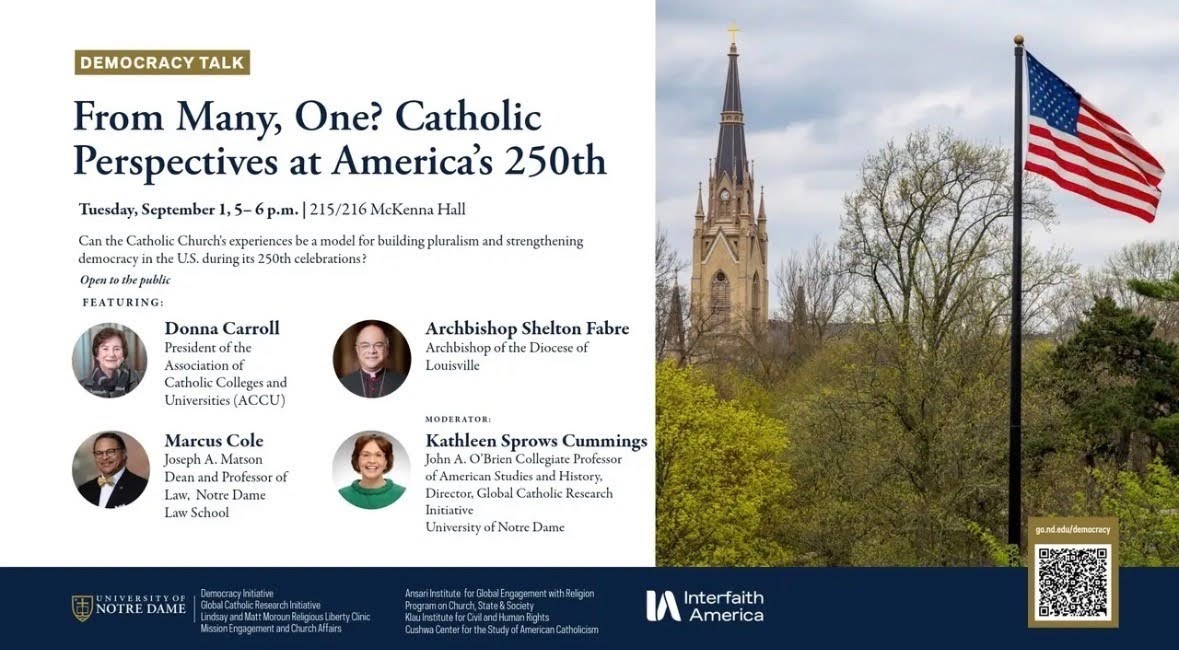
The Notre Dame Democracy Initiative (NDDI) hosted a forum discussing Catholic experiences with polarization and its relevance to American democracy on September 1. The panel discussion was entitled, “From Many, One? Catholic Perspectives at America’s 250th.”
It was hosted in partnership with the Global Catholic Research Institute, Ansari Institute for Engagement with Religion, and the Klau Institute for Civil and Human Rights. The event was also hosted by InterFaith America, a non-profit organization aimed at encouraging political pluralism.
Panelists included Donn Carroll, President of the Association of Catholic Colleges and Universities; and G. Marcus Cole, Joseph A. Matson Dean of Notre Dame Law School; as well as the archbishop of the Archdiocese of Louisville, Archbishop Shelton Fabre, who is currently chairman of the United States Conference of Catholic Bishops’ Committee on Domestic Justice and Human Development.
The discussion was moderated by Professor Kathleen Cummings, the John A. O’Brien Collegiate Professor of American Studies and History, as well as the director of the Global Catholic Research Initiative.
In honor of America’s bicentennial, InterFaith America has launched PluribUS 250—a public initiative aimed at celebrating pluralistic achievements in America’s history. The philosophy of InterFaith America, according to its website, is to “embrace the power of pluralism, where we cooperate across differences for the common good.”
President Carroll commented on the necessity of respect and tolerance when ideas conflict with one another in the sphere of education. She stated, “As I think of pluralism in Catholic universities, I really think of the important opportunity for us to bring people together that are different, and not let[ting] difference be divisive, but rather … enriching our education.”
Abp. Fabre elaborated on Carroll’s point, noting that “the important thing about pluralism is that everybody has a respect for the other person.” He specifically cited the presence of pluralistic interests within particular religious communities, as he stated, “In any archdiocese there are all kinds of different interests—Catholic schools, higher education, youth ministry, Adoration, the charismatic group—all these different things that are all gifts.”
Abp. Fabre continued, tying the pluralism present within the Church to the need for tolerance of each other’s conflicting interests. He explained, “We do respect one another. We look for the giftedness in one another. … So for me, pluralism is differences and different approaches to things, but I think that there’s also a respect there for each and every viewpoint.”
In response to Abp. Fabre, Carroll offered advice on how to engage and confront diversity within a Catholic environment. She said, “If we can ground [ourselves] in that common understanding of what we believe, then we’re not fearing difference. And if we’re not fearing difference, we can engage and learn from it. And it doesn’t need to be divisive.” She added, “I think Catholics are made for this polarizing moment, to be that unifying community and voice that helps democracy move forward.”
Dean Marcus Cole expanded on Carroll’s point by magnifying the importance of pluralism to a national scale. For Cole, the importance of pluralism in the Notre Dame community is that we “actually model for our country what it means to serve.”
To demonstrate his point, Cole provided an anecdote from the Archdiocese of Washington, D.C., stating “The archbishop of Washington, D.C. in 1956 was urged to close Catholic schools in a Black section of Anacostia. … The argument was made to him that we should close these schools because these kids aren’t even Catholic.” And yet, they kept the school open. To Cole, “That’s an example we can set for our country.”
The New York Times notes that Roman Catholic Churches are experiencing a significant surge in adult converts, with many reporting year-to-year increases of 30 percent to 70 percent. The Catholic Church remains the largest non-governmental provider of social services, while also boasting a globally diverse population. Cole provided the following advice: “If we are going to be true to the Gospel, we also need to embrace the immigrant, especially as Catholics. And if we are to grow as a Church, we have to look to where the Church is growing.”
Senai Alem is a sophomore majoring in the Program of Liberal Studies and Arabic. He enjoys reading classics, listening to 2000’s hip-hop, and eating cheesecake. Contact him at salem@nd.edu.