
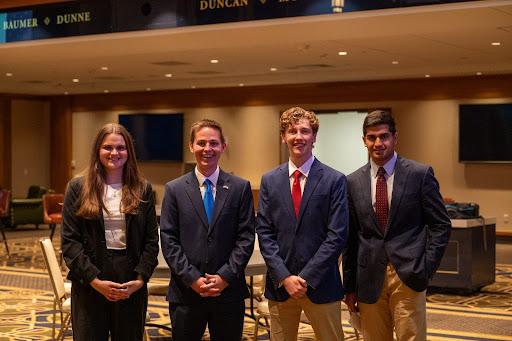
BridgeND hosts first event of its kind in three years
BridgeND hosted a debate between Notre Dame College Republicans and College Democrats on October 8, the first such event in nearly three years. Shri Thakur and Luke Woodyard represented the College Republicans, and Alex Young and Alex Funk represented the College Democrats. Professor and director of the Kroc Institute’s Mediation Program Laurie Nathan moderated.
Debaters tackled key issues such as immigration, tariff policy, political violence, and the Israel-Palestine conflict in front of a filled Danke ballroom on Wednesday evening.
Republicans touted Trump’s successes with economic gains from manufacturing, border security, and took several jabs at the Biden administration, while the Democrats highlighted alleged authoritarian overreach, criticized deportation policy, and discussed Obamacare.
Professor Nathan posed the first question, addressing immigration, to the Republican side, asking whether or not recent enforcement actions represented “executive overreach,” or were simply “the implementation of a stricter immigration policy to address the leniency of past administrations.”
The Republicans presented ICE enforcement as a strength after they stressed President Biden’s mishandling of the border, saying, “Ten million illegal immigrants … poured into our country, overwhelming our cities, sending the price of housing soaring, and in many cases committing heinous crimes against our people.” Democrats pushed back, saying, “This [ICE tactic] is an example of authoritarianism. No more due process rights under this administration because the Republican Party is not the party of law and order.” They also highlighted the need for amnesty and lack of immigration reform legislation.
On healthcare, the parties sparred on comments revolving around the Democrats’ support for healthcare for illegal immigrants and the prior passage of Obamacare. Democrats began the segment by arguing that “Republicans shut down the government,” and argued the Big Beautiful Bill (BBB) threatened to kick millions of people off their health insurance. Republicans, conversely, blamed Democrats for the shutdown, pointing out they had voted for the budget they are now blocking in March.
The Republicans continued, “By shutting down the government, [Democrats] are threatening essential health care services for Americans right now, including health care for women and children, telehealth services for Medicare, and community health centers that don’t have funding anymore.” The Republicans also criticized Obamacare and claimed that the BBB did not cut Medicaid but only instituted a 20-hour work requirement to receive it.
The debate then moved to tariffs. Republicans defended President Trump’s tariffs as “affirming the fundamental principle that making things in America matters,” while Democrats criticized them as causing inflation. The Republican side argued that “tariffs don’t cause inflation … because they don’t change the money supply,” and pointed out that inflation was much lower today than under the Biden Administration.
The Democrats responded, “Tariffs do cause inflation. Ask your professor.”
The two parties seemed to reach common ground when discussing the war in Israel. Democrats began the segment by discussing the need to hold Israeli Prime Minister Benjamin Netanyahu “accountable” for Israel’s actions in Gaza, while still referring to Israel as an important strategic ally. Republicans agreed to some extent, arguing that, “We agree that what’s happening in Gaza is a humanitarian crisis. We agree that the Israeli conduct in the war has gone way too far. And we agree that the broader escalation of this war in the region is not in American interests.”
Republicans added, however, that Biden had failed to restrain Netanyahu and that the recently brokered ceasefire was the result of President Trump’s actions alone, while Democrats tried to take credit for the peace deal.
Both sides condemned political violence, but the Republican side drew a distinction between the words of the College Democrats and the actions of the national party. They specifically pointed to the refusal of national Democrats to call on Virginia Attorney General candidate Jay Jones to withdraw from the race after text messages were leaked showing him wishing death on a political opponent and his children.
“[The Democrats] can give speeches on how much they love dialogue all they want. But if they’re not willing to sacrifice a little bit of political convenience for this cause, then they don’t believe in it at all,” the Republicans said.
The debate concluded with questions on both the flaws in the Democratic and Republican parties and some audience questions, which included topics such as the Epstein files and illegal immigration.
Lewis Junior Lily Vonderwell told the Rover, “I was impressed by the turnout on Wednesday and found it comforting, regardless of what side they are there for, that so many ND students were taking an interest in the debate. Genuine interest and time invested is the first step towards combating the ‘globalization of indifference’ that was quoted from Pope Francis, at least in the realm of politics.”
On the question of which side performed better, freshman student Declan Harrington perceived a decisive Republican victory, telling the Rover, “At Bridge ND, much like in the 2024 election, the intellectual and moral superiority of Republican leadership was evident in the rhetoric of Shri and Luke. The debate offered a glimpse of our nation’s future in action. I’m looking forward to the next event and another Republican victory.”
Conversely, Baumer sophomore Quinlen expressed some frustration with both sides, saying, “It’s a shame that neither party of the debate accurately depicted the genocide that is ongoing in Palestine, but rather tiptoed around the issue that should have been directly addressed in a very clear and open way.”
Senior Keough resident Connor Whalen added, “From the beginning, I was pretty impressed by the event. There was a great turnout, and people were pulling chairs from all over into the ballroom to have a place to sit. I was a little underwhelmed by the depth of the discussion, though. There was a very limited time allotted to a given topic, and there was never any direct back-and-forth allowed between the two sides.
He concluded, “Overall, I’m glad I attended, and I hope there are a lot more debates and forums for controversial discussions moving forward.”
Kevin Andrews is a junior studying Political Science and Economics. He can be reached at kandrew6@nd.edu.
Photo Credit: BridgeND Instagram
Subscribe to the Irish Rover here.
Donate to the Irish Rover here.