
Letting go of the future and giving a gift that grows
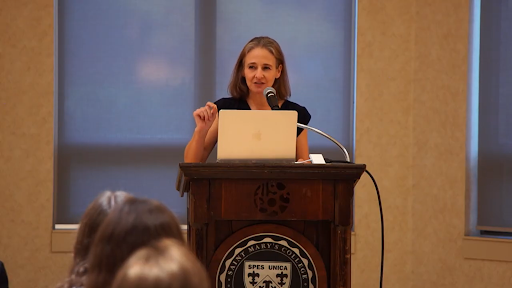
Catholic theology, Aristotelian philosophy, and modern literature met in the annual McMahon Aquinas lecture, delivered September 17 at Saint Mary’s College. The talk, titled “Motherhood and the Meaning of Self-Gift: Reflections on The Giving Tree,” was given by Angela McKay Knobel, Professor of Philosophy at the University of Dallas and Visiting Scholar at the de Nicola Center for Ethics and Culture.
Drawing on insights from Lewis Hyde’s book The Gift and Shel Silverstein’s The Giving Tree, Knobel examined the subject of what constitutes well-ordered maternal self-gift through the lens of her upcoming book about motherhood and virtue.
Though The Giving Tree is widely regarded as a children’s classic, Knobel noted that many parents take issue with its portrayal of self-gift, which can appear suicidal and self-desructive. Knobel argued that advocates of either position ought to be asking themselves a different question, instead: What makes good giving—especially in the context of motherhood—different from bad giving? Indeed, what is the nature of giving?
According to Knobel, critiques of The Giving Tree often fail to “accommodate the narrative shifts that occur in the story itself.” In the first half of the story, the tree gives in such a manner that she can continue to do so. This changes in the second half, when the tree “progressively destroys [her] ability to give”: her apples do not grow back, her limbs are cut off, and ultimately, she becomes a stump, unable to give to anyone.
Using Mother Teresa’s ill health as an example, Knobel argued that self-diminishment need not necessarily be opposed to good giving. Indeed, even after Mother Teresa’s passing, her legacy continues to be a gift, as does her sainthood. A gift ought to inspire gratitude in the recipient, the desire to give to another because you yourself have received a gift. A gift, Knobel said, “[ought] to grow in the giving.”
Knobel explained that some gifts, such as the dedication of immigrant parents to their children or the sacrifice of kidney donors, inspire gratitude. Other gifts do not. The reason some unstinting gifts do not inspire gratitude is that not all gifts are good, despite what some parents may believe.
Happiness, a gift many parents try to give their children, is an admirable gift. However, Knobel said that “many mothers, both real and fictional alike, approach securing their children’s happiness as a matter of seeing to it that certain things happen in their child’s life.” But trying to foist happiness on another almost never works.
Rather, Knobel said one gives a gift like happiness “only by bearing witness to whatever it is one wants to give,” even if the giver is not a perfect witness. Further, in order to give in such a way, the giver must be willing to let the gift develop over time and to put in the long effort required of giving. Thus, in order to be able to truly give, a mother must be willing to let go of control of her child’s future and live a life that inspires her child to give as well.
Attendees were then given the opportunity to ask questions. Therese Cory, Director of the Maritain Center and John and Jean Oesterle Associate Professor of Thomistic Studies, asked if Knobel saw a connection between St. Thomas Aquinas’ remarks on teaching and the idea that, “when we’re giving a gift, we’re giving to someone who’s fundamentally an agent,” and has dignity as such.
Knobel said that such a connection was likely subconscious but still real. She added that her favorite passage in Aquinas’ work is found in De Veritate, where “[Aquinas] talks about how you can’t teach people. All the teacher can do is assist the movement of the students’ own reason from premises to conclusion. A student has to do that work on their own or they don’t learn.”
Giving is much the same, at least in motherhood. A mother cannot force happiness on her child, all she can do is try to guide her child to happiness through her own example.
One student who attended the lecture told the Rover, “I think the idea of motherhood is especially prominent [at] a women’s college. … Reading books as women in society, we hear a lot about how do we give and not give too much? So, hearing that from the perspective of a book we’re all familiar with and a woman who also is working actively and as a mother is really beautiful. ”
Another student told the Rover, “I think [the lecture] brought a lot of perspective for me as a young woman about what my goals should be as a mother and as a person.”
Lilian Lewen is a sophomore history and philosophy major from Indianapolis. If you’d like to hear her ramble on about Thomists or rant about Irish terriers and their troubled history with Notre Dame, email her at llewen01@saintmarys.edu.
Photo Credit: The Edna and George McMahon Aquinas Chair in Philosophy on Youtube
Subscribe to the Irish Rover here.
Donate to the Irish Rover here.