
Professor speaks against ‘tampering’ with history
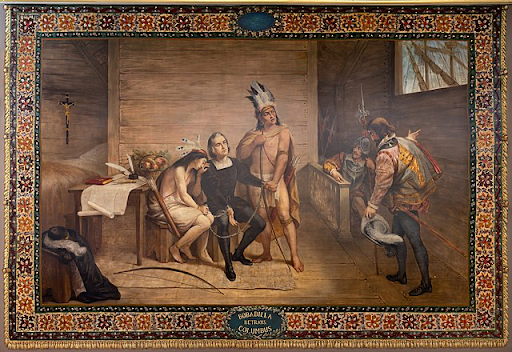
Under the Golden Dome rest 12 murals, painted onto the walls of the Main Building from 1882 to 1884. Commissioned by Fr. Edward Sorin, C.S.C. after the 1879 fire that destroyed the second iteration of the Main Building, these paintings depict the life and death of Italian navigator Christopher Columbus.
The artist, Luigi Gregori, left his post at the Vatican for a position at Notre Dame as a professor and artist-in-residence, which he held from 1874 to 1890. During his time at the university, Gregori designed and painted works for many buildings on campus, including the basilica, the Main Building, and St. Edward’s Hall.
In 2019, then-university president Fr. John Jenkins, C.S.C. announced that the murals would be covered in response to growing unrest from students, faculty, and alumni, who objected to the portrayals of the Native Americans in the murals, calling them “culturally insensitive” and claiming that the paintings “celebrated” indigenous enslavement.
All 12 paintings were covered by tapestries in September of 2020, secured by wooden frames attached to the paintings. These covers remain in place, removed only a few days each academic year for educational purposes. The murals were most recently on display from October 27 to 31.
The Rover interviewed Felipe Fernández-Armesto, the William P. Reynolds professor of history at Notre Dame, in a conversation about the history of the murals and their importance to the university.
Fernández-Armesto began by noting that the university’s objections to the murals existed long before the outburst in 2019. In 1986, the titles of a few of the murals were painted over and changed in what the historian called a “falsification of historical documents.”
“The other thing that you notice here is it says, ‘Columbus, Explorer.’ And Gregori’s original caption to this painting said, ‘Columbus, Discoverer,’” explained Fernández-Armesto. “Not only have the murals been obscured—in other words, these very important historical documents that have shown us so much about the history of Notre Dame, and the history of the perception of Columbus in this country, and the history of U.S. performances—not only have they been obscured, they’ve actually been distorted and tampered with.”
“To me, these are historical documents, and if you change the language of a historical document, you’re tampering with the evidence,” he concluded.
As Fernández-Armesto pointed out, this aversion to referring to Columbus as a ‘discoverer’ was an unfounded one. “[Columbus] was a discoverer because … he was the first person to discover a viable route back and forth across the Atlantic, linking the densely populated and rich part of the Old World and the densely populated and rich part of the New World.”
But the proper interpretation of the murals requires an understanding of their original context and purpose.
“Back in 1879, the Main Building is burnt down,” Fernández-Armesto explained. “[Fr. Sorin] has done wonders in raising money to rebuild it. 1883 he’s got to decorate the interior, and he chooses Columbus, I think partly, obviously, because of his agenda of showing that you can be Catholic and American. … This is a response to nativist skepticism about the feasibility of being a loyal American whilst also being obligated to this ‘foreign power,’ as they called [the Vatican] in their case.”
“Columbus was generally a national U.S. hero,” said Fernández-Armesto. “So Columbus was, in that sense, a very sensible choice. … But I think above all, Columbus appealed to [Fr. Sorin] because [his] vision for Notre Dame … was going to show the world that Notre Dame could be part of the creation of a newer, purer kind of Catholicism than immigrants had left behind in the Old World.”
Gregori’s own intent in the murals’ design is another important consideration, Fernández-Armesto told the Rover.
“I think [Gregori] was a romantic. He had a kind of romantic notion of what history painting was—not that it was meant to represent the facts of history, but that it was meant to exploit history as a source of moral exemplification. And you can see that’s why they were tapestries,” said Fernández-Armesto, referring to the fact that the paintings are themselves set within a tapestry border.
The historian continued, “[Gregori’s] saying, ‘These aren’t paintings of real scenes. They’re paintings of tapestries depicting real scenes.’ He’s deliberately distancing himself and the onlooker from the historical events that are represented, which were completely different from what Gregori chose to show us.”
As Fernández-Armesto told the Rover, the murals “show a very positive image of the Native Americans as these grand, noble figures.”
“Why do the murals need protection? It’s because people don’t look at them and don’t see what they’re really about. They don’t understand that they’re actually a tremendous exultation of the Native Americans as these noble, innocent, pure beings who are going to be the basis of the new Church that Fr. Sorin is hoping Notre Dame will lead on this side of the Atlantic,” Fernández-Armesto said.
He continued, “They don’t appreciate that Gregori’s aim was not to show historical episodes, but to show morally uplifting and improving versions of those episodes, which shouldn’t be judged on their historical accuracy—that’s irrelevant. They should be judged on the noble and deeply religious intentions that they represent.”
“We haven’t got any other public art in this university that celebrates the Native American contribution to the heritage of Catholic America,” Fernández-Armesto said. “I hope that, because this is a university where we value truth and where we ought to be teaching people to see what is really there when they look at historical documents, … we will get back to the point where people … come to embrace these murals as a living part of the heritage of the university, a really critical document in the past, not only of Notre Dame, but of American Catholicism.”
Lucy Spence is a junior from McLean, Virginia majoring in piano performance and the Program of Liberal Studies, with a minor in philosophy. She can be reached at lspence@nd.edu.
Photo Credit: Matt Cashore/University of Notre Dame
Subscribe to the Irish Rover here.
Donate to the Irish Rover here.