
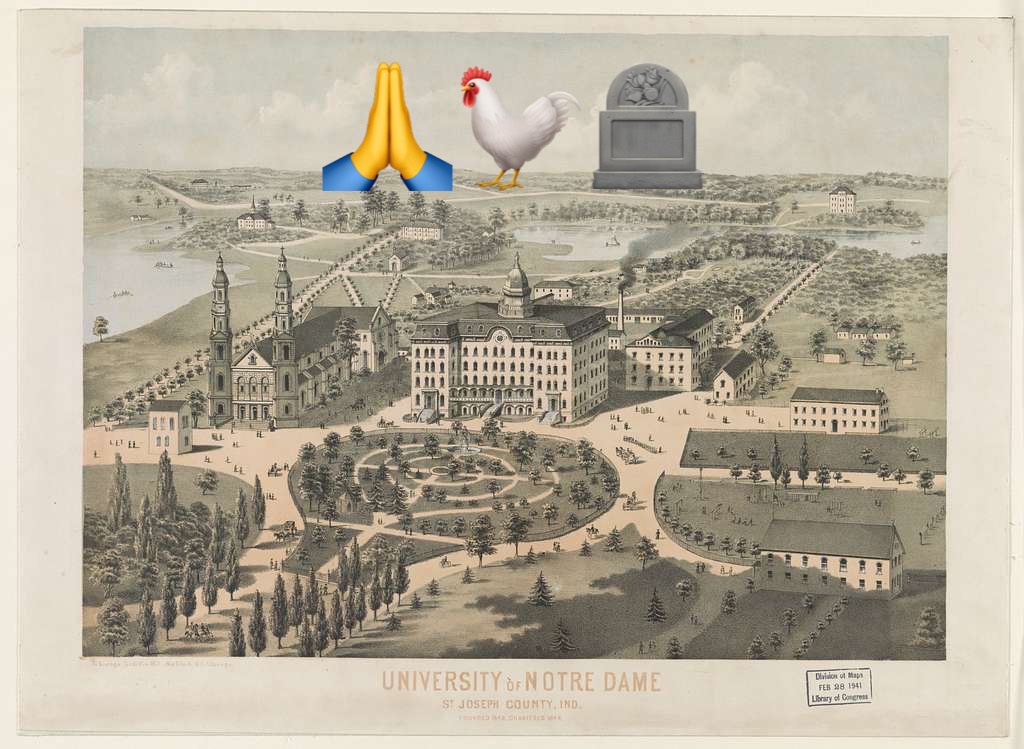
And it’s better than yours
We at the Irish Rover acknowledge that the land on which we periodically associate (i.e., Flanner Hall) once supported the lives, languages, and cultures of many forgotten academic departments whose names are not all known to us today. We honor their memory and recognize that their absence from this land is the result of historical violence and displacement over the last three decades. We don’t know what it was, but it was no doubt unjust.
Even more grievously, we want to honor the memory of the dispersed peoples who first called this land of Flanner home in 1969: the Gamecocks People. The entire building of Flanner, including our fifth floor, is the traditional, ancestral, unceded land of the Gamecocks, or “Cocks,” as they called themselves.
Several representatives of the Cocks still occupy the nearby lands, namely Fr. John Jenkins, C.S.C. and Nicholas Sparks, and we want to honor their gracious hospitality. In commemoration of the significant cultural contributions of the Cocks, we at the Rover will be establishing a museum showcasing such important Gamecock cultural artifacts as framed pictures of Fr. Jenkins with Presidents Obama and Biden, as well as a first edition of The Notebook.
Of course, the construction of Flanner was only made possible by the decimation of Vetville, a “temporary tribe” of World War II veterans and their families living in “thirty-nine prisoner-of-war barracks” from Missouri. We are grateful to the veterans for their service and for graciously ceding their homes so that the Notre Dame administration could build the ugliest high-rise buildings conceivable.
To continue honoring all involved parties and peoples who called this place home before the construction of Vetville, we want to acknowledge and honor the 19th century French settlers who used to play “sóççèr” [sic] in that unused patch of grass east of campus. In their honor (and for no other reason), EIC emeritus Michael Canady plays sóççèr once a week mere yards north of the ancestral C.S.C. sóççèr field.
We would be remiss not to acknowledge our presence on the land of the Pokégnek Bodéwadmik / Pokagon Potawatomi peoples, who have called this land their home since the mid-1700s. However, we must call attention to the disturbing fact that the 18th century Potawatomi failed to issue any sort of land acknowledgment when they moved into land which had been inhabited by the Miami tribe before the Iroquois displaced them over hunter-ground power struggles. Neither did the Iroquois release a statement of apology or reconciliation for their aggression toward the Miami. Nor did the Miami publish a land acknowledgment when they moved into the area in the late 17th century. Get with it, guys. This is what we do now.
We also must acknowledge our presence on the native land of various indigenous Ice Age megafauna, such as many unnamed (but never forgotten) mastodons, mammoths, and giant ground sloths, whose memory we honor. And while these megafauna didn’t publish a land acknowledgment either, we believe they can be pardoned because glacial movements of the Ice Age decimated any Paleozoic and Mesozoic geological records. They couldn’t have known about the dinosaurs that likely lived here before them. Also, written language hadn’t been invented, so you really can’t hold it against the megafauna.
We also hang out at O’Rourkes sometimes. Big thanks to them.
James Whitaker is a graduate student in the theology department. He accidentally became an Indiana history buff in his preparations for this land acknowledgment (none of this was fabricated; see the online version for his credible source hyperlinks). If you have any further information for him about human habitation of northern Indiana before the late 17th century, you can reach him at jwhitak5@nd.edu.
Photo Credit: Irish Rover
Subscribe to the Irish Rover here.
Donate to the Irish Rover here.