

A look into ND’s 1.7 billion-dollar annual budget
This past summer, Notre Dame’s executive officers announced a 2.5 percent cut to the university’s annual budget, a pause on new construction and renovation projects, and a continued suspension of new staff hiring. This decision will drastically change the university’s expenditures, which totaled 1.68 billion dollars in 2024. In light of these changes, the Rover investigated how Notre Dame spends her money.
An exhaustive account of the university’s spending in a given year is difficult to come by. While a number of budget tools are available on InsideND, they require authorization to access. This is not unusual for private universities. As one Mendoza professor told the Rover, “It is common for private universities to have somewhat private financial records. Public universities tend to have more detailed records … publicly available because of state laws requiring transparency for government-affiliated institutions.”
Still, a number of financial documents are available to the public—namely, the university’s Annual Report, Consolidated Financial Statements (CFS), and IRS 990 filing.
The 2024 Annual Report is useful for identifying the university’s major sources of revenue. Payout from Notre Dame’s 20 billion dollar endowment constituted the university’s major source of funding in 2024, with tuition and Auxiliary Enterprises in second and third place. Notre Dame received 375 million dollars in revenue from tuition and 362 million dollars in revenue from Auxiliary Enterprises. Funding from grants declined slightly in 2024, and termination of millions of dollars in federal grants will certainly see this number decline in the coming year.
Professor Emeritus of Accountancy Edward Hums served as assistant comptroller for the budget under Father Theodore Hesburgh, C.S.C. In an interview with the Rover, Hums said, “Things have changed. … Notre Dame has expanded and got much bigger, and got more complex. But many years ago, I used to compile the budget by hand.”
According to Hums, after revenue from Auxiliary Enterprises and unrestricted endowment funding has been determined, the budgeting team set the price of tuition. “So then you go through and you balance all the numbers out, and you come up with what’s left is what the revenue from tuition has to be,” Hums explained.
Hums spoke to his personal experience as a former Notre Dame student and his considerations in setting tuition prices: “This was the hardest part of putting a budget together, coming up with a tuition rate.”
He continued, “My mom and dad put three kids through Notre Dame and got literally no financial aid. … It was very much a sacrifice for my parents. I mean, they gave up everything so they could give the greatest Catholic education in the world for their kids. … So when you were putting that budget number together, it was very personal. … You always wanted to keep it as low as possible.”
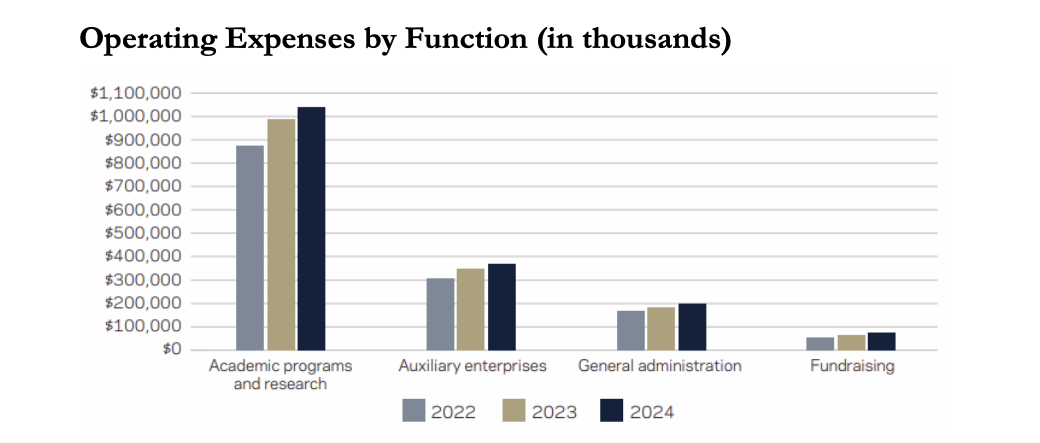
Notre Dame’s Consolidated Financial Statements document provides an introduction to the university’s budget. This statement splits operating expenses into four categories: Academic Programs and Research, Auxiliary Expenses, General Administration, and Fundraising. The CFS is the source of the aforementioned 1.68 billion dollar figure, though it does not contain a comprehensive breakdown of university spending.
Unsurprisingly, the majority of Notre Dame’s spending falls under Academic Programs and Research, which receives over one billion dollars annually. Auxiliary Enterprises come in second, receiving over 360 million dollars. According to the CFS, these expenses cover athletic programs, dining halls, student dorms, bookstores, and events management. While Auxiliary Enterprises are a significant expense, they are an important source of revenue for the university via ticket sales, media licensing, and billing for room and board. Additional information on the General Administration and the Fundraising categories is not available in the CFS.
The university’s IRS 990 filing goes into greater detail. This filing records the amount of money allocated to the university’s day-to-day operations, highest paid contractors and “key” employees, as well as grants awarded by the university.
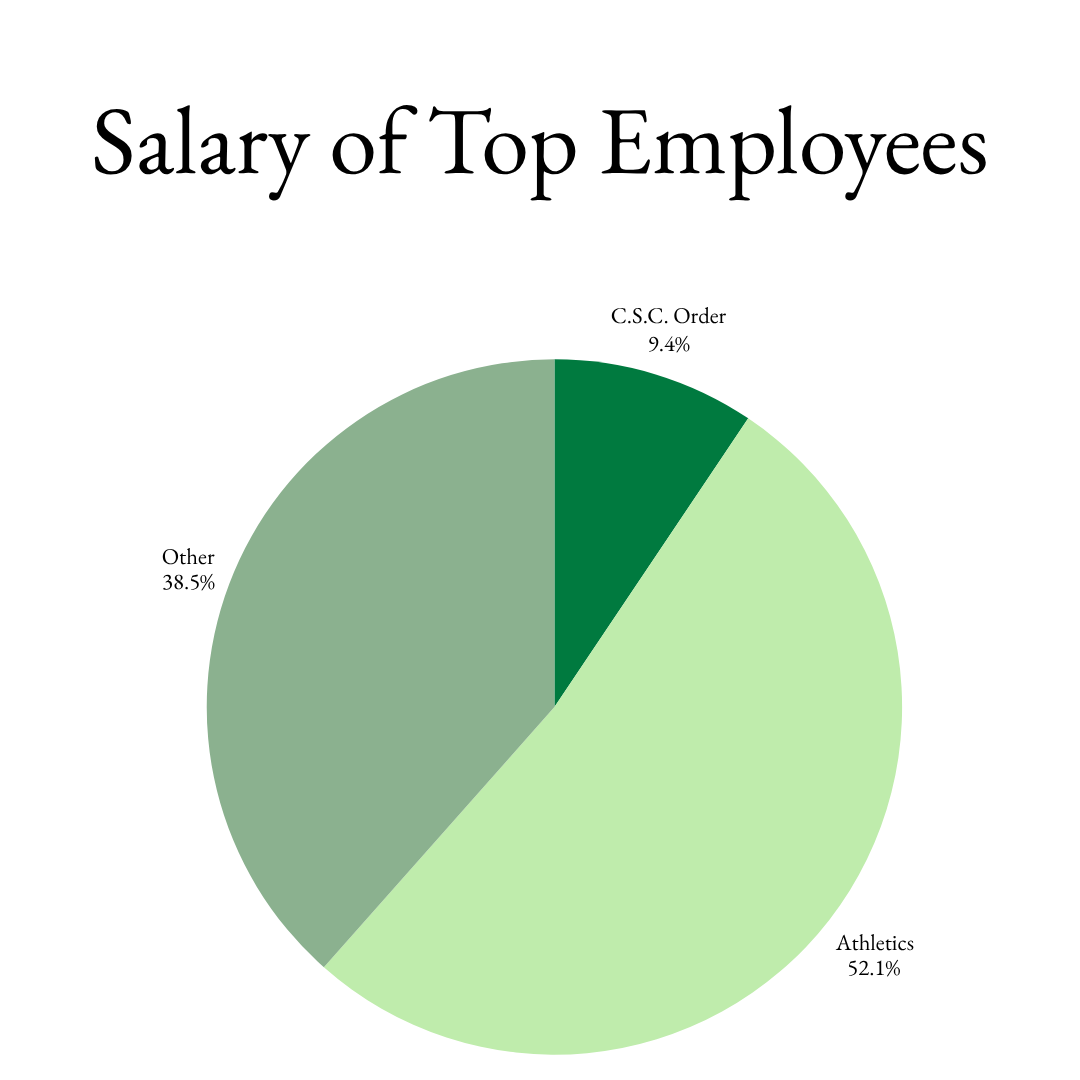
The salaries of fifty-two employees are available on the filing. Per the filing, these employees are either “officers, directors, trustees, key employees, [or the] highest compensated employees.” These fifty-two employees earn a combined 26.5 million dollars, though it should be kept in mind that the forty-one trustees listed are not paid and the salaries of highly compensated Holy Cross priests are paid directly to the religious order. Academic figures are not the highest salaries paid by the university. For example, Head Football Coach Marcus Freeman brings in over six million dollars in base compensation. According to the CFS, the university spent nearly 770 million dollars on salaries and wages in 2024.
The IRS 990 filing reports over 450 million dollars in “grants and other assistance to domestic individuals.” The overwhelming majority of this spending, about 439 million dollars, is allocated for scholarships and fellowships. The 357 total recipients of grants from the university are diverse, with award amounts ranging from less than ten-thousand to over a million dollars.
The majority of grant recipients are other universities, Catholic parishes, seminaries, schools, and various non-profit organizations. While universities consistently received larger grants from Notre Dame, several non-profit organizations received grants in excess of one-million dollars: the Christ Child Society of Detroit, the Henry M. Jackson Foundation, the South Bend Elkhart Regional Partner, and The Lord’s Place.
Notre Dame’s annual spending is comparable to other top Catholic universities—despite its significantly larger endowment. For example, Georgetown University reported over 1.8 billion dollars in expenditures in 2023 with only a 3.6 billion dollar endowment while Boston College reported a 1.1 billion budget.
Compared to these other universities, Notre Dame is quite generous in awarding grants. For example, Georgetown’s IRS 990 filing lists 186 grant recipients while Boston College’s filing lists only four. This increased grant giving is not unexpected since Notre Dame’s revenue is nearly double that of Boston College and Georgetown’s.
Federal grant cancellations and heightened endowment taxes have dramatically impacted Notre Dame. In response, the university’s executive officers expressed intent to reduce the university’s budget. In a message to the university’s faculty and staff, the executive officers wrote, “It is clear that the reductions in federal and state funding are likely to be long-term. Those institutions that will thrive are those that can adapt by becoming better stewards of their resources.”
Hums highlighted Notre Dame’s remarkable ability to manage the university budget over the years. In reference to the team at the budget office, Hums remarked, “They bought into the budget. They were serious about meeting the budget. They did not tolerate overspending. I guarantee that they did not tolerate overspending.”
In response to the recent federal attacks on university finances, Hums reflects on the team’s conservative budgeting. “And sometimes I think when Father Bob talks about the budget … the reason that we’re able to take some of the budget hits now are we had a very conservative and very thrifty management way in the past. I kind of think my predecessors and myself … and that’s kind of what we contributed to the university.”
Andrew Blake is a sophomore in Keough Hall studying political science. He can be reached at ablake5@nd.edu.
Photo Credit: University of Notre Dame
Subscribe to the Irish Rover here.
Donate to the Irish Rover here.