Leah Sargeant on the dependence that marks us all
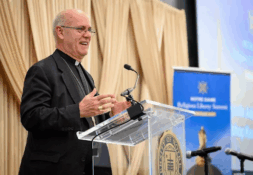
Leah Sargeant is a mother, wife, writer, and public policy analyst in Washington, D.C. Her book The Dignity of Dependence: A Feminist Manifesto was published in the fall of 2025 with Notre Dame Press.
Could you give a brief synopsis of The Dignity of Dependence?
My book has two ideas at the heart of it: that women’s equality with men does not depend on our being interchangeable with men, and that the natural state of what it means to be a human being is to be dependent, not to be autonomous.
How has your vision of dependence changed throughout writing the book?
I think a lot of it is trying to braid different ideas together. The paradigmatic example throughout the book is pregnancy, because that’s the specific form of openness to another’s needs that’s distinctively female. Taking a generically human approach to life means you will shortchange women, because this isn’t something that is shared by men. And then it’s about looking to where you have moments that are also about exposure to need, or exposure of your own needs.
Where this example is so fruitful is the image of a mother brought up by the Church Fathers. We all can look to this image to guide our life. St. Augustine urges us to become mothers of Christ by bringing people to new birth in baptism, as maternity is a moment of love that makes you vulnerable as you care for someone’s need. The goal of my book is to show how this idea is not so alien to everyone else.
How can college students create a greater culture of dependence, especially when it’s so easy to live an autonomous life?
I’ll give two pieces of advice, one that’s more institutional and one that’s more individual. I think it’s good, though uncommon, for schools to co-locate pre-schools and nursing homes on campus. In this weird moment where you get this very age-stratified social group, you have an invitation to think about what else is coming in your life.
The other thing for countering individualism is making yourself more vulnerable. Take on bigger, more ambitious projects. Do something that might fail, where you’re going to have to call someone and ask for help. For me in college, that was often theater. There will be moments of crisis where you have to drop everything to help someone else, or you will have to grab whoever’s nearby for help yourself. I had to get three stitches when I worked on Romeo and Juliet my freshman year—you don’t have to lean into that part. But if you take on something weird with other people, you find yourselves over your skis very quickly, and that’s good.
What advice would you give to ambitious young people, like those at Notre Dame, who might struggle to live the vision of dependence you’re proposing?
It is good to develop the talents you’ve been given, and it’s good to think of yourself as a steward of these talents, and not the owner. Ambition is good when it’s directed towards the idea that God has given me gifts, and I’ve got to find a way to put them to work. If He’s given me this intellect, then there’s a way I’m meant to serve people with this intellect, which is different than, “I need to win this particular award.” But I don’t want to counsel people away from ambition or excitement about developing what God has given you.
I think the other thing that goes with this is you need a sense of freedom when your plans don’t work out. One of the places that this can be found is the stories of the martyrs. A story that really struck me is about a priest in Iraq who was captured by ISIS. Even while he was imprisoned, he said that he was freer than his captors. He was free to pray, and he had this peace in God that was apparent even to his captors, as they would even ask for advice about their marriages or ask him to pray for them.
Obviously that’s not the same thing as not getting the job I wanted, but I think, even in those moments there’s something to learn from a man in prison, under threat of death, who is radically free because he dwells in God. I am also free in that way. I’m free to do good, even if a particular way is closed, because I’m free to pray. I’m always free to love other people. For me, that gives a sense of incredible freedom of action. Many doors can close, and yet this one critical door of the heart remains open.
In what ways do you think your book would have been different if you weren’t approaching it from a Catholic perspective?
I think there’s a turn or a volta in the book in “The Blessings of Burdens” chapter. Up till then, I am more making the case of, “You are dependent, you have to acknowledge this because it is true, and you might not want it to be true.”
But the more you try and work against the grain of human reality, the more you don’t secretly become autonomous. You just develop painful compromises to hide your dependence. Chapter Seven is making the case that, not only are you not autonomous, but also that it’s good that you aren’t autonomous. Don’t hope for this!
While I think you can make that argument for dependence as a non-Catholic, you definitely have to make it as a Catholic. There’s no way out, because we are people who are dependent on God for our salvation, for being loved and to be. You could be someone who’s secular, who resents embodiment, but is realistic about it, and says resenting it moment to moment isn’t helpful. But you can’t be a Catholic and resent dependence, because you’re poisoning your love for God.
How has discovering your own dependence shaped your prayer and relationship with God?
The image of maternity is something we all participate in—men or women—because we all have a mother and are carried by her. In pregnancy, you may not know the gender of your baby, you don’t know what their personality is, but you love them simply because they are. And then after birth again, there are some parts of a child’s personality that come out, but mostly you love them because they exist, and certainly not because they’re doing things for you or repaying you.
I think it’s easy to fall into the trap of thinking: how can I pay God back so that I’m not in His debt, or how God could love me if I don’t do anything for Him? Even though it’s not perfectly analogous, the experience of being loved as infants is our tutorial in being loved simply for being, and reminds us that God does not love us for what we can do for him. He loves us because we are. Of course, the tricky thing is, none of us remember being loved as infants, which is a nice thing about living in a culture where there are babies—you get to kind of spy on people and say, “That’s how I was loved.”
Elizabeth Mitchell is a junior in the Program of Liberal Studies and theology. She can be reached at emitche8@nd.edu.
Photo Credit: Word on Fire
Subscribe to the Irish Rover here.
Donate to the Irish Rover here.