
Fr. Stephen Koeth on the problem of community and catechesis
Green lawns, fenced yards, and a comfortable commute—suburban life is now a staple of modern American culture. But behind its mundane appearance lies a complex and quite recent history that has dramatically reshaped American Catholicism.
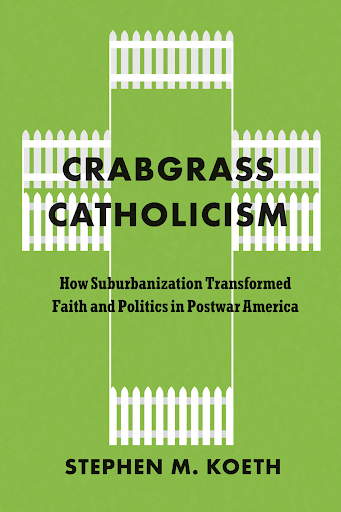
In his debut book, Crabgrass Catholicism: How Suburbanization Transformed Faith and Politics in Postwar America, Rev. Stephen M. Koeth, C.S.C. delves into the shift from a communal practice of the faith in the city to the private, family-oriented Catholicism of the suburb. Fr. Koeth is both a Notre Dame alumnus and an associate professor of urban, religious, and political history at the university.
What follows is adapted from an interview with the Irish Rover on Crabgrass Catholicism.
Fr. Koeth, himself a native of Staten Island, chose to center his research on New York City. He explained that in response to the suburban boom of the 40s and 50s, the Vatican established the first fully suburban parish in the nation as the Diocese of Rockville Center on Long Island.
“Catholics across the country noticed this and took note and said, let’s pay attention to the Diocese of Rockville Center, because this is proof that the Vatican sees the suburbs as the future of the Church in the United States. We can watch what’s going on there, and we can learn how to transplant the church into the suburbs outside of Chicago and outside of Detroit and outside of St. Louis and outside of Boston,” he continued.
Fr. Koeth described New York City and specifically the Diocese of Rockville Center as a “case study” that is “emblematic” of how postwar suburbanization reshaped Catholic faith, parish life, and political engagement across the United States after World War II.
During the interview, Fr. Koeth noted that many of the shifts that Americans ascribed to the Second Vatican Council “were already underway even prior to the council, and that the council really is ratifying or approving changes that were already coming up from the grassroots, not from the bishops and from theologians and documents from the Vatican on down, but from the bottom up.”
For example, the rapid development of suburban communities challenged parish communities to adapt. Fr. Koeth explained, “[Imagine] last year, [the] land was all potato farms; now, all of a sudden, you’ve got 2000 families, and you establish a brand new parish.”
He continued, “Well, that priest is probably by himself… [with] 2000 families. They’re going to have to have the laity be involved in recruiting people to join the parish, and do the funding drive to build the building, and probably do some work to find a temporary place for Mass to be said.”
Education was likewise affected: “There are no nuns in the school because there’s no school yet. So who’s teaching the kids catechism? The parents are going to have to do that.”
Fr. Koeth continued, “All of a sudden, the laity, because of suburbanization, is doing a lot more in leadership and authority in the Church than they had done before, and that’s before Vatican II says the Church is the people of God and the laity have a mission, a role in the mission of the Church.”
More than just an “area outside the city,” suburbs also brought a new, more private mentality to Catholic practice.
Fr. Koeth explained, “[In] the Old Irish neighborhood, the old Italian neighborhood, the old Polish neighborhood, you participated in Mass because you were Catholic, and because you were Polish, and because you lived in the neighborhood, and because your parents did it, and because your grandparents did it, and they lived nearby. The webs of connection were tight and universal.”
“In the suburbs,” Fr. Koeth continued, “the practice of the faith is less a product of one’s place in an interconnected community, [an] ethnic community. Now your practice of the faith is a personal choice, and you make that personal choice amidst a variety of personal choices. Should I be a Mets fan or a Yankees fan? You know, should I drive a Chevrolet or a Ford? It’s consumer culture. I’m the arbiter, and I pick and choose what will compose my identity.”
As a result, parishes, while no longer divided on ethnic lines, became divided on the same socioeconomic, racial, and ideological lines as the suburbs themselves.
By the later half of the 20th century, an individualistic mindset had crept into the moral life of American Catholics as well. Fr. Koeth gave the example of Pope Paul VI’s Humanae Vitae, which reaffirmed Church teaching on the immorality of contraception. He explained that at the time,“[the laity] continue to practice artificial means of contraception, and, as I argue here, that signals that the credibility and authority of the hierarchy was being called into question. Lay people are basically making their own choices. They’re saying ‘the bishops might say this is immoral, but we’re still going to do it.’”
He continued, “In a way, that would not quite have been true prior to Humanae Vitae and prior to the Second Vatican Council. You have Catholics who feel very comfortable calling themselves Catholics and participating in the life of the Church, and yet they don’t follow the Church’s teaching on contraception.”
Fr. Koeth concluded on a hopeful note, “The path forward rests on young people today. A lot has been spoken of in the last couple of months about how Gen Z may be coming back to religion. OCIA programs are booming.”
In particular, Fr. Koeth hopes that by leaning into community and catechesis—both of which were deeply impacted by suburbanization—the Church can “provide what [young people] are looking for-–provide that community [and] answer the big questions of life.”
He concluded, “The two problems are community and catechesis. The two solutions are community and catechesis.”
Crabgrass Catholicism is available for purchase from the University of Chicago Press. Fr. Koeth’s article Crabgrass Catholicism: Suburbanization and the Plight of Black Catholics can be found online in the Church Life Journal.
Artur Krutul is a sophomore in Stanford Hall studying neuroscience and behavior. After a recent PCL surgery, Artur has graduated to (Cart)ur, zooming about campus in his all-terrain vehicle. When he is not stuck in some snow, he can be found getting up to no good in his quad. Reach him at akrutul@nd.edu.
Photo Credit: The University of Chicago Press
Subscribe to the Irish Rover here.
Donate to the Irish Rover here.