
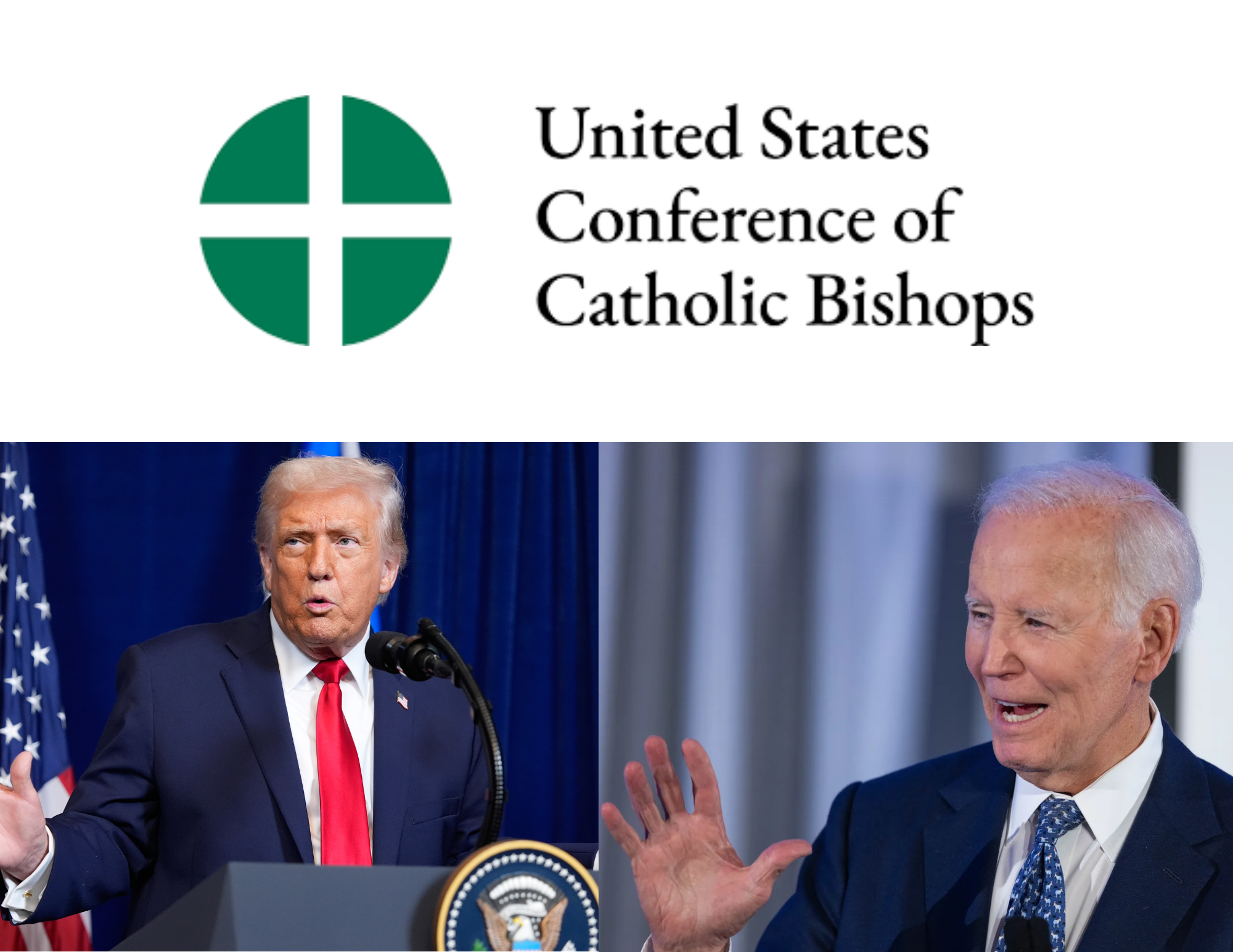
American bishops have long served as the Church’s voice on salient political issues in the country. Their role as shepherds extends beyond the pulpit—they are “teachers of the moral law,” as the United States Conference of Catholic Bishops (USCCB) writes. From statements regarding abortion and gay marriage to guidelines for public figures’ reception of Holy Communion, bishops have frequently clarified Church doctrine to the faithful.
The Rover investigated major responses elicited from the USCCB during the Biden and Trump administrations, examining which political issues garnered the most attention from the ecclesial body, and under which administrations.
During the Biden administration’s four years, the USCCB released multiple statements primarily responding to the self-proclaimed Catholic president’s policies on abortion and human sexuality.
One week after he took office, Biden signed Executive Order 14079, which allowed U.S. taxpayer funds to be sent to organizations that provide abortions in developing countries. The USCCB “strongly oppose[d]” the action, saying it was “incompatible with Church teaching.”
In July of 2022, Biden signed Executive Order 14076, which protected access to “reproductive healthcare services,” including abortion. The USCCB response called the order “deeply disturbing and tragic,” and implored the president to “abandon this path that leads to death and destruction.”
Four days after he took office in 2025, President Donald Trump revoked the two executive orders. The USCCB responded positively to the reversal, affirming its support for the Hyde Amendment, which prevents federal funding of elective abortion.
In addition to his promotion of abortion, in June of 2023 Biden signed Executive Order 14101, which aimed to “further strengthen and bolster access to affordable, high-quality contraception.” There was no official response from the USCCB following the order.
In June of 2022, Biden signed Executive Order 14075, which increased access to “gender-affirming care” for “LGBTQI+” individuals, including hormone therapy and puberty blockers. There was no official response from the USCCB following the order.
When Trump rescinded this order early in his second term, however, Bishop Robert Barron of the Winona-Rochester diocese, then-chairman of the USCCB’s Committee on Laity, Marriage, Family Life, and Youth, released a statement praising the reversal. He wrote, “It is unacceptable that our children are encouraged to undergo destructive medical interventions instead of receiving access to authentic and bodily-unitive care.”
Unlike Order 14075, the USCCB publicly criticized Biden’s Executive Order 13988, which addressed gender-identity or sex-based discrimination based on the Supreme Court case Bostock v. Clayton County. The USCCB wrote, “[The order] threatens to infringe the rights of people who recognize the truth of sexual difference or who uphold the institution of lifelong marriage between one man and one woman.”
One instance of support from the bishops came in December of 2024, when Biden commuted the death sentences of 37 men. Archbishop Timothy P. Broglio wrote, “This action by the president is a significant step in advancing the cause of human dignity in our nation. As we continue to proclaim the Gospel in a broken world, this act of mercy is a step closer to building a culture of life.”
In the first year of Trump’s second term, the USCCB has released several statements criticizing the Republican president, largely focusing on his approach to immigration and foreign policy.
Claims of misconduct and ill treatment of immigrants by the Department of Homeland Security’s Immigration and Customs Enforcement (ICE) unit have gained national attention in recent months. The bishops’ statements call for unity, citing the need for national security coupled with a respect for the dignity of all people.
In November of 2025, the USCCB’s Office of Public Affairs released a rare “special message” lamenting the division caused by immigration policies, the first time in 12 years that the USCCB had released this kind of statement.
“Catholic teaching exhorts nations to recognize the fundamental dignity of all persons, including immigrants,” the statement read. “Human dignity and national security are not in conflict. Both are possible if people of good will work together.”
“We oppose the indiscriminate mass deportation of people,” the statement continued. “We pray for an end to dehumanizing rhetoric and violence, whether directed at immigrants or at law enforcement.”
The USCCB’s 2026 report on religious liberty also expressed unease with the Trump administration’s immigration policies, stating that “the U.S. bishops have been united in their support for the rights of immigrants and for every person to be treated with the respect their God-given dignity demands, regardless of immigration status.”
Responding to anxieties related to ICE detentions and unexpected deportations, some bishops have granted a Sunday Mass dispensation for immigrants. The report on religious liberty noted that although “nations have a responsibility to regulate their borders and establish a just and orderly immigration system … there should be basic agreement about the rights of communities to be able to worship without fear.”
In addition to commenting on immigration policies, U.S. bishops have voiced opinions on Trump’s foreign relations, particularly his interest in annexing Greenland. In January of 2026, Archbishop Blase Cupich of Chicago, Illinois; Archbishop Robert McElroy of Washington, D.C.; and Archbishop Joseph Tobin of Newark, New Jersey criticized Trump’s foreign policies. In a joint statement, they said that “the events in Venezuela, Ukraine and Greenland have raised basic questions about the use of military force and the meaning of peace.”
Although many of the USCCB’s recent responses to the Trump administration have been critical, bishops have also praised Trump’s actions regarding abortion policies and the rights of vowed religious.
In a recent presidential message on National Sanctity of Human Life Day, Trump said, “As President, I pledge to always be a voice for the voiceless and to never tire in fighting to protect the intrinsic dignity of every child, born and unborn.” A statement released days later from the USCCB’s Committee for Pro-life Activities chairman, Bishop Daniel Thomas, praised Trump’s pro-life legislation.
Though bishops have expressed their gratitude for Trump’s pro-life policies, a statement in October of 2025 clarified their unequivocal condemnation of the administration’s support for in-vitro fertilization (IVF) treatments.
“Though we are grateful that aspects of the Administration’s policies announced Thursday intend to include comprehensive and holistic restorative reproductive medicine, which can help ethically to address infertility and its underlying causes,” the statement read, “we strongly reject the promotion of procedures like IVF that instead freeze or destroy precious human beings and treat them like property.”
Another act which drew praise from the USCCB was Trump’s Interim Final Rule, issued in January. The rule amended federal regulations requiring a minimum time outside the country for vowed religious workers before they could acquire another religious worker (R-1) visa. The USCCB called the rule “a truly significant step that will help facilitate essential religious services.”
The Rover spoke with Professor Richard Garnett, the director for Notre Dame’s Program on Church, State, and Society, regarding the intersection of the USCCB’s reactions to the presidential administrations and the separation between church and state.
Garnett noted that the concept of separation between church and state is often misunderstood; rather than implying that “religious people should not be active in the public square or that religious convictions and commitments should never affect public policy,” Garnett said this divide means that “the state does not get to decide religious questions or interfere in internal church affairs.” Garnett emphasized that bishops’ responses to the Trump administration in no way infringes on this separation.
Daniel Philpott, Professor of Political Science, echoed Garnett’s statement. “[The separation of church and state] crafted something unique,” he told the Rover, “a democracy in which no one religion dominated and in which the state did not suffocate religion, yet one in which religion could participate freely and contribute vigorously to the common good. The arrangement has stood the test of time.”
Madeline Page is a sophomore studying biology. She prefers discussing phasmids to politics, but will respond to comments about either at mpage4@nd.edu.
Lucy Spence is a junior studying piano performance and the Program of Liberal Studies. Reach her at lspence@nd.edu.