
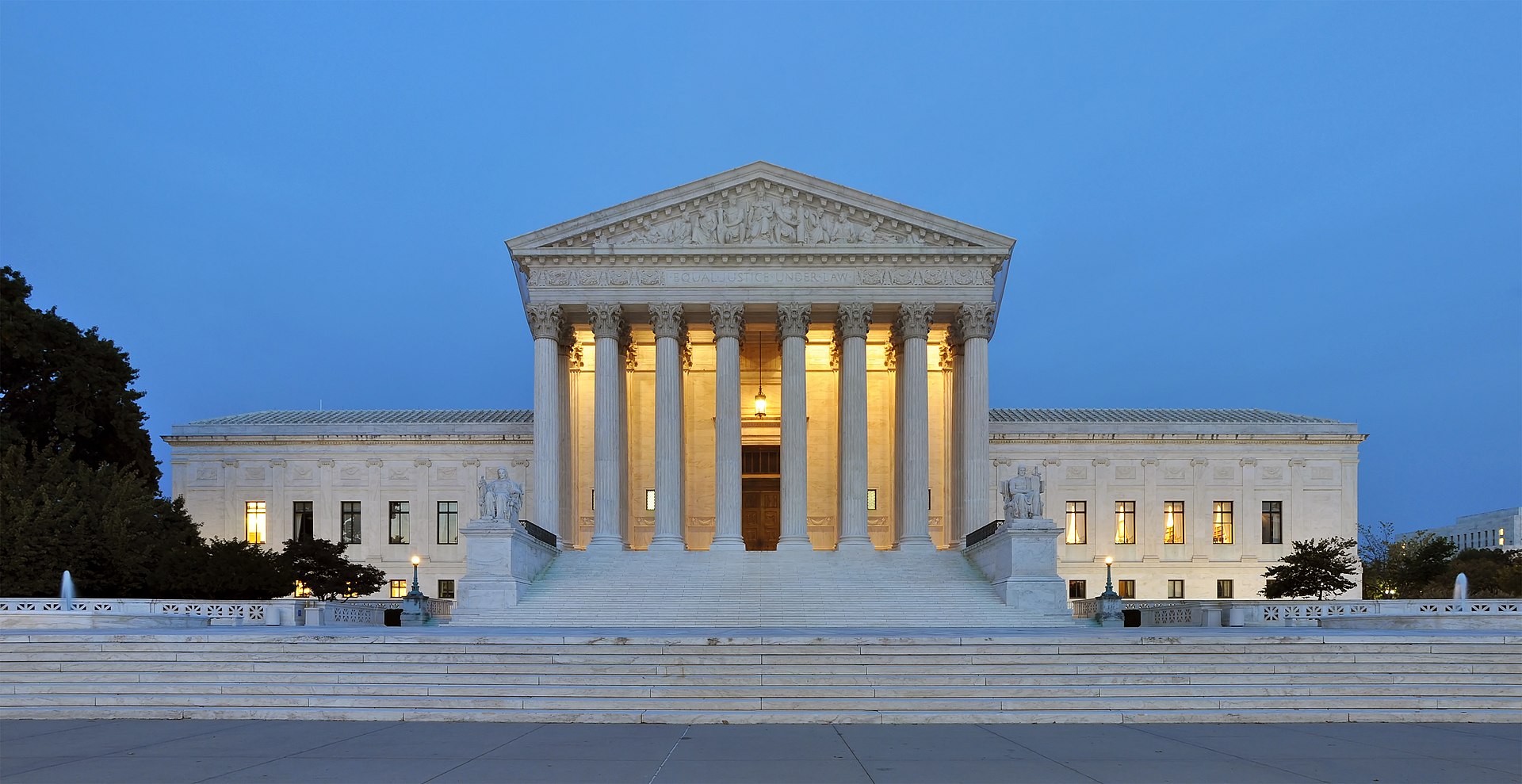
In the ongoing legal case Trump v. Barbara, the United States Conference of Catholic Bishops (USCCB) has provided the Supreme Court amicus curiae briefs in an effort to oppose President Trump’s Executive Order 14160, which ends birthright citizenship. The briefs are a recent demonstration of the bishops’ increased judicial and political involvement surrounding immigration.
The USCCB has consistently voiced concerns with Trump’s immigration policy. This past November, the USCCB issued their first “Special Message” in 12 years condemning mass deportation attempts and Trump’s immigration rhetoric.
Archbishop Timothy Broglio, the president of the USCCB, wrote in a statement that Trump’s executive orders were “harmful to the most vulnerable of us,” and Bishop Mark Seitz, Chair of the Migration Committee, argued the executive orders were “contrary to moral law.”
Prior to the Trump v. Barbara case, the USCCB also sent amicus curiae briefs to the Supreme Court in the Noem v. Al Otro Lado case, which deals with similar Trump immigration policies.
In the Trump v. Barbara amicus curiae briefs, the core legal argument revolves around the Citizenship Clause of the Fourteenth Amendment, which the bishops argue “[establishes that] children born within the physical territory and subject to the jurisdiction of the United States are citizens of the United States.” Using this definition of the Fourteenth Amendment, they conclude that any effort to end birthright citizenship is unconstitutional. They also reference other statutory violations that were formerly codified in Congress that the Executive Order violates.
Further, the brief uses the precedent of United States v. Wong Kim Ark (1898), which determined that a Chinese child born of non-citizens in America had legitimate status as an American citizen, as an additional legal argument for maintaining birthright citizenship. Although their primary argument revolves around this case, the bishops also invoke the precedent of Dred Scott v. Sandford, Murray v. Schooner Charming Betsy, and Trop v. Dulles.
The USCCB’s briefs deal heavily with the organization’s commitment to Catholic Social Teaching. They argue that, by ending birthright citizenship, the Trump administration is violating the “dignity of all human life” and the fact that “all are created in the image and likeness of God.” They assert that the laws of citizenship should correspond with the equal dignity of man.
The USCCB stated, “Birthright citizenship reflects the Catholic principle of subsidiarity by recognizing persons as members of the community from birth, thereby enabling their participation in civic life and ensuring that state power serves the human person as a social being.” Ending birthright citizenship in turn violates the “moral foundations of American society,” the bishops argue.
They clarify that “not only is the principle of birthright citizenship woven into our Nation’s history and Western tradition, but it is also consistent with Catholic teaching.” Although there were no high-ranking clergy members who publicly opposed the USCCB’s briefs, several Catholic commentators and professors have stated that the briefs were legally tenuous.
Dr. C.C. Pecknold, a theology professor at the Catholic University of America, heavily criticized the content of the briefs. Pecknold stated in an article in the American Mind that “[the brief] doesn’t attempt to sway the Court’s opinion on anything other than affirming the basic pieties of liberal orthodoxy on birthright citizenship. Despite a few non-sequitur invocations of the Catholic Catechism, the brief makes no serious attempt to teach anything about the Catholic Church.” He also criticized the USCCB using the legal support of the prestigious law firm, WilmerHale, who supported gay marriage in the Obergefell case and abortion in Dobbs-related cases.
Michael Fragoso, a lawyer and fellow at the Ethics and Public Policy Center, argued in a recent First Things article that the USCCB did not make any substantial legal arguments and attempted to form “a sermon” that loosely appealed to a liberal immigration agenda. He also raised the issue of constitutional secularism, stating, “[T]he brief literally tells the Supreme Court that it should adopt Catholic theology in its constitutional adjudication.”
Leaders of Notre Dame’s College Republicans expressed their opposition to the brief in a statement to the Rover, saying, “NDCR condemns the USCCB’s amicus brief filed in Barbara v. Trump, which misleadingly and outrageously attempts to portray authentic Catholic doctrine on migration as mandating unconditional birthright citizenship.”
NDCR continued, “The Catechism of the Catholic Church contains no suggestion whatsoever that children born to illegal immigrants or foreign visitors automatically deserve U.S. citizenship, and even the Vatican—as a sovereign entity—does not extend citizenship by mere birth on its territory. Additionally, while the overwhelming majority of countries worldwide enforce far more restrictive citizenship-by-descent or naturalization rules than those the Trump administration has proposed, the Catholic Church has never pressured any of those nations to alter their policies to align with unrestricted jus soli.”
NDCR concluded, “The USCCB’s intervention thus appears thoroughly politicized and remarkably imprudent. It risks severely undermining the Church’s credibility among the American faithful and, regrettably, could even drive some individuals away from the Catholic faith.”
Other campus leaders applauded the USCCB’s conflict with the Trump administration. Alex Young, President of Notre Dame’s College Democrats club, told the Rover, “We agree with the Catholic Bishops. President Trump’s attempts to undermine citizenship are bad policy, blatantly unconstitutional, and deeply immoral.”
Guadalupe Vallejo Delgado, president of Notre Dame’s Student Coalition for Immigration Advocacy, explained to the Rover, “Our mission has always been and will continue to be to fight for the rights and protection of immigrants. … It is true that the U.S. is no longer the country we were centuries ago. According to a 2025 report by the American Immigration Council, approximately 46.2 percent (or 231) of Fortune 500 companies were founded by immigrants or their children. This includes 109 companies founded by immigrants and 122 by children of immigrants. These companies employ over 14.8 million people and generate immense revenue.”
Delgado continued,“It is understandable to state that the U.S. has continued to benefit today from the promotion of immigration. My question to President Trump would be: Is the U.S. ready to stop growing? If times have changed, would that not mean the Constitution is, truly, a living document?”
Raymond Webber is a sophomore philosophy major. His favorite hobby is listening to Bishop Fulton Sheen homilies on YouTube. Contact him at rwebber2@nd.edu.