
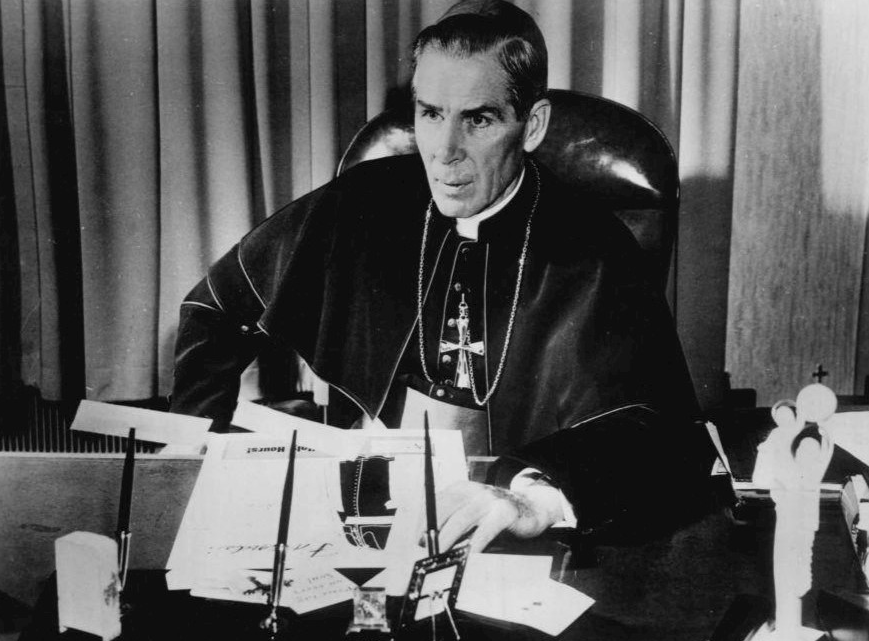
Often called one of the greatest evangelists of the 20th century, Venerable Archbishop Fulton J. Sheen will finally be beatified after a six-year delay. In the wake of this news, Notre Dame reflected on his legacy and present importance.
After a six-year pause due to legal proceedings in the state of New York, where Archbishop Sheen was head of the diocese of Rochester from 1966-1969, the Vatican has approved his beatification to proceed. Although no official date has been set, it is expected to occur in 2026.
“He was a radio personality and then made the transition to television,” Father Stephen Koeth, C.S.C., Assistant Professor of History, told the Rover. “He was wide-[reaching] and wildly, wildly popular, drawing 30 million viewers. That meant he wasn’t just appealing to Catholics but non-Catholics too, in an era when American culture was still suspicious of Catholicism. [Archbishop] Sheen made Catholic philosophy and theology and Catholic teaching and practice understandable and approachable to the average American.”
The author of over 60 books during his lifetime, Archbishop Sheen won an Emmy in 1953 for his show Life is Worth Living. He fundraised millions of dollars for the Society for the Propagation of the Faith and was responsible for bringing countless famous actors, politicians, musicians, communists, and atheists to the Catholic faith.
“He wasn’t just some flash in the pan,” recounted Father Wilson Miscamble, C.S.C., Professor Emeritus of History. “He saw the importance of spreading God’s word and using new methods to do so.”
Archbishop Sheen is often credited as the father of the Catholic evangelistic movement today, serving as an inspiration and model for contemporary figures such as Bishop Robert Barron and Father Mike Schmitz. He is also widely regarded for his spiritual depth and steadfastness.
“[Archbishop] Sheen always preached for prayer—Adoration before the Blessed Sacrament in a Holy Hour—and starting the day with one’s relationship with God to nourish and help shape one’s day,” Fr. Miscamble explained.
One example of Archbishop Sheen’s perhaps prophetic spirituality took place during his show in early 1953. At the end of an episode examining communism’s threat to religion, Archbishop Sheen proclaimed that “Stalin must one day meet his judgement!” Within a week, the leader of the USSR suffered a major stroke and died shortly after.
Yet, aside from his apparently prophetic predictions and high-profile convert-making, Archbishop Sheen inspired millions of Americans—Catholic and non-Catholic alike—to take on the issues of the spiritual life, and he remains relevant today.
“I think the issues that Fulton Sheen addressed in his show, in his sermons, and [in] his books are as pertinent to now as they were in his day,” remarked sophomore Max McNiff. “And I think that his example of taking on those issues with a great sincerity but also charisma was really great. The fact that his show was as popular as it was, even in the secular culture, really speaks to the kind of influence that Catholics can have. And if we can have that kind of influence today, we can really make a change in the culture for the good.”
“It starts with striving for personal holiness,” Fr. Koeth urged. “To be devoted to the Eucharist, to be devoted to Mary and the practice of daily prayer in some form. I think in this era we have to make sure that we study the Faith as [Archbishop Sheen] did and know it through spiritual practices and pious practices but also through scholarly work.”
Anticipating his upcoming beatification, many Catholics from across America and the broader world are revisiting Archbishop Sheen and turning to his life as an extraordinary example of holiness.
“I think folks realize today that we need models for evangelization,” said Fr. Miscamble, “and that Ven. Fulton Sheen can provide inspiration for how to evangelize and why it matters so much to bring Christ into a culture where there may be a lot of resistance to religious thinking. His beatification provides a sort of enormous boost to the idea that we are to go outwards.”
Fr. Miscamble concluded, “We aren’t a comfortable Church; our task is to reach out and engage the culture. And the students here at Notre Dame, they need to take their Christian faith out into the world and be evangelists themselves.”
Luke Fisher is a freshman from Detroit living in Siegfried Hall. He is majoring in theology and also struggling his way through the Program of Liberal Studies. If he’s not snacking during class or repeating the same joke for the 15th time that day, you can usually find him doing the chapel crawl around campus. To join in (or chat), reach out at lfisher8@nd.edu.