
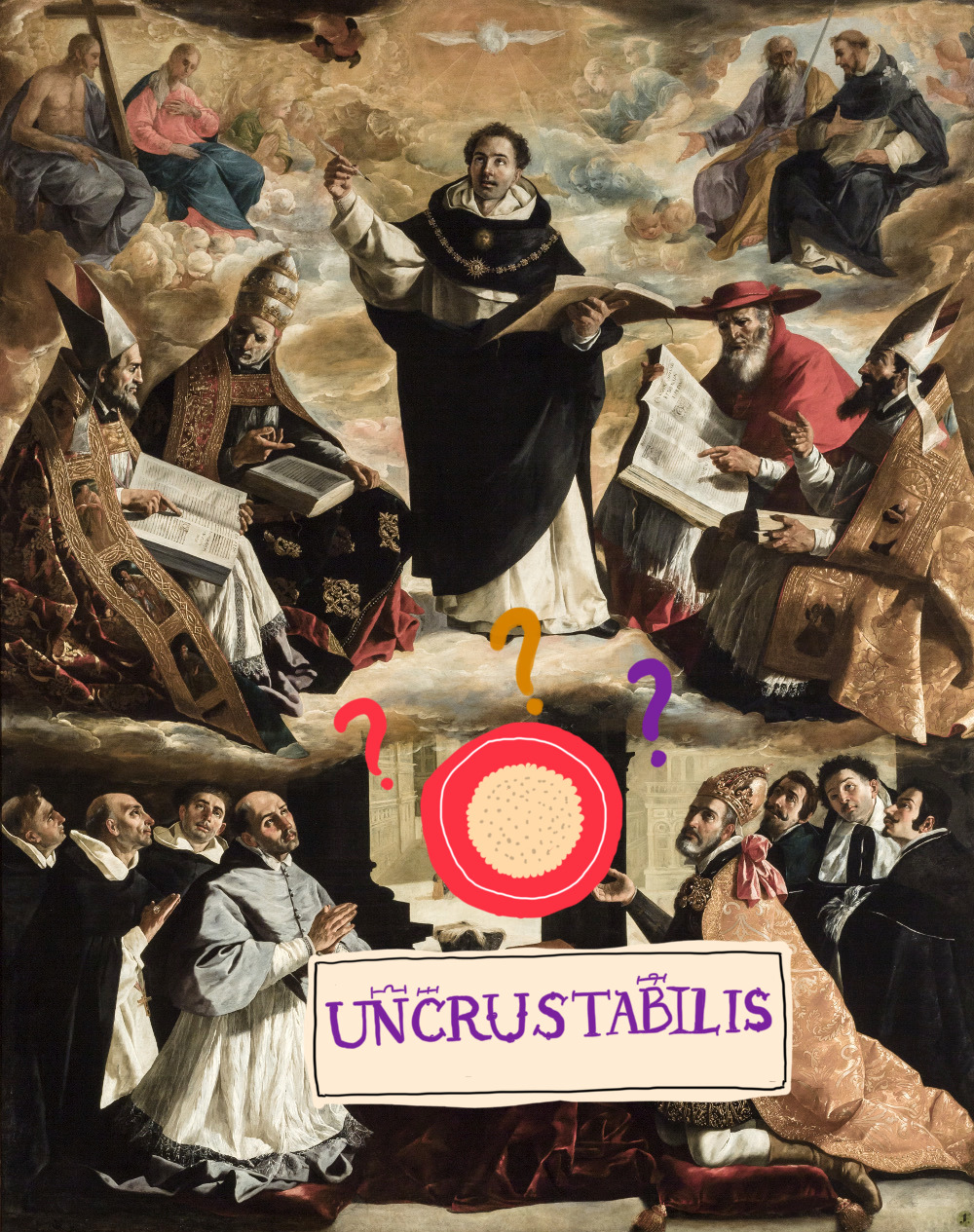
Article 1: Whether Uncrustables are rightly so called?
Objection 1: It seems that Uncrustables are not rightly named. For the Philosopher (Prob. X.27) observes that “the crust that forms on boiled wheat meal” has a notably different appearance than the bread itself. But Uncrustables have a uniform appearance with no darkened edges. Therefore, they are more properly called “Uncrusted” than “Uncrustable.”
Objection 2: Further, to be called “uncrustable” denotes a lack of potency with respect to becoming crusted. For something should only be called “uncrustable” when its potency to have crust has already been actualized, i.e., it is crusted. But Uncrustables are rather the only sandwiches without crusts in actuality, and are therefore more properly called “Crustables.”
Objection 3: Scripture and the Fathers together affirm that a crust is a meager and undesirable thing. Solomon says (Proverbs 17:1), “Better a dry crust with peace and quiet than a house full of feasting with strife.” But Uncrustables are clearly desirable. Therefore, they have no crust and are rightly called crustable.
On the contrary, In Holy Scripture, Job says (Job 7:5), “My flesh is clothed with maggots and a crust of dirt.” And the Lord said that Job spoke rightly (Job 42:7). Therefore, “crust” can rightly be said in multiple ways.
I answer that the concept of being crusted (i.e. having crust in actuality) and being crustable (i.e. having crust in potency only) can be thought of in four ways.
A sandwich may be crusted materially, in that its edges are characterized by the darkened and drier crust of bread. And in this sense, Uncrustables are in fact uncrusted and therefore crustable in potency.
A sandwich may also be crusted formally, in that all sandwiches have a delineating border to their physical form, being finite creatures contained in space. And in this sense, all sandwiches are uncrustable, being actually crusted in some sense.
A sandwich may also be uncrustable efficiently, in that no natural agent is capable of modifying the sandwich in such a way that it becomes crusted. In the same way, God alone is able to actualize man’s potency for sanctification, God alone is able to crust uncrusted sandwiches while natural causes are insufficient.
Most significantly, a sandwich may also be uncrustable finally, or teleologically, in that some sandwich’s natural end is to be uncrusted, and that its perfection can only consist in its lack of material crust. And it is in this sense that Uncrustables are most properly named, because an Uncrustable cannot be crusted without enduring a corruption or deficiency directly contrary to its teleological perfection.
This suffices for the Replies to the Objections. For the first two consider only material crustability. The third objection is answered by a consideration of the Uncrustable’s natural end and the obstruction of material crust to that good end.
James Whitaker is a graduate student in the theology department. What a waste of an education. You can reprimand him at jwhitak5@nd.edu.