
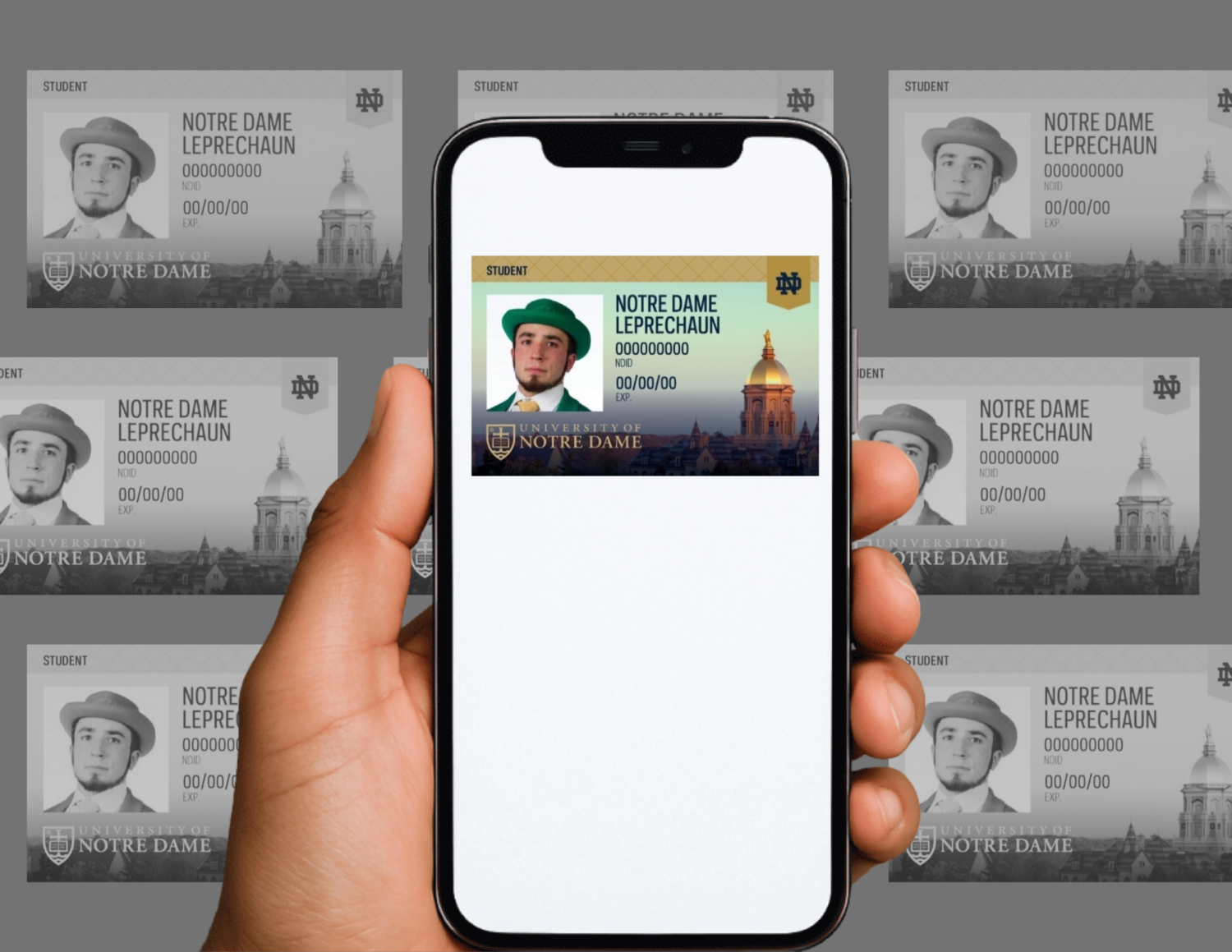
Nearly two years ago, Notre Dame shifted its student and faculty credential system, Irish1Card, to a completely digital base. Now, students are required to download an app which allows them to unlock classroom and residence hall doors, swipe into the dining halls, and spend flex points with the tap of their phone, rather than the tap of a card.
The change was first announced in a press release by CBORD on June 4, 2024. CBORD, one of the technology providers for the mobile Irish1Card system, listed user convenience and university sustainability initiatives as motivations behind this transition. The IT partner wrote, “With mobile credentials, users can seamlessly enter buildings, make purchases and manage their campus activities, all from their mobile devices. This integration underscores Notre Dame’s sustainability goals, which include a commitment to becoming carbon neutral by 2050.”
Mike Hovestol, assistant manager of Notre Dame’s parking and credentialing services, told the Rover that the university’s shift to a digital credential system was initiated by representatives of the student body. Hovestal said, “The primary driver behind us being able to go digital in terms of funding was the Student Senate. … They wanted to see the digital card on campus, and so that was the primary reason why we got the funding to actually move forward with the project”
Hovestal cited security as the primary benefit of a digital Irish1Card. He told the Rover, “The security behind the card usage was one of the benefits of moving to this. We made changes to all the readers. … So everything is secure now that’s used on campus when you tap your phone or your card.”
Hovestol also highlighted the environmental impact and convenience of this transition, saying, “We previously ordered roughly 10,000 cards a year, and that translates to 1,000 pounds plus of plastic that we don’t use anymore.” Hovestol added, “Seventy percent of the student body would replace their cards over the course of their time here on campus. … And with the phones, they tend not to lose them as much.”
Since the change was effected during the summer of 2024, current upperclassmen have seen both systems. They expressed varied opinions about their experiences to the Rover.
Senior Matthew Baldwin told the Rover, “I initially saw it as an unnecessary effort to modernize and digitize everything possible.” Baldwin was an incoming junior during the first year when the digital Irish1Card was implemented. Although returning students were instructed to use the digital ID, their physical ID cards still functioned. “I was glad when I heard that we were able to continue using our physical IDs since I never faced any issues with this system,” he continued.
Despite his initial hesitations, Baldwin recognizes the benefits of the new system. “After I lost my ID, I switched to the digital one, and I did end up preferring the convenience of never having to take a physical card out. I do sometimes wish I could leave my dorm without having my phone on me, but as a whole I appreciate never getting locked out because I leave my wallet behind or lose my ID.”
Sophomore Dominic Browne expressed a similar initial preference for the physical ID. “It definitely surprised me going in as a freshman. … Not having the freedom to use a physical ID was really shocking,” Browne told the Rover.
Unlike Baldwin, Browne was a freshman during the pilot year of the digital Irish1Card, but has since transitioned to using a physical card. He reported that the card office strictly enforced the digital ID, and that the process of receiving a physical card was difficult. He said, “Immediately, I went over and just asked if I could get one. And they said, ‘No, we’re completely getting rid of it. And there’s nothing we can do for you unless you have a special circumstance.’”
It took Browne multiple visits until he received permission to carry a physical ID. He explained, “I didn’t have a good enough excuse the first time. … I tried again. That didn’t work.” Browne gave up on his pursuit of a physical ID until the next semester. “I finally just said, ‘All right, well, I’m giving up my phone for Lent’, … And they finally gave [an ID] to me,” Browne said.
When asked about common reasons students provide when requesting a physical ID from the card office, Hovestal replied, “Students just want to move away from using their phone as much. And so that would be a case where you get them a plastic card.”
Holy Cross College sophomore Andrew Hale, along with some of his friends, recently exchanged his iPhone for a flip phone to detach from social media and time-consuming habits. The digital Irish1Card at Notre Dame, however, was an obstacle for Hale’s friends at Notre Dame. He told the Rover, “Of those who did not [join], the only explanations they could come up with for why they couldn’t do it was, ‘I want to, but I need my phone so that I can get into my dorm,’ or, ‘I need my phone to enable two factor authentication,’ and all school-related reasons that are not even remotely academic and could easily be solved by reverting back to a more reasonable, old school design.”
About half of the student body has never experienced life on campus with physical ID cards because current freshmen and sophomores arrived after the digital system was established. Underclassman reception of this system is largely positive, although some express preference for a tangible ID.
Jane Cousino, a freshman in Lewis Hall, shared her appreciation for the convenience of the digital Irish1Card to the Rover. “It’s honestly very helpful, as I’m prone to losing things. I like not having to keep track of as many items wherever I go.”
Sophomore Ava Hall conceded this, saying, “I like how the Irish1Card is easy to use and hard to lose.” Much like Browne, though, Hall expressed her personal preference for a card. “I also love having physical media which I am able to save and look back on when I am older.”
Clare DiFranco is a junior studying accounting and Italian. Since she is a transfer student, she never received a real Notre Dame ID. If you know someone who can get her a convincing fake, reach her at cdifranc@nd.edu.