
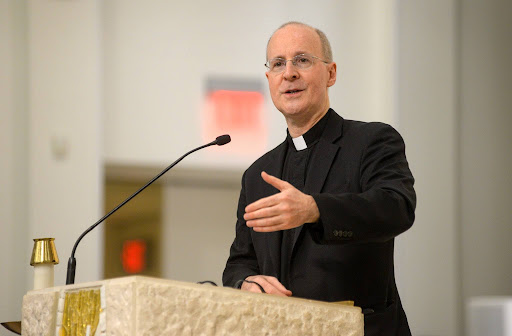
Father James Martin, S.J., the Jesuit author whose LGBTQ ministry has made him a controversial figure in the American Church, made his first visit to Notre Dame from August 28 to September 3, drawing large crowds to two public addresses despite petitions calling for his invitation to be revoked.
Fr. Martin has garnered both firm opposition and support within the Church for his work in LGBTQ ministries. He is the author of Building a Bridge, a work which centers on relations between the Catholic Church and the LGBT community. In this book he writes: “For a teaching to be really authoritative it is expected that it will be received by the people of God … From what I can tell, in the LGBT community, the teaching that LGBT people must be celibate their entire lives … has not been received.”
He is also the founder of Outreach, an LGBTQ Catholic ministry whose website prominently features an article titled “This Transgender History Month, pray to Catholic saints who defied gender norms.”
The first of Fr. Martin’s speaking events took place on the evening of August 28, when the Institute for Social Concerns hosted its annual Rev. Bernie Clark, C.S.C., lecture in Catholic Social Tradition, entitled, “A Conversation with James Martin: Joy, Work, and Purpose.” After an introduction from Provost John McGreevy, who labeled him “a prominent voice on some of the most consequential questions facing the church in American society,” Fr. Martin engaged in a fireside chat with Leo and Arlene Hawk Executive Director Suzanne Shanahan.
In front of a standing-room-only audience in the Geddes Hall auditorium, along with two full overflow rooms where the talk was broadcast live, Fr. Martin reflected on the recent death of Dolly Parton, whose charitable acts and public adoration he saw as evidence of the attractiveness of holiness, his own “loopy” path to the priesthood, and how to find meaning as a student.
When asked about his own vocation, Fr. Martin traced his path from Wharton, where he studied economics, to General Electric, where he grew steadily more miserable. He described watching a television documentary on Thomas Merton, a Trappist monk, as the beginning of his call, and posited that vocation rarely arrives in a predictable way, noting that he entered the Society of Jesus thirty-eight years ago to the day of this event.
Questioned how students should approach their own work to find meaning, Fr. Martin said that in four years at Wharton no one had ever asked him what he wanted in life. The question he offered the Notre Dame audience instead: “Who do you want to be, and whose do you want to be?”
After being asked for his explanation for his controversial status, Fr. Martin responded that “people can have legitimate critiques and have legitimate concerns and have questions, but some of it’s kind of over the top. I just try to preach the Gospel.” He mentioned that he has been the target of protests, had hosts withdraw invitations, and received death threats, including what he called “Catholic death threats” from people wishing him to hell. However, he found solace in the fact that his Outreach ministry, Building a Bridge, and other works were undertaken with his superiors’ permission within the Society of Jesus, and quoted Pope Francis’ counsel to him: “There are Pharisees everywhere.”
The following Wednesday, Fr. Martin delivered the final of his two public speaking engagements in the DeBartolo Performing Arts Center titled “Work in Progress: A Conversation and Reading with Rev. James Martin, S.J.” Fr. Martin engaged in dialogue with the director of the Global Catholic Research Initiative and Professor of American Studies and History Kathleen Sprows Cummings, followed by a reading of excerpts from his new book, Work in Progress: Confessions of a Busboy, Dishwasher, Caddy, Usher, Factory Worker, Bank Teller, Corporate Tool, and Priest.
Fr. Martin introduced his book as a lighthearted attempt to capture the 1960s–70s era of his youth, examining how a sequence of jobs led to his personal formation. He chose to read excerpts from his book about mowing lawns, daydreaming as a kid, and a vivid scene walking through a meadow as “one of the first times I felt a real longing for God.” He particularly stressed how these ordinary experiences and memories can reveal God’s presence, saying that “sometimes [God’s grace] is only possible to see in retrospect.”
Both the American Society for the Defense of Tradition, Family, and Property and LifeSiteNews organized petitions pushing the University to revoke Fr. Martin’s invitation to speak. In its petition urging the University to withdraw the invitation, the American Society for the Defense of Tradition, Family, and Property calls Fr. Martin a “wolf in sheep’s clothing,” alleging that he “supports transgenderism for children,” has said Catholics should “reverence” homosexual unions, and favors “homosexual kissing during Mass.”
Wesley Buonerba, a senior studying architecture and theology, told the Rover that “[Notre Dame] is a Catholic University, and our mission is to provide constructive and critical analysis of the world, and all aspects of the church as well.” Buonerba reasoned that “excluding him because of the work he’s done in the past perhaps isn’t the most fair decision.”
In a written statement to the Rover, Director Shanahan defended the Institute’s choice of speaker: “He does all his work with consent of his Jesuit superiors and serves the Pope (Leo and Francis before him). His work is about engaging marginalized individuals and communities and that’s the work of the Institute.”
In his own written statement to the Rover, Fr. Martin commented: “It’s been a whirlwind. But maybe the most moving moment was participating in the Profession of Vow Mass with the C.S.C.s. At one point, looking up at the stained glass windows, and hearing the choir, I thought: I wish I had come here as an undergrad! But at least I finally made it!”
Jack Carter is a sophomore majoring in philosophy and Italian, and minoring in constitutional studies and international security studies. He can be reached at jcarte26@nd.edu.