
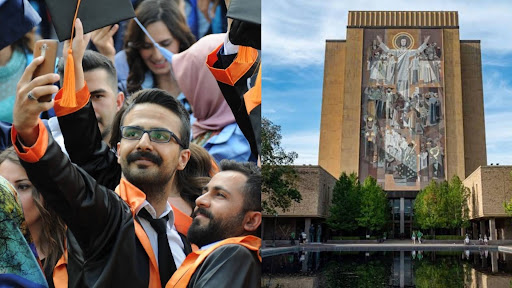
Due to a new federal law that requires institutions to maintain a Public Access File on the hiring of employees with an H-1B visa, Notre Dame’s department of International Student and Scholar Affairs (ISSA) recently revealed that the university is hiring four employees with the legal status of an H-1B or E-3 employee. The notice of intent disclosed that the Keough School of Global Affairs will be hiring an H-1B employee for the role of its Associate Director in Global Supply Chains, and the Kellogg Institute for International Studies will be hiring an H-1B employee for their new Executive Director role.
Additionally, the notice declared that the university hired one H-1B employee to occupy an unspecified executive director role and another to work as a DevOps (IT) engineer. All of these new employees have been offered salaries in the range of 82 thousand dollars and 155 thousand dollars. Over the course of 2026 alone, Notre Dame has filed for 49 H-1B visas for its employees. 46 of these have been certified by the federal government; zero have been denied.
Since 2019, only one H-1B visa has been rejected for Notre Dame employees—under the Biden administration. Over 300 employees with non-immigrant work visas across 45 countries currently work at Notre Dame with most working as professors, researchers, and marketing analysts. ISSA celebrates this, stating on their website, “[These] employees join the thriving academic community of Notre Dame, enriching departments, classrooms, and labs across campus every year.”
They go on to say, “International Student and Scholar Affairs collaborates with colleagues by providing the necessary immigration documents and expert advising for scholars and employees on the requirements and responsibilities for maintaining their immigration status while in the US.”
Despite the Trump administration’s recent legal investigations into visa fraud among elite universities, the University of Notre Dame has steadily increased its hiring of H-1B employees and has maintained organizations committed to the incorporation of students and employees with non-immigrant visa statuses.
Outside of ISSA, which directly provides resources to such students and employees, the Klau Institute for Civil and Human Rights has publicly promoted their Migration Research Initiative which raises money for research that accompanies the aims of ISAA. According to the initiative, this research is intended to “deepen the university’s appreciation for the dignity of migrants.” Recently, the initiative funded Amy Hsin to research how “barriers to immigration limit opportunities” and “hinder people from pursuing education.”
The Notre Dame Institute for Latino Studies created the Cross-Cultural Leadership Program that funds students to engage with Latino and immigrant populations in major cities through internship opportunities. The Student Coalition for Immigration Advocacy (SCIA), the university’s only student immigration-focused club, promotes immigrant vendors in South Bend through their Bi-annual Flea Markets; hosts UndocuAlly Trainings aimed at helping students form alliances with undocumented individuals; and fundraises money for undocumented immigrants and refugees.
Nevertheless, even with the vast amount of resources that Notre Dame has dedicated to immigrant workers and students, the university ranks 570th among all visa sponsors in the U.S. and hires far fewer H-1B employees than some of her elite colleagues. For example, Harvard University filed for 1,379 H-1B visas last year; the University of Michigan filed for 2,381; and Stanford applied for 500 H-1Bs in comparison to Notre Dame’s 49.
Beyond employees, Notre Dame’s peer institutions also significantly outweigh Notre Dame’s foreign-born undergraduate population. Foreign-born students make up 26 percent of Harvard undergraduates, 40 percent of Columbia, 25 percent of Duke, and about 18 percent of Georgetown, while only 10 percent of Notre Dame undergraduates are foreign born. This aligns with Notre Dame’s lack of international or foreign-born diversity quotas, despite its strategic plan’s aspirations to raise Notre Dame’s international students to 12 percent of the student body by 2033.
This number drops drastically, however, when looking at Notre Dame’s international graduate students, whose demographics closely align with those of other elite universities. Specifically, 30 percent of Notre Dame’s graduate students are foreign-born and 43 percent of the students in Notre Dame’s ESTEEM Master’s program are foreign-born.
According to the National Center for Science and Engineering Statistics, nearly half of U.S. doctorate recipients with temporary visas were from China or India. Additionally, only 61 percent of all doctorate recipients from American universities were American citizens. Last year, Notre Dame admitted 2,200 graduate students, almost 700 of which are not American citizens.
The declining amount of American graduate students in comparison to foreign-born students has long been an issue. According to Jeffery Mervis in an article in ScienceInsider written in 2011, “U.S. students had a much harder time getting into American graduate schools this past year than did their peers from China and the rest of the world.” In 2017, the New York Times published an article titled, “The Disappearing American Grad Student” that described how Chinese students were outperforming American students. Despite these concerns, Notre Dame continues to increase the rate of their foreign-born graduate students.
Although the Trump administration has targeted specific universities, like Harvard and Stanford, for their H-1B hiring practices—including penalizing these universities for admitting and hiring those with non-immigrant visas and investigating visa fraud on their campuses—President Trump is no longer pursuing restrictions on H-1B visas for most colleges. After a judge struck down Trump’s 100,000 dollar H-1B visa fee for universities in September 2025, the Trump administration removed the fee altogether and exempted nonprofit research institutions—like Notre Dame—from visa caps.
As a result, Notre Dame has largely persisted in her H-1B hiring, and has even expanded the number of H-1B employees on campus with little to no administrative interference over the past two years.
Raymond Webber is a junior Philosophy major. His favorite hobby is going to Nantucket and esoterically referencing the Lacrosse Segue Finance Pipeline. When he is not forgetting an error or grinding on Wall Street, contact him at rwebber2@nd.edu.