
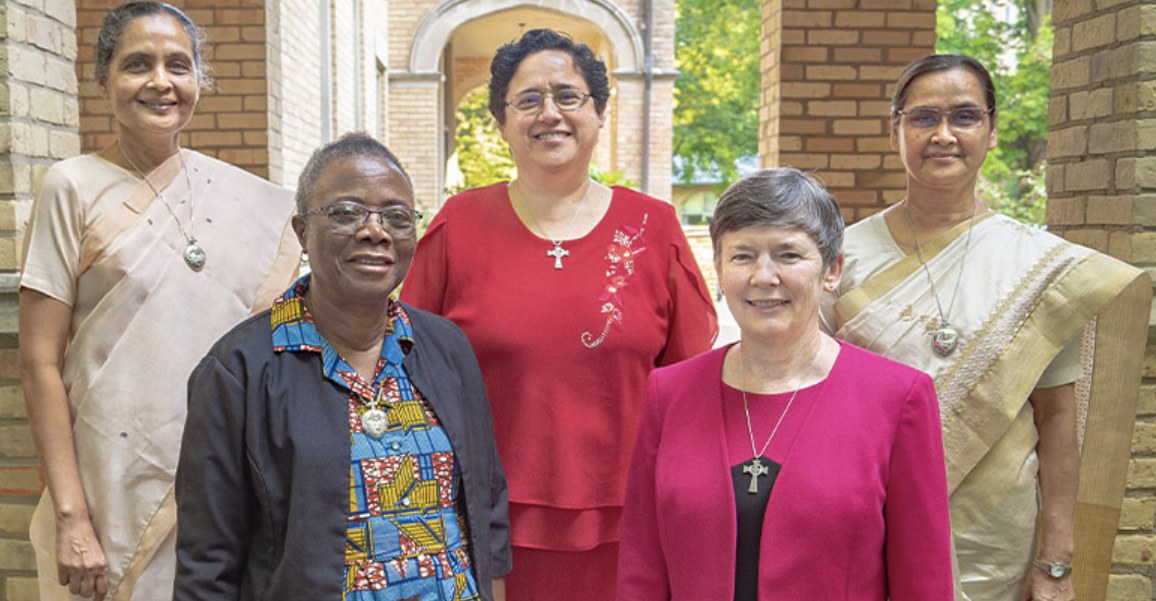
Sister Mary Veronique Wiedower, the chief operating officer and United States postulant director for the Sisters of the Holy Cross, explained her view of vocational discernment with the Sisters of the Holy Cross in an interview with the Rover.
Prior to assuming her current role, Sr. Wiedower served as the Sisters’ worldwide president for ten years. She was also involved in many different facets of the formation of women religious. She entered the community in 1965 and professed her perpetual vows in 1973.
The charism of the Sisters of the Holy Cross, Sr. Wiedower told the Rover, is to “read the signs of the times, discern needs, and respond as they can.” The Sisters do this in a variety of ways, serving as teachers, nurses, lawyers, and advocates.
As a result of this flexibility, Sr. Wiedower said, “Women can see us and say, ‘No matter what my passion is, I can find a home in Holy Cross.’” As an international apostolic community, the Sisters have convents and missions in nine different countries including Bangladesh, Peru, Ghana, and Uganda, in addition to the United States.
Sr. Wiedower noted that women are attracted to the Sisters of the Holy Cross for a myriad of reasons. “For one woman it was being friends with a sister and hearing about their stories, saying, ‘You know, that one person made a difference. And if I had this community to support me, maybe I could do that too.’”
Other women, Sr. Wiedower said, appreciate that the order includes people of various personalities and persuasions. “I think that Catholicism is that big, wide tent. And I think the Sisters of the Holy Cross encourage that big wide tent, so I think that that helps draw people who see themselves as part of a bigger whole,” she explained.
Even with the order’s flexibility, Sr. Wiedower told the Rover that discerning religious life has become “so countercultural in American culture.” As families have become smaller, a sense of community has become less common and people have become more individualistic, so most young women are not looking for a life of poverty and celibacy. According to Sr. Wiedower, the hardest part for women discerning religious life is “the idea of making a permanent commitment.” She continued, “This society is not one that holds that up as an ideal.”
Despite the negative effects of modern American culture on women’s vocational discernment, in the years since Sr. Wiedower joined the community, young women have tended to enter into discernment with “a better understanding of themselves” and “enough life experience to know that there would be sacrifice in any decision they make, and that they can be happy and be a good Christian woman in any vocation.”
Sr. Wiedower told the Rover that this makes vocational discernment easier, to a certain extent, because young women are able to discern with the community in greater freedom. She added, “We want our women to be independent, but we want them to also be able to be interdependent, that they can work within a community setting and use their gifts for the common good.”
Sr. Wiedower provided an overview of the discernment process with the Sisters of the Holy Cross. Typically, a woman begins with the question of how she may be called to follow Jesus. If she believes the answer may be religious life, then she asks what she would look for from a religious community.
“Some women are looking more for a cloistered kind of community, where prayer is the most important part. For us, prayer and action are always balanced,” Sr. Wiedower explained. “Some people are looking for religious communities that have habits, and we don’t have a uniform habit. … If they begin to narrow it down to us, then we usually do some come-and-see opportunities for them to be with the Sisters.”
If she and the Sisters feel she is so called, the woman may then become a postulant in the community for anywhere between six months and two years. After that, the woman may spend two years in the novitiate in Indiana. She would next return to her home country, work in an appropriate ministry, and profess her initial vows for three years, then renew them two years later. Finally, she would profess her perpetual vows.
Sr. Wiedower told the Rover that there is a natural rhythm to vocational discernment: the greater the problems or turbulence in society, the more willing people are to reflect and ask the important questions. “People want to be part of something else that’s bigger, and I think that the present generation has that perspective. I think there will be a kind of resurgence. I’ve seen that every two or three generations.”
She encouraged young people to give religious life a chance, remarking that, “They are a gift to the community and the community is a gift to them as they continue to deepen their own life in Christ.”
Lilian Lewen is a senior history and philosophy major from Indianapolis. If you would like to help her get Notre Dame’s leprechaun an Irish Terrier, email her at llewen01@saintmarys.edu.