
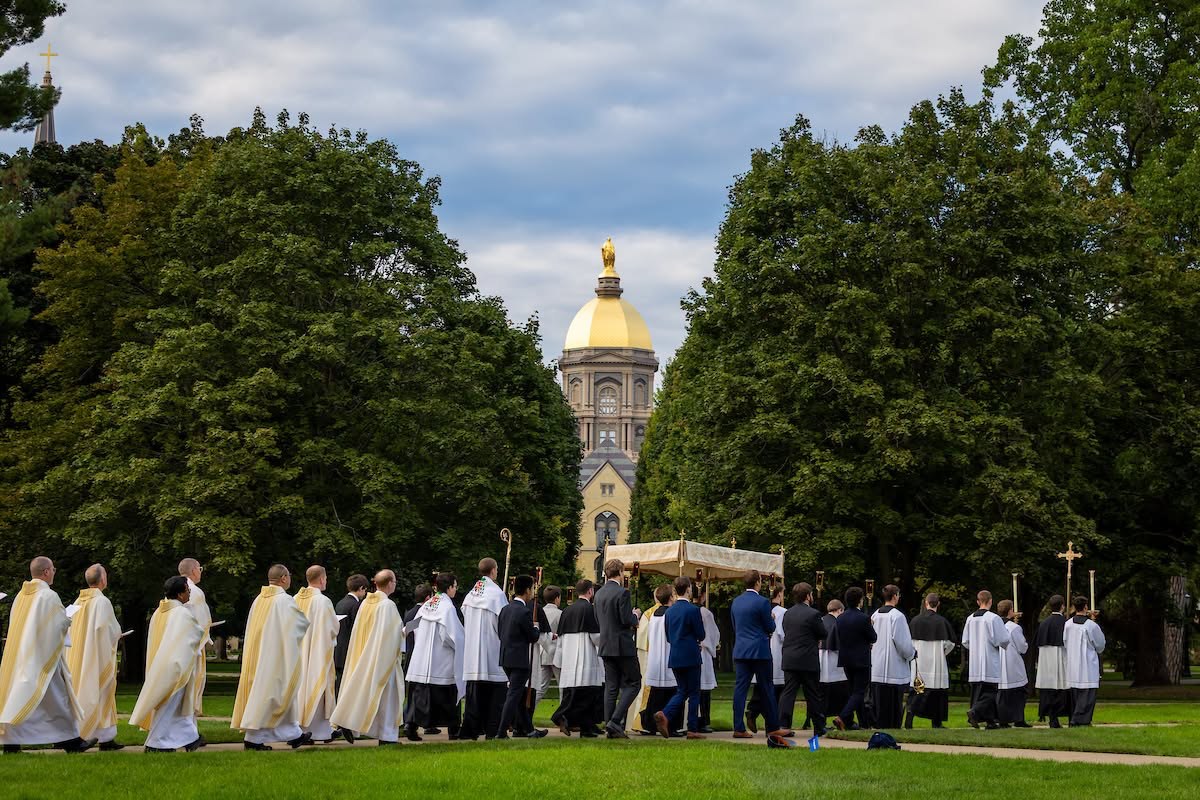
Taking classes taught by men seen walking across campus in flowing cassocks, students might wonder about the priests staffing the University of Notre Dame and other apostolates across the country. In an interview with the Rover, Father Drew Clary, C.S.C., Director of the Office of Vocations for the Congregation of Holy Cross, discussed his journey to the priesthood and the Congregation’s vocational discernment process.
“The vocation story I tell now starts with my family … and when my cousin came here,” Fr. Clary began. “She passed away from leukemia when she was a junior, and that was my first encounter with Holy Cross: the way the university responded to my family. Father Mark Poorman, C.S.C. flew down for the funeral, and two months later they had members of my family up [on campus] for a memorial Mass. My family and I experienced firsthand the familial nature of Notre Dame, and I think that’s an outgrowth of our Holy Cross identity.”
This strong sense of family is what brought Fr. Clary to Notre Dame as a student, and after graduation, a teacher through Notre Dame’s ACE (Alliance for Catholic Education) program. Yet after completing two years of teaching in Mobile, Alabama and working directly for ACE, Fr. Clary found himself still drawn to the familial aspects of Holy Cross he experienced in years prior.
“Fraternity [and] our common life is a constitutive part of our community,” Fr. Clary explained. “I didn’t realize that I was missing that community until I visited Moreau [Seminary] and found that I felt at home as part of the community even just from stepping inside the building.”
Fr. Clary spent seven years studying in seminary, serving as a middle school social studies teacher during his final two years in formation and first year as a priest. The next year, he moved into Siegfried Hall and joined the vocations office, helping guide young men in discerning religious life.
Speaking about the type of man who enters Holy Cross, Fr. Clary explained that “we’re looking for someone who has a solid foundation in human formation. Can he relate to people? Does he have decent self-knowledge? Has the call [to religious life] been persistent?”
Holy Cross men in formation come from varied backgrounds and regions. “One of the things I love about our community is that we can have differences and are still brothers at the table [and] brothers in the chapel,” Fr. Clary said. “Because our community can look different ways in different religious’ lives, I can’t just find cookie cutter images of what a Holy Cross religious is. I think that helps us to minister to anybody that God places in our parish or dorm or wherever we are.”
Described as “Educators in the Faith,” the Congregation of Holy Cross operates six colleges and universities throughout the United States. At Notre Dame, the Congregation operates an undergraduate seminary program known as Old College, where young men receive formation while pursuing a Notre Dame or Holy Cross College degree.
“There are plenty of other places that vocations come from, but Notre Dame is a big one. The Vocations Director before me also revamped SSIP [the Summer Seminary Immersion Program], and other guys will hear us calling through Old College,” Fr. Clary noted.
Discussing the obstacles to young men’s discernment, Fr. Clary said, “I think a lot of things that challenge discernment are things that challenge freedom. I would ask, ‘To what extent have I felt God’s unconditional love in my life?’ as well as asking about whether or not they have freedom from sin. [Also], about silence, it’s really hard but that’s necessary to build prayer into their lives.”
Fr. Clary continued, “I [also] see this one a lot with college students: ‘Can I be freed from [how] I see my life story … free from my own narrative of my path?’”
Another obstacle Fr. Clary often sees is young men over-analyzing discernment and becoming paralyzed by choice. “I think we live in a culture that forms us to go through life maximizing the number of doors we keep open,” he explained. “But then you don’t actually walk through any doors, and [you] infantilize yourself. I always say ‘just try something.’ There’s nothing you’re going to try that is going to result imminently tomorrow in a perpetual obligation.”
Despite these frequent difficulties in discernment, Fr. Clary believes the vocational trend is beginning to reverse. He expressed disagreement with the hypothesis of an ongoing study on young men and vocations from the Catholic University of America. It proposes that, “despite anecdotal interest in religion among young men, vocational commitment, whether to the priesthood, religious life, or family life is still being delayed entirely.”
“I think that was very true for the past 20 or 30 years,” he reflected, “but that [early discernment has] been coming back over the past 10 years. It’s a lot more common now … for people to [discern] young. Every school I visit [as Vocations Director] has a discernment program … and so many young men that want to discern and find themselves talking to us. There are a lot of signs of hope.”
Luke Fisher is a sophomore from Detroit living in Siegfried Hall. He is majoring in theology and trying to prove Plato wrong in the Program of Liberal Studies. If he’s not coming up with another grand project or admiring his yellow pickup truck, you can usually reach him by discussing new foods to have after dorm Masses. To suggest any (or chat), reach out at lfisher8@nd.edu.